Norse and Aztecs · 1521
Why was the Mexica system so vulnerable to human enemies?
The seminar question: “Why did the Mexica system, so effective against the environment, prove so vulnerable to its human enemies?”
For decades the Triple Alliance fought ritualised flower wars against Tlaxcala, Huexotzinco and Cholula and blockaded Tlaxcala, making enemies it never conquered. In September 1519 Tlaxcala chose alliance with a few hundred Spaniards, and with an epidemic they turned Tenochtitlan’s lake against it; the city fell in 1521.
Chapter 11 is part of membership. WW2 is free — every chapter. Try chapters 1–2 of any 2 other atlases (3 with a free account). Opening a new atlas uses one of them. Membership opens all 21 — Join.
Free printable Norse and Aztecs study guide, sent by email ↓
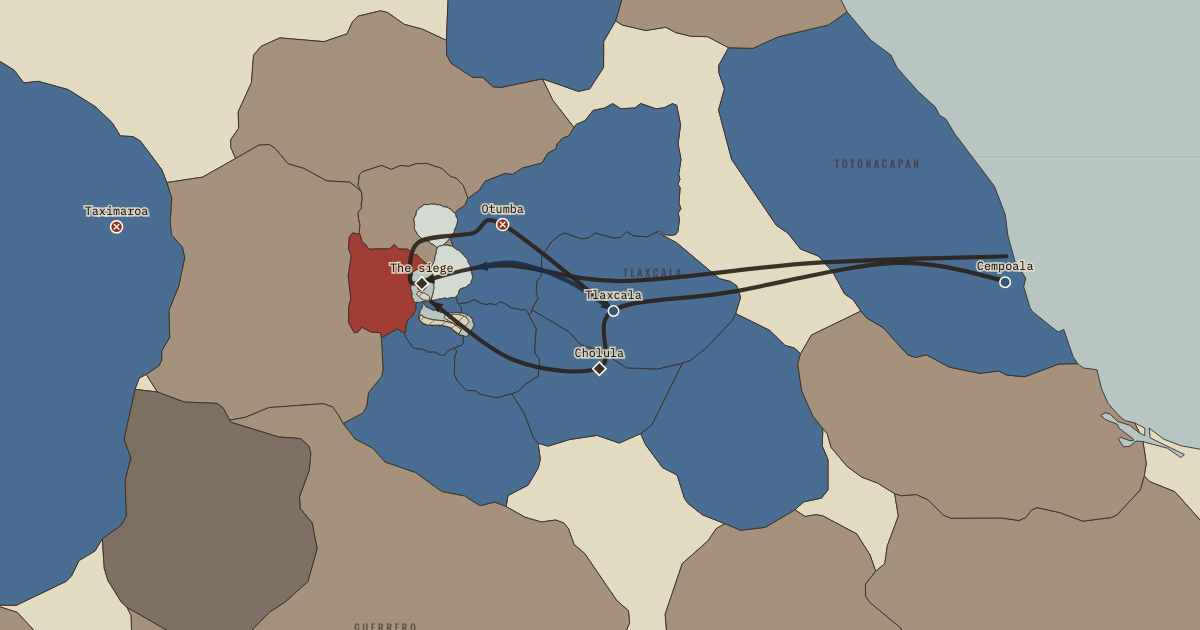
The flower wars, ritualised battles fought by agreement to take captives, somewhat like scheduled tournaments with lethal stakes, show how the empire managed enemies it could not, or chose not to, conquer. According to the Texcocan chronicler Fernando de Alva Ixtlilxochitl, the Alliance agreed in 1454, in the last year of the great famine, to fight Tlaxcala, Huexotzinco and Cholula on agreed fields, usually near Atlixco, to take captives for sacrifice while leaving each other’s lands untouched. Diego Durán credits the Mexica adviser Tlacaelel with the idea. Ross Hassig argues that these were deliberate wars of attrition, cheap ways to wear down strong enemies, while Barry Isaac argues that the ritual explanation was invented later to hide a failure to conquer. Meanwhile the Alliance encircled Tlaxcala with tributary provinces, conquered regions that paid regular tribute like a tax, and, according to Tlaxcalan complaints recorded by the Spaniards, cut off its salt and cotton. Exclusion created a neighbour with every reason to seek revenge.
The short answer
- Tribute and encirclement created enemies. The empire that fed Tenochtitlan rested on tribute from conquered peoples who kept their own rulers and resented the burden, and on the encirclement of independent rivals. Tlaxcala, surrounded by Mexica tributary provinces and reportedly cut off from salt and cotton, nursed long grievances, and Totonac lords complained of tribute collectors. When an outside force appeared, these peoples saw a chance to overturn Mexica rule, and many took it within months.
- Unfinished wars left strong rivals. The Alliance never conquered Tlaxcala, Huexotzinco or the Tarascan kingdom, whose army destroyed a Mexica force near Taximaroa around 1478–79, killing, by Durán’s probably inflated count, over 20,000 men. Fortified frontiers faced each other, with the Mexica fortress of Oztuma against Tarascan strongholds. These undefeated neighbours gave any invader potential allies and a secure base, which Tlaxcala provided for Cortés in 1520 when he retreated from the city with his army broken.
- A new disease met a population without immunity. Smallpox had never reached the Americas, so nobody had immunity, and it spread rapidly after arriving with Narváez’s expedition in 1520. The Nahua accounts in the Florentine Codex describe victims too covered with sores to move and many who starved because nobody could care for them. The epidemic killed the ruler Cuitlahuac after about eighty days in power and weakened the defenders before the siege, while sparing the Spaniards, most of whom had survived childhood exposure.
- The engineered lake had points of failure. Tenochtitlan depended on causeways for land access, an aqueduct for drinking water and canoes for food, all of which could be cut. The dike that had freshened the lagoon became an obstacle that Spanish brigantines, small sailing warships built on the lakeshore, broke through, and the aqueduct from Chapultepec was severed at the start of the siege. The very works that had made the city great gave a besieger clear targets, and the Spaniards’ allies knew exactly where they were.
THE TURNING POINT
Tlaxcala chooses alliance, September 1519. The decision of Tlaxcala’s rulers to ally with Cortés in September 1519, after defeating and then negotiating with his small force, is the hinge of this chapter. Without Tlaxcala the Spaniards would have had no secure base, no army of tens of thousands and no refuge after their flight from Tenochtitlan in 1520. The choice was made by an independent state pursuing its own long war against the Triple Alliance. It shows that the fall of the Mexica system came from within Mesoamerica’s own politics as much as from outside.
What it changed
The fall of Tenochtitlan. The city fell on 13 August 1521 when Cuauhtemoc, the last ruler, was captured on the lake. Tens of thousands of people had died of hunger, thirst, disease and violence, and the chroniclers’ figures of up to 240,000 cannot be checked. A plaque set up at Tlatelolco in the 1960s reads, in translation, “It was neither triumph nor defeat; it was the painful birth of the mestizo people that is the Mexico of today.”
A population catastrophe. Smallpox in 1520 was followed by further epidemics, including the cocoliztli of 1545, which struck during a severe drought recorded in tree rings. Central Mexico’s population fell by perhaps 80–90 percent within a century, from an uncertain starting point of perhaps 5–25 million to about 1 million. The labour that had maintained the lake system, its dikes, canals and fields, largely disappeared.
Spain inherits the lake. The Spaniards rebuilt the city on the ruins and inherited its hydraulic problems without the Mexica knowledge or labour that had managed them. Floods in the following century led them to begin draining the lake, a choice whose consequences, from the great flood of 1629 to the sinking of Mexico City today, the epilogue examines. The skills and labour that had kept the lake in balance were lost within a generation.
The full answer, argued
The Mexica system was built to manage water, frost and food, and the same features that made it effective against nature made it exposed to a coordinated human attack. Concentrating perhaps 200,000 people on an island made the city efficient to feed by canoe and causeway, but it also meant that cutting the aqueduct, controlling the lake with brigantines and blocking the causeways could starve it. The tribute empire that supplied food also produced resentment among subject and encircled peoples, who provided the tens of thousands of allies without whom the Spaniards could not have won. Smallpox, a shock no Mesoamerican society could have anticipated, removed leaders and defenders at the decisive moment. Historians differ on the weight of each factor, with Restall and Townsend stressing Indigenous politics and others stressing disease and Spanish technology. The transferable insight is that systems optimised for one kind of threat can concentrate vulnerability to another.
An interesting fact
The most detailed Indigenous picture of the conquest was painted to win privileges from the Spanish crown. Around the 1550s the town council of Tlaxcala commissioned the Lienzo de Tlaxcala, a great painted cloth showing scene after scene of Tlaxcalan warriors fighting beside the Spaniards, from the first alliance to the siege of Tenochtitlan and later campaigns. Its purpose was to prove Tlaxcala’s loyalty and earn exemptions from tribute. The original cloth has been lost, and historians study it through later copies, including one made in 1773, as a Tlaxcalan account in which the Tlaxcalans are the heroes.
This is the study layer of Fall of the Aztec Empire, chapter 11 of Climate and Innovation: The Norse and the Aztecs, c. 790–1521; the full index of the atlas is here.
Related questions
THE FREE PRINTABLE STUDY GUIDE
Join the Dispatch — a short welcome series, then a letter when a new atlas opens — and the printable study guide for Climate and Innovation is yours now, free.
NO TRACKING · YOUR ADDRESS IS USED FOR THE DISPATCH AND NOTHING ELSE · UNSUBSCRIBE ANYTIME