Feminism and the Tunisian Revolution · 2011
Why did the 2010–11 protests topple Ben Ali?
The seminar question: “Why did the protests that failed in the Gafsa mining basin in 2008 succeed in bringing down Ben Ali in 2010–11?”
On 17 December 2010 the street vendor Mohamed Bouazizi set himself on fire in Sidi Bouzid after officials confiscated his scales, and protests spread from the interior to Tunis, Sfax and Sousse. Police killed protesters in Kasserine, Thala and Regueb, and after twenty-eight days the 23-year rule of President Ben Ali fell.
Chapter 9 is part of membership. WW2 is free — every chapter. Try chapters 1–2 of any 2 other atlases (3 with a free account). Opening a new atlas uses one of them. Membership opens all 21 — Join.
Free printable Feminism and the Tunisian Revolution study guide, sent by email ↓
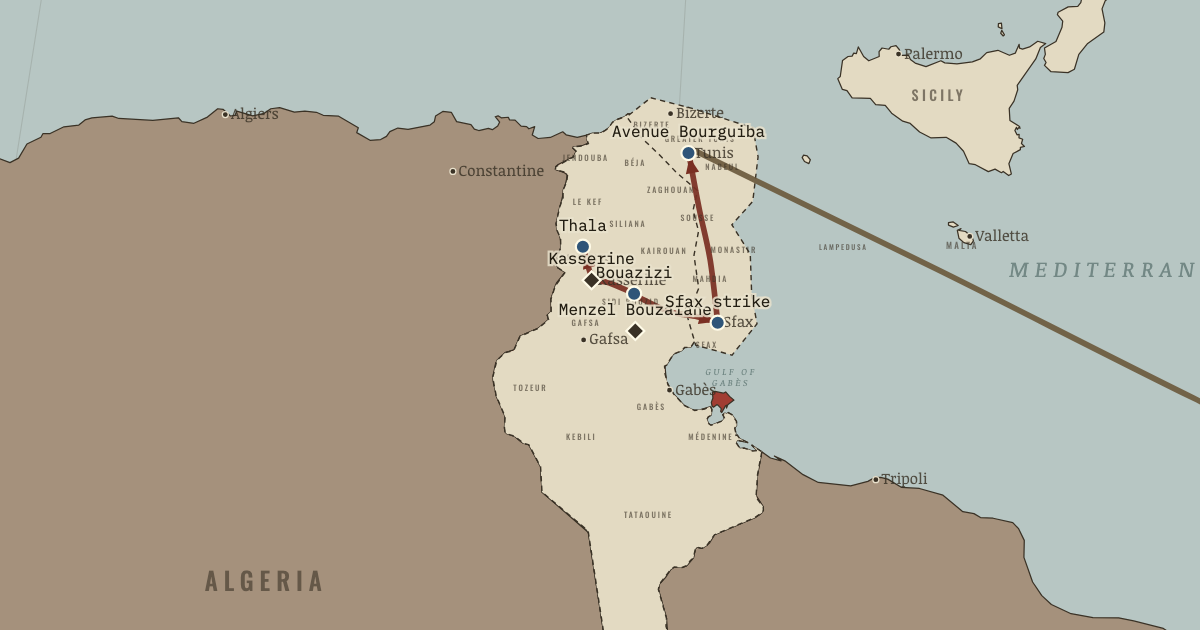
The revolt began where the regime’s bargain, the unwritten deal by which Tunisians accepted political silence in return for jobs and order, had failed most visibly, and it spread through networks that already existed. In Sidi Bouzid, in the poor Centre-West, the street vendor Mohamed Bouazizi set himself on fire on 17 December 2010 after officials confiscated his scales and refused to hear his complaint. That day his relatives and local unionists marched on the offices of the governorate, one of Tunisia’s 24 provinces; a cousin filmed the protest, and the footage reached Al Jazeera, which Tunisians watched by satellite. On 24 December the National Guard, a paramilitary police force, shot dead Mohamed Ammari, aged 18, in Menzel Bouzaiane, where a memorial marks the place. He was the first of the uprising’s martyrs, the name Tunisians give to those killed by the security forces. By 31 December protests had reached the eleven governorates coloured red in the second snapshot. Revolutions rarely start from nothing; they borrow the organisations that already exist.
The short answer
- Blocked hopes in the interior. The revolt began in the interior because hope had been blocked there longest: Sidi Bouzid, Kasserine and Gafsa had unemployment far above the national rate of 13 per cent and poverty about four times that of the coast. Young people had been educated for jobs that did not exist and were humiliated by police and officials when they tried to make a living informally. The interior had already revolted in 1984 and 2008, so the grievance was old; what changed was the speed and scale of its expression.
- Dignity as the demand. Bouazizi’s act was a protest against humiliation as much as poverty, and Tunisians call the uprising the “Revolution of Freedom and Dignity”; many dislike the foreign label “Jasmine Revolution”. Demands for dignity unite people across classes in a way that economic demands often do not, because everyone has experienced the contempt of a corrupt official. That breadth helped the protest jump from the poor interior to the coastal middle class.
- Networks ready to mobilise. Trade-union branches, the lawyers’ bar, teachers’ unions and human-rights activists had survived Ben Ali’s rule in weakened form and had gained experience defending the Gafsa prisoners. In December 2010 they organised marches, documented killings and called strikes. Spontaneous anger becomes a movement when organisations with national reach give it structure, and in 2008, when the UGTT’s national leadership held back, that was missing.
- New media against an old blackout. Phone cameras, Facebook and Al Jazeera allowed Tunisians to see what state television hid, and the publication of US diplomatic cables by WikiLeaks in December 2010 confirmed what many suspected about the ruling family’s corruption. Footage filmed in Thala in the afternoon could be watched in Sfax the same evening. Information that crosses a regime’s barriers faster than police can block it removes one of a dictatorship’s main tools, the isolation of each protest from every other.
THE TURNING POINT
The Sfax general strike, 12 January 2011. Bouazizi’s act lit the uprising, but the general strike in Sfax is the hinge, because it was the moment the revolt of the poor interior became a national movement with the power to stop the economy. Sfax is Tunisia’s second city and industrial centre, inside the coastal outline on the map, and its regional union was the strongest in the country. Once the UGTT authorised regional strikes on 11 January, tens of thousands marched in Sfax and strikes followed in Kairouan and Tozeur, while Tunis’s suburbs rose that night. From that point Ben Ali faced organised workers able to stop the economy, a far greater threat than scattered riots, and two days later he was gone.
What it changed
A dictator falls in four weeks. Ben Ali’s flight on 14 January ended 23 years of his rule and 55 years of one-party government. The interim authorities, led at first by figures of the old regime, faced continuing protests that would force a far more radical break than they intended. The first were the Caravan of Liberation, a march of young people from the interior to the capital, and the sit-ins in the Kasbah square outside the prime minister’s offices. The most lasting change was that Tunisians no longer feared to speak in public.
The Arab uprisings. Tunisia’s example inspired protests across the Arab world within weeks: in Egypt from 25 January, where Hosni Mubarak fell on 11 February, in Libya from 17 February, and in Yemen, Bahrain and Syria. The slogan “the people want the fall of the regime” travelled with them. Only Tunisia’s revolution produced a democratic transition, and it lasted a decade before President Kaïs Saïed suspended parliament in 2021. The speed of Tunisia’s success encouraged protesters elsewhere to believe that regimes could fall quickly, an expectation that cost many lives in Libya and Syria.
A revolution without leaders. The uprising had no single party, leader or programme, which made it hard to suppress and hard to steer afterwards. The vacuum was filled by the old regime’s officials, by the UGTT, by returning exiles such as Rached Ghannouchi and by new parties, so the question of who would inherit the revolution became the central conflict of the next three years.
The dead and the wounded. Families of the dead and the wounded became a lasting pressure group, demanding recognition, compensation and trials of police officers. Their campaigns kept the memory of Kasserine and Thala alive, and the official list of martyrs, published only in 2021, showed how slowly the new state delivered justice, a grievance that resurfaced in every later crisis.
The full answer, argued
The grievances were the same in both cases: unemployment, corruption, regional neglect and police abuse. The difference lay in the mechanisms of spread and in the response of the regime’s pillars. In 2008 the revolt stayed in one isolated basin, the national union leadership held back, and images reached few people, so the police could cordon the region and jail its leaders. In 2010 protests broke out in many governorates within two weeks, faster than the police could contain them; videos on Facebook and Al Jazeera broke the blackout; the regional unions pushed the UGTT into authorising strikes; and the killings in Kasserine created national outrage. Finally the army, which had no stake in Ben Ali’s survival, stood aside. Historians weigh these factors differently, with some stressing new media and others the unions, but the comparison suggests that no single factor was sufficient. The transferable lesson is that revolutions usually need both a spreading mechanism and a defection among the regime’s defenders, and that a failed protest can supply the experienced organisers that a later success depends on.
An interesting fact
The most famous lines of the revolution came from a poem written in 1933 by Abu al-Qasim al-Shabbi, a young Tunisian poet who died of heart disease the following year, aged 25. His poem “The Will to Live” begins with a couplet promising that if a people one day wills to live, fate must answer and the chains must break. The couplet had been part of Tunisia’s national anthem since 1987, so it was sung at every official ceremony of Ben Ali’s regime. In January 2011 crowds chanted it in the streets of Tunis, so a verse the regime had made official became the anthem of its overthrow, and demonstrators in Cairo and other Arab cities soon took it up as well.
This is the study layer of Tunisian Revolution, chapter 9 of Protest and Change: Second-Wave Feminism and Tunisia, 1945–2015; the full index of the atlas is here.
Related questions
THE FREE PRINTABLE STUDY GUIDE
Join the Dispatch — a short welcome series, then a letter when a new atlas opens — and the printable study guide for Protest and Change is yours now, free.
NO TRACKING · YOUR ADDRESS IS USED FOR THE DISPATCH AND NOTHING ELSE · UNSUBSCRIBE ANYTIME