MAPS OF HISTORY · IB HISTORY · THE DECOLONIZATION OF AFRICA
IB HISTORY · 1945 – 1994 · 12 CHAPTERS
IB History: The Decolonization of Africa — notes, maps and essay questions
The half-century in which the most bordered continent on earth drew its own map — negotiated in some capitals, fought for in others.
IB notes for this atlas are in preparation. Meanwhile, this page gathers the study notes every one of its 12 chapters already carries: why each episode happened, the moment it turned on, what it changed, and the question historians still argue about. It also shows where the atlas fits the IB course.
WW2 is free — every chapter. Try chapters 1–2 of any 2 other atlases (3 with a free account). Opening a new atlas uses one of them. Membership opens all 21 — Join.
Where it fits the course
The atlas is filed under Paper 2 (Popular Movements) and Paper 3 for Higher Level (Africa and the Middle East). Its IB notes, with evidence lists, primary sources and model essay plans, are in preparation. These are the IB History pages for the parts of the course it serves:
Why it began
Causation questions start at the beginning. These are the causes the atlas’s opening chapters argue, each in a few sentences you can test against your own reading.
Chapter 1: How Thin the Empire Really Was
Rule by a handful, through intermediaries. Colonial administration was astonishingly thin. “indirect rule,” Frederick Lugard’s doctrine, governed through existing chiefs and emirs precisely because Britain could not afford anything else. The same thinness that made empire cheap made it brittle: it depended on African collaboration, and the moment that collaboration became refusal, there was almost nothing behind it.
An economy built for extraction, not development. Colonies were designed as suppliers of raw materials and buyers of finished goods. Roads and railways ran from mine and plantation to port, not town to town. Almost nothing was invested in African education or industry. At independence, the Belgian Congo had a handful of African university graduates for thirteen million people. The grievance this bred was economic as much as political.
The war as solvent. 1939–45 shattered the myth of European invincibility (Singapore, the fall of France) and mobilized Africa as never before. Soldiers, cash crops, forced labour. Veterans came home having killed white men and seen Europe’s weakness. The Atlantic Charter had put self-determination in the Allies’ own mouths. The colonizers had armed the argument against themselves.
Pan-Africanism finds its leaders. The 1945 Manchester Congress turned an intellectual movement. Du Bois, Padmore, Garvey’s inheritance. Into a political programme, and its delegates into the men who would rule: Nkrumah, Kenyatta, Hastings Banda. The ideas of liberation were in place, held by a generation about to go home and govern.
Chapter 2: The First Doors
Suez: the canal as a symbol of who rules. Nasser nationalized the canal to fund the Aswan Dam after Washington pulled its loan. And to assert that Egypt, not London and Paris, owned the ground under Egypt. For Britain and France the canal was empire itself: prestige, oil, the road to Asia. The collision was not really about a waterway. It was about whether Europe could still command the postcolonial world by force.
The dollar veto. The invasion was a military success and a total political defeat. Eisenhower, furious at being deceived and fearful of driving Arab states toward Moscow, refused to support the pound as it came under speculative attack and blocked emergency oil. Sterling would have collapsed. Britain folded in days. It was a demonstration that the age of independent European action was over. The West now had one leader, and it was not in Europe.
France chooses Algeria. Paris granted Tunisia and Morocco independence in 1956 with relatively little struggle for a hard-headed reason: they were protectorates, not settled French soil, and letting them go freed troops and legitimacy for the one place France would not yield. Algeria, constitutionally three French départements with a million pieds-noirs. Triage: sacrifice the flanks to hold the centre.
Nasser and the power of the example. Nasser’s survival. Defying three armies and winning by losing. Made him the hero of the Arab and African world overnight and the model for a militant, non-aligned nationalism. Radio Cairo’s “Voice of the Arabs” beamed the lesson across the continent: the empires could be faced down. Egypt became a training ground and megaphone for liberation movements from Algeria to Angola.
Chapter by chapter
The atlas has 12 chapters. For each, the causes it explains and the moment it turns on; the title opens the chapter’s free page with the full explanation, a discussion question and the map.
1. How Thin the Empire Really Was
CHAPTER 1 · THE COLONIAL MAP OF 1945
Why it happened: Rule by a handful, through intermediaries · An economy built for extraction, not development · The war as solvent · Pan-Africanism finds its leaders
The turning point: Brazzaville, January 1944.
2. The First Doors
CHAPTER 2 · 1951–1956
Why it happened: Suez: the canal as a symbol of who rules · The dollar veto · France chooses Algeria · Nasser and the power of the example
The turning point: Suez, November 1956.
3. Ghana — The Model
CHAPTER 3 · 1947–1957
Why it happened: The invention of the mass party · “Positive Action” and prison as credential · Why Britain conceded the model · Cocoa: an economy that could pay
The turning point: Accra, midnight, 6 March 1957.
4. Algeria — The Exception
CHAPTER 4 · 1954–1962
Why it happened: Settlers change the equation · The FLN’s strategy: provoke, internationalize, endure · Torture and the loss of legitimacy · De Gaulle’s cold arithmetic
The turning point: The Battle of Algiers, 1957 — victory as defeat.
5. The Year of Africa
CHAPTER 5 · 1960
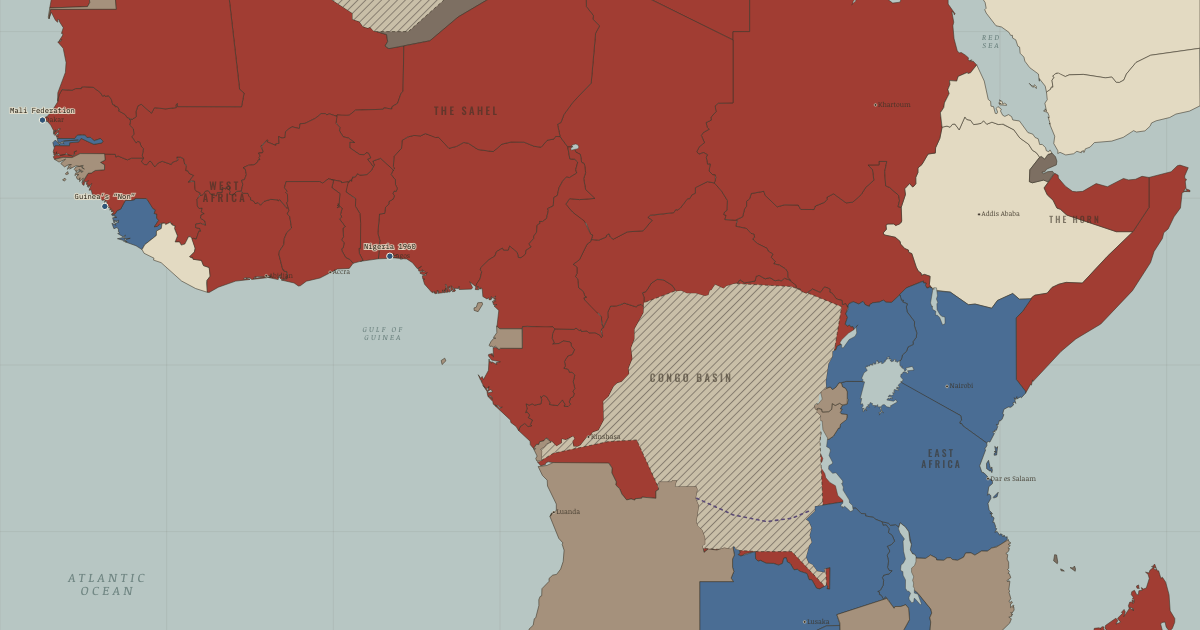
Why it happened: The loi-cadre alumni · Guinea’s “Non” and the collapse of the Community · The international tipping point · Momentum and the fear of being last
The turning point: Lagos, 1 October 1960 — the giant rises.
6. The Congo Crisis
CHAPTER 6 · 1960–1965
Why it happened: A colony deliberately left unprepared · Katanga: secession to protect a mine · The Cold War descends · The UN’s impossible mandate
The turning point: Katanga secedes, 11 July 1960.
7. Building States from Colonies
CHAPTER 7 · 1963–1979
Why it happened: The border bargain of 1964 · Economies inherited, not chosen · Why the coups came · Françafrique and the persistence of dependence
The turning point: Addis Ababa & Cairo, 1963–64 — the borders are frozen.
8. The Portuguese Empire Falls Last
CHAPTER 8 · 1961–1975
Why it happened: Why Lisbon could not let go · Cabral and the theory of the peasants’ war · The army that overthrew its own war · The Cold War inherits the war
The turning point: Luanda, 11 November 1975 — freedom and civil war on the same day.
9. The Settler Redoubt
CHAPTER 9 · 1965–1990
Why it happened: Settlers with nowhere to go, again · “Kith and kin” and the failure of sanctions · Lancaster House: how a settler state is negotiated away · Cuito Cuanavale: the myth broken
The turning point: Cuito Cuanavale, 1987–88 — the hinge.
10. Apartheid’s Long Fall
CHAPTER 10 · 1948–1990
Why it happened: The architecture of apartheid — and why recap it here · The turn to armed struggle · Sanctions and capital flight — the argument that actually bit · De Klerk’s calculus
The turning point: Mandela walks free, 11 February 1990.
11. The Four Years That Decided It
CHAPTER 11 · 1990–1994
Why it happened: Two sides that could each destroy but not win · The third force and the strategy of chaos · Hani, and the brink · The choice of reconciliation over revenge
The turning point: The election, 27 April 1994.
12. What Independence Achieved, and Could Not
EPILOGUE · THE LEDGER OF FREEDOM
Why it happened: The real achievements, named · The limits colonialism built in · The coup cycle and the strongmen
The turning point: Pretoria, 10 May 1994 — the ledger’s closing entry.
Essay questions, argued
Every chapter ends with a discussion question that historians still argue about, with our answer in brief. Use them as essay practice: plan your own answer, then read how we would argue it.
DISCUSSION QUESTION · CHAPTER 1
If the colonial system was so thin and cheap, why had it not fallen sooner — and why did it fall so fast after 1945?
Before 1945 the system held because it faced no coordinated challenge and Europe’s prestige seemed unbreakable: the thinness worked as long as Africans mostly cooperated and no rival demonstrated Europe could be beaten. The war removed both props at once. It beggared the imperial powers, mobilized and radicalized African populations, discredited white supremacy on the battlefield, and gave nationalists a global language of self-determination and a superpower (America, and the USSR) with reasons to encourage them. The lesson is that brittle systems can persist for decades and then collapse in a rush: what changed was not the machinery of rule but the willingness to obey it.
The chapter behind it: How Thin the Empire Really Was. Every chapter’s question is on the discussion questions page.
DISCUSSION QUESTION · CHAPTER 5
Why did seventeen countries become independent in the single year 1960 — and was the speed a triumph or a problem?
The clustering was mechanical and psychological: France had pre-built African governments through the loi-cadre so the handover was largely complete before the flag changed. The collapse of de Gaulle’s Community after Guinea’s survival converted autonomy into full independence across French Africa within two years. The UN and both superpowers had made independence the expected norm. And momentum made each transfer easier than the last. Whether it was triumph or problem is genuinely debatable, and the honest answer is both. Triumph: an epochal, largely peaceful liberation of a continent. Problem: many states arrived sovereign but structurally unready. Colonial economies, arbitrary borders, shallow institutions, tiny educated classes. And the speed meant almost no time to build the foundations independence needed. The Congo (next chapter) shows the catastrophic end of the spectrum. The enduring debate is whether a slower transition would have built stronger states or simply prolonged colonial rule under a new name.
The chapter behind it: The Year of Africa. Every chapter’s question is on the discussion questions page.
DISCUSSION QUESTION · CHAPTER 9
Why did settler rule in southern Africa survive decades longer than colonialism elsewhere — and what combination of pressures finally ended it?
It survived because the settler equation was at its strongest here: large, entrenched white populations who saw the region as their only homeland, controlled its wealth and arms, and would fight rather than concede majority rule. The Algerian dynamic without a metropole to withdraw to. No single pressure was sufficient: sanctions alone were evaded for fifteen years. Guerrilla wars alone could not militarily defeat well-armed states. International isolation alone was tolerable. What ended it was the accumulation and interaction of all of them. Sustained armed struggle that made the countries ungovernable, the collapse of the Portuguese buffer that exposed the redoubt, economic strangulation by sanctions and capital flight, and finally the military check at Cuito Cuanavale that destroyed the myth of white invincibility and shifted the political arithmetic. The transferable lesson is that deeply entrenched minority regimes rarely fall to one clean blow. They fall when military, economic, diplomatic and internal pressures compound over time until the cost of holding on exceeds the cost of letting go. And when the belief in their own invincibility, which is half their strength, is finally broken.
The chapter behind it: The Settler Redoubt. Every chapter’s question is on the discussion questions page.
DISCUSSION QUESTION · CHAPTER 12
Was the decolonization of Africa a success or a failure — and why is the way you frame that question as important as the answer?
The honest answer is that it was a profound success at its own core task and a disappointment against the hopes it raised. And that the two verdicts are not contradictory. As liberation, it succeeded completely: within fifty years a continent almost wholly ruled from Europe governed itself, and the human gains of self-rule (life expectancy up roughly a decade, mass education, the end of colonial dispossession and daily racial subjection) are enormous and real. As a promise of development, prosperity and stable democracy, it fell short. Undone by colonial economic structures it could not quickly escape, arbitrary borders, shallow institutions, Cold War interference, a debt crisis, and its own leaders’ failures. But the framing matters as much as the answer: to ask “success or failure?” against a standard of instant Western-style prosperity is to import the colonizer’s condescension and ignore the extractive ruin colonialism actually left. To ask it against the baseline of 1945. Foreign rule, no schools, no votes, extraction. Is to see an epochal liberation with a hard, unfinished aftermath. The deepest lesson of the whole atlas is that winning the flag was the achievable, decades-long first act. Building nations, economies and institutions worthy of the freedom is the far longer work that colonialism deliberately left undone. And that work, judged fairly, is still under way.
The chapter behind it: What Independence Achieved, and Could Not. Every chapter’s question is on the discussion questions page.
What it changed
Consequence questions need the end of the story. The final chapter, What Independence Achieved, and Could Not, sets out what the period left behind:
Rwanda, April 1994 — the darkest counterpoint. In the same weeks the map completed in red, some 800,000 Rwandans were murdered in a hundred days while the world looked away. It is named here soberly and only once: as the era’s darkest hour and the proof that liberation from colonialism did not immunize the continent against catastrophe. Often catastrophe with colonial roots (the Belgians’ racial classification of Hutu and Tutsi among them). Its full account, and the Congo wars that followed, belong to the planned atlas of conflict and intervention. Remember the dead of Rwanda.
Afro-pessimism versus the democratic wave. The 1990s brought a fashionable Afro-pessimism. The continent written off as a hopeless case. It was always too simple. The same decade saw a genuine democratic wave: one-party states falling to multiparty elections across the continent, the end of apartheid, the winding-down of the Cold War proxy wars in Angola and Mozambique. The record is neither triumph nor tragedy but a hard, mixed, ongoing struggle. And judging it requires holding both the gains and the failures in view at once.
Revision tools
The atlas ends with a map quiz that asks you to find places and moments on the map itself (part of membership and of the Exam Sprint). The quick quiz and the discussion questions with our answers are free pages on this site, and the printable study guide gathers every chapter’s notes into one document for revision.
Read next
- Kenya’s road to independence · TWO ROADS TO INDEPENDENCE
- Indian independence and partition · INDIAN INDEPENDENCE & PARTITION
Maps of History is independent and is not affiliated with or endorsed by the International Baccalaureate Organization. IB course names describe alignment only; paper, theme and section names follow the new course outline and may change when the final guide is published.
THE DISPATCH
A short welcome series, then a letter when a new atlas opens — and the printable study guide for The Decolonization of Africa is yours now, free.
NO TRACKING · YOUR ADDRESS IS USED FOR THE DISPATCH AND NOTHING ELSE · UNSUBSCRIBE ANYTIME