Haiti and Kenya independence · CHAPTER 6 ·
Haiti’s independence debt
Chapter 6 of Two Roads to Independence: Haiti 1789–1838 and Kenya 1895–1978: “The Price of Recognition”
In April 1825 Charles X recognised Haiti’s independence if it halved duties on French goods and paid 150 million francs to former colonists for lost property that had included enslaved people. President Boyer accepted in July 1825, and Haiti borrowed in Paris to pay, creating a double debt that lasted a century.
Chapter 6 is part of membership. WW2 is free — every chapter. Try chapters 1–2 of any 2 other atlases (3 with a free account). Opening a new atlas uses one of them. Membership opens all 21 — Join.
Free printable Haiti and Kenya independence study guide, sent by email ↓
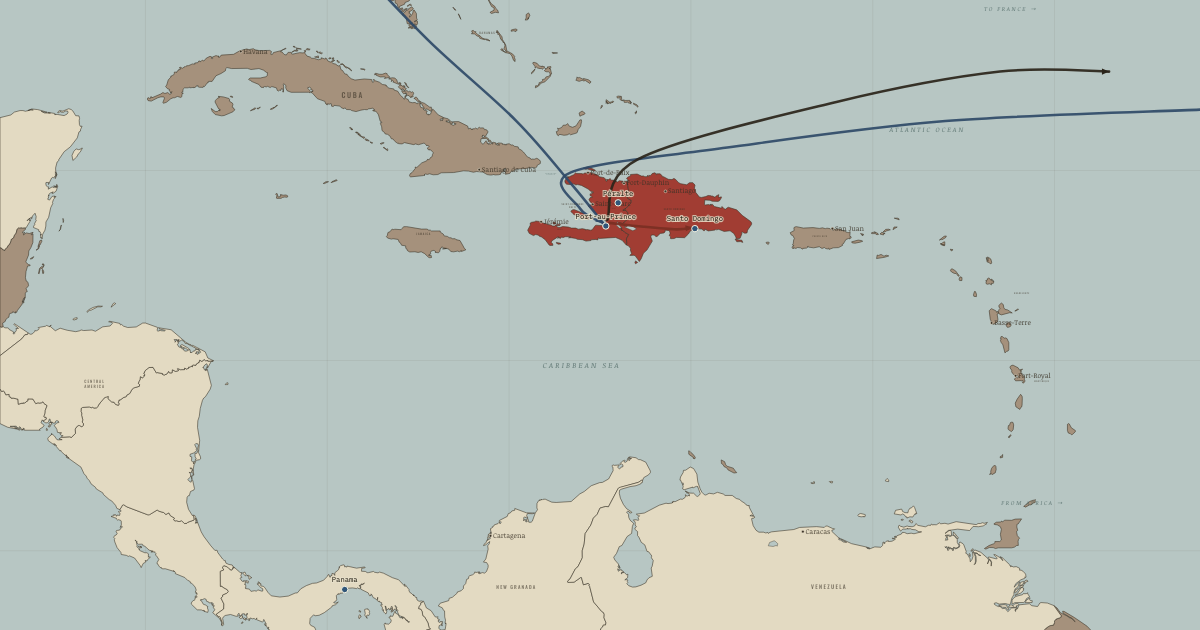
The map above is the world of Haiti, July 1825 — One island — and the price of recognition.
Part of IB History: Haiti and Kenya →
BRIEF EXPLANATION — THE ESSENTIAL ARGUMENT
Haiti won its independence by war in 1803, and France made it pay for recognition in 1825, in a bargain whose weight lasted more than a century. Recognition meant France’s formal acceptance of Haiti as a sovereign state, the step that today lets a new country open embassies, sign treaties and borrow abroad. In April 1825 King Charles X issued an ordinance, a royal decree much like a modern executive order, granting “the full and complete independence” of the former colony on two conditions: Haiti would halve its customs duties on French ships and goods, and it would pay 150 million francs in five yearly instalments to compensate the former colonists for their lost property, a property that had included the people once enslaved there. This payment was called the indemnity. A French envoy, the Baron de Mackau, brought the ordinance to Port-au-Prince in July backed by warships carrying some 500 guns, whose approach is the arrow entering from the east, and President Jean-Pierre Boyer accepted. The arrangement resembled a ransom paid by former captives to those who had held them.
The indemnity became what historians call a double debt, because Haiti had to borrow in order to pay it: for the first instalment Boyer took a loan of 30 million francs in Paris, and after fees Haiti received only 24 million. France reduced the total to 90 million francs in 1838, yet each payment required new loans, so the burden passed to American bankers and then to the United States, which occupied Haiti from 1915 to 1934, and the final payments came only in 1947. On the map the whole island is red in 1825, because Boyer had united it in 1822, while the arrow carrying the money runs out toward Paris. Estimates of the cost vary with the method: about 112 million francs actually paid, roughly 560 million dollars today, or 21 to 115 billion dollars of economic growth lost. Recognition was bought, and the price shaped what the Haitian state could become.
The full story
Haiti accepted the indemnity because isolation had become more dangerous than debt, and the ordinance’s wording shows how France framed the bargain. Since 1804 no great power had recognised Haiti, that is, formally accepted it as a sovereign state with which treaties could be signed, much as governments today decide whether to recognise a breakaway region. The United States had banned trade with it in 1806, and France still claimed the colony. Boyer, who had reunited the north in 1820 and marched into Santo Domingo in 1822 along the arrow across the island, wanted secure borders and open trade. Charles X’s ordinance of 17 April 1825 was addressed to “the current inhabitants of the French part of Saint-Domingue”, as if France were granting freedom, and its sum was calculated from the colonists’ revenues in 1789. When Mackau arrived on 3 July, Boyer accepted within days. Haiti exchanged a threat of war for a debt it could not pay.
The indemnity, the 150 million francs demanded as compensation for the colonists, became a double debt because Haiti had to borrow to pay it, on French terms. In November 1825 it issued a loan of 30 million francs at 6 percent through the Paris bank of Ternaux, Gandolphe and Company; its bonds, IOUs sold to investors much like government bonds today, were sold at 800 francs for every 1,000 owed, so Haiti received 24 million and owed the full 30, with interest. It could not keep up payments on both debts and stopped paying, or defaulted, after 1826. The treaty of 12 February 1838 at last recognised Haiti outright and cut the unpaid indemnity to 60 million francs, making 90 million in all. Governments raised the money mainly through taxes on coffee exports and imports, which fell on the peasants who grew the coffee and bought the cloth. The poorest citizens of the free republic paid for the property their enslavers had lost.
The debt outlived the indemnity, passing from French to American creditors, and estimates of its total cost depend on how it is measured. Sources disagree on when the indemnity itself was cleared, between 1878 and 1888, partly because it was refinanced with new loans, such as those of 1874–75 from the Paris bank Crédit Industriel et Commercial, whose fees took a large share of the capital. In 1910–11 a consortium of French, German and American banks, National City Bank of New York among them, took over Haiti’s national bank, which held the government’s revenue, and in December 1914 US Marines removed 500,000 dollars in gold from its vaults. The United States occupied Haiti from 1915 to 1934, ran its customs, the movement shown by the arrow from the north, and crushed the Caco revolt led by Charlemagne Péralte, and the last payments on loans descended from the indemnity came in 1947. The New York Times calculated in 2022 that Haiti paid about 112 million francs over 64 years and lost 21 to 115 billion dollars in growth. The first figure counts what was paid, the second what that money might have built.
DEEP EXPLANATION — EVIDENCE & INTERPRETATION
How to measure the cost of the indemnity
Every estimate of what the indemnity cost Haiti rests on a choice of method, and the choice explains why the figures differ by a factor of two hundred. The narrowest measure adds up what was actually paid. A team of New York Times reporters, in the series “The Ransom” (May 2022), traced payments over 64 years and found about 112 million francs, including payments on the loans, equal to roughly 560 million dollars in 2022 when converted with price indexes. A wider measure, called counterfactual because it models a history that did not happen, asks what that money would have produced had it stayed in Haiti. With fifteen economists, the same team modelled a range from 21 billion dollars, if the money had grown at Haiti’s own historical rate, to 115 billion, if Haiti had grown like its Latin American neighbours. In 2003 President Jean-Bertrand Aristide demanded restitution of about 21.7 billion dollars, a figure built by compounding the original sum. Critics of such models note that political instability, elite rule and the US occupation also held Haiti back, so no model can isolate the debt’s effect. Both kinds of figure answer real questions: what was taken, and what was lost.
How the debt shaped the Haitian state
The indemnity shaped the Haitian state by making its first fiscal duty a duty to creditors. Governments needed hard currency, and the easiest source was customs duties on coffee leaving the country and goods coming in, so the state concentrated its energy on ports and customs houses, which became the prizes of every coup. Boyer’s Rural Code of 1826 tried to force peasants back onto plantations to raise exports, and it failed because rural Haitians refused to return. The historian Gusti-Klara Gaillard-Pourchet has shown that the sum was calculated from colonial property values, so that, as the title of her 2023 essay puts it, “the slave” served as “a unit of account”. Frédérique Beauvois’s Between Blood and Gold (2017) follows the money to the thousands of French claimants and heirs who received it. Later, the National Bank of Haiti founded in 1880–81 under the control of the Paris bank CIC drew profits from the state’s accounts, an arrangement the economist Éric Monnet describes as extraction. Schools, roads and health care competed for what remained. A state built to pay its debts had little left to build a nation.
Recognition delayed
Haiti’s leaders spent decades seeking recognition, and Julia Gaffield’s Haitian Connections in the Atlantic World (2015) shows how actively they pursued it through trade, letters and envoys. Britain traded with Haiti and posted consuls from the mid-1820s without a formal treaty. When Bolívar called the new Spanish American republics to the Congress of Panama in 1826, Haiti, which had armed him, was not invited, because the creole elites, the American-born descendants of Spanish settlers who led the new republics, feared its example. The Holy See, the Pope’s government, signed a concordat, a treaty governing the Catholic Church in Haiti, only in 1860. The United States recognised Haiti in 1862, once the senators of the seceding slave states had left Congress during the Civil War; Lincoln commissioned the first envoy that July, and in 1889–91 the abolitionist Frederick Douglass served as the US minister in Port-au-Prince. France’s President François Hollande spoke of a moral debt in 2015, and on 17 April 2025, the bicentenary of the ordinance, President Emmanuel Macron said it had put a price on the freedom of a young nation and set up a joint commission of French and Haitian historians to study its effects. Recognition was a political commodity, and few states have paid for it as dearly as Haiti.
Key places on the map
Why it happened
Isolation after 1804. No great power recognised Haiti after independence. The United States banned trade in 1806 under pressure from slaveholders, Spain still held Cuba and Puerto Rico, and Britain dealt with Haiti only informally. Without recognition Haiti could not sign treaties or borrow easily, and its leaders lived in fear of invasion. By the 1820s Boyer judged that recognition at almost any price was worth having.
A claim France never abandoned. France never accepted the defeat of 1803. Former colonists lobbied in Paris for compensation or reconquest, and French ministers sent envoys in 1814 and 1816 to negotiate the colony’s return. The Bourbon kings, restored to the French throne after Napoleon’s fall in 1814–15, needed to satisfy the planters’ lobby and saw an indemnity as a way to do so without a war France could not afford. The ordinance of 1825 turned a lost colony into a source of revenue.
Boyer’s need for security and trade. Boyer ruled the whole island after 1822 and faced the cost of a large army, a French threat and an economy that depended on coffee exports. Open trade with France promised revenue, and a settlement promised that the army could shrink. The terms were harsh, but the alternative, he believed, was a war Haiti might not survive. His acceptance was a calculation made under the guns of Mackau’s squadron.
Money borrowed on others’ terms. Haiti had no access to credit except through Paris, where bankers set the terms. The loan of 1825 delivered only 24 million francs for a debt of 30, and later loans in 1874–75 carried fees that consumed a large share of the money raised. Each refinancing added interest and charges. The indemnity became a long chain of debts, each one forged by the need to pay the last.
THE TURNING POINT
Port-au-Prince, July 1825. Boyer’s acceptance of the ordinance in July 1825 is the hinge because it bought recognition at the cost of the state’s finances for generations. Mackau arrived with an ordinance already written in Paris and with warships in the bay, and Boyer accepted within five days, persuaded that the alternative was war. The decision ended the threat of French reconquest and opened trade, yet it committed Haiti to a sum it could pay only by borrowing, and it defined Haitian freedom as something France had sold. Every later quarrel over the debt, from the treaty of 1838 to the commission of 2025, starts from that week.
What it changed
A double debt for a century. The indemnity and the loans taken to pay it absorbed Haitian revenue from the 1820s until 1947, passing from French bankers to American ones. Its weight on schools, roads and investment is debated, but no historian doubts that it narrowed Haiti’s choices. The epilogue sets this burden beside Kenya’s, where independence was paid for in land bought back from settlers.
The east breaks away. The cost of the indemnity fell on the whole island Boyer governed, and taxes and conscription fed resentment in the east. Boyer was overthrown in 1843, and on 27 February 1844 Santo Domingo declared itself the Dominican Republic; on the map the eastern half of the island changes colour that year. The two nations sharing Hispaniola were born, in the Dominican case, from independence against Haiti.
From French bankers to American Marines. Debt opened the door to foreign control. A consortium including New York’s National City Bank took over Haiti’s national bank in 1910–11, US Marines removed its gold in 1914, and the occupation of 1915–34 ran Haiti’s customs and finances while suppressing a peasant resistance led by Charlemagne Péralte. The occupation ended in 1934, yet American control of Haitian customs continued until 1947, when the last debts were paid, so debt kept Haiti’s finances under foreign management for thirteen years after the last Marines left.
DISCUSSION QUESTION — How far did the indemnity shape Haiti’s history after 1825?
The case for a decisive effect is strong. The indemnity and its loans drained revenue for over a century, pushed the state to tax coffee peasants and imports, made customs houses the target of every coup and opened the way to American financial control and occupation. The New York Times estimate of 21 to 115 billion dollars in lost growth expresses that view in numbers. Yet the debt was not the only force: political instability, elite rivalries, environmental decline and the occupation itself all shaped Haiti, and counterfactual models cannot separate them cleanly. Historians such as Dubois therefore treat the indemnity as a structural weight that interacted with internal choices. A strong answer distinguishes between what the debt caused directly, such as the fiscal drain, and what it made more likely, such as dependence and instability. The transferable lesson is that the terms on which a new state is recognised can bind it long after the ceremony.
An interesting fact
A French print published in 1825 to celebrate the ordinance shows King Charles X bestowing freedom on a kneeling Black figure, presenting the ordinance as the king’s gift of independence to Saint-Domingue. The image, now in the collections of the Bibliothèque nationale de France, turned a forced payment into an act of royal generosity and showed Haitians as supplicants receiving a freedom they had in fact won at Vertières, the battle of November 1803 that ended French rule. The print shows how France told the story of the indemnity to itself.
Related
THE FREE PRINTABLE STUDY GUIDE
Join the Dispatch — a short welcome series, then a letter when a new atlas opens — and the printable study guide for Two Roads to Independence is yours now, free.
NO TRACKING · YOUR ADDRESS IS USED FOR THE DISPATCH AND NOTHING ELSE · UNSUBSCRIBE ANYTIME