Indian independence · CHAPTER 1 ·
Indian Rebellion of 1857
Chapter 1 of Indian Independence & Partition, 1857–1964: “The Rebellion and the Crown”
In May 1857 sepoys of the East India Company’s army mutinied at Meerut and rode to Delhi, where they placed themselves under the Mughal emperor. Annexations under the Doctrine of Lapse, the seizure of Awadh and a rumour about greased rifle cartridges drove the rising, after which the British Crown replaced the Company.
WW2 is free — every chapter. Try chapters 1–2 of any 2 other atlases (3 with a free account). Opening a new atlas uses one of them. Membership opens all 21 — Join.
Free printable Indian independence study guide, sent by email ↓
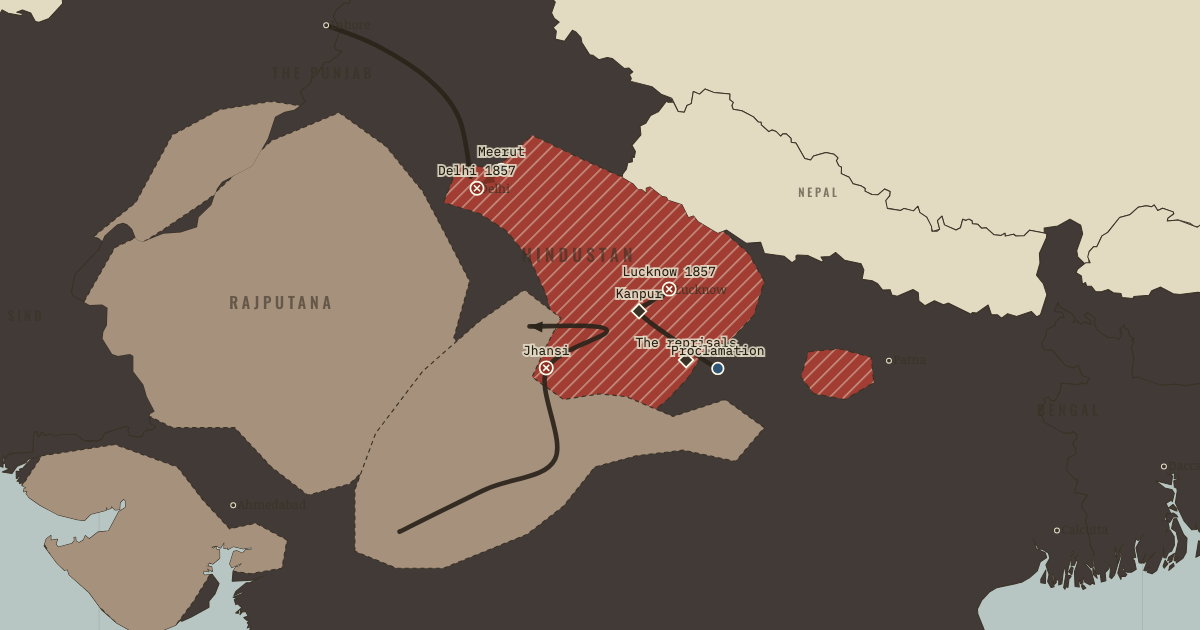
The map above is the world of India, July 1857 — The rising at its height.
Part of IB History: Indian Independence and Partition →
BRIEF EXPLANATION — THE ESSENTIAL ARGUMENT
The central question of this whole atlas is how the largest colony in history came to free itself, and what its freedom delivered, and the story begins with the last attempt to end British rule by force. In 1857 most of India was ruled by the East India Company, a British trading corporation that had conquered an empire and governed it under licence from Parliament, much as if a modern multinational ran its own army. Its power rested on sepoys, Indian soldiers in its pay much as a private security firm pays local guards, and there were about 311,000 of them beside some 40,000 British troops. Many rose in 1857 because a decade of annexations had threatened princes and landholders, and because a rumour that new rifle cartridges were greased with cow and pig fat convinced soldiers that the Company meant to break their religion. In May the sepoys at Meerut mutinied and rode to Delhi. There they proclaimed as sovereign Bahadur Shah Zafar, the elderly and powerless last Mughal emperor, whose dynasty had once ruled most of India and whose title still commanded loyalty, much as a deposed royal family’s name can today. Within weeks princes, landholders and peasants had joined them across the Ganges plain, the red-hatched zone on the map, which shows that a soldiers’ mutiny had become a regional rising.
The rising failed, and the way Britain answered it shaped the next ninety years, although even its name is still argued, because each name passes a judgement. British writers called it the Indian Mutiny and V. D. Savarkar, a nationalist, the First War of Independence (1909); most historians now say the Indian Rebellion, since it began in the army and spread far beyond it without becoming national. Britain had largely crushed it by the end of 1858, though fighting flickered on into 1859, and both sides killed prisoners and civilians. Parliament then abolished the Company and put India under the Crown, so that the British government ruled it directly in the monarch’s name. Queen Victoria also promised the princes, hereditary rulers of several hundred states who accepted British overlordship much like vassal kings, that no more of their land would be taken. The failure of the rising therefore froze the political map of India for most of a century.
The full story
The rising broke out where Company rule had most recently overturned established interests, and the hatched lands on the map of January 1857 show where those were. The Governor-General, Lord Dalhousie, the Company’s chief executive in India, used the Doctrine of Lapse to take Satara, Jhansi and Nagpur. Under this rule a dependent state passed to the Company when its ruler died without a natural son, much as if a government seized a family firm left to an adopted child. In 1856 he annexed Awadh (Oudh), home to many of the Bengal Army’s sepoys, the Company’s Indian soldiers. New revenue settlements, the official assessments of who held each village and what tax it owed, then stripped its great landholders, the talukdars, of villages their families had held for generations. Caste, the inherited rank that governed whom a Hindu could marry or eat with, sharpened every grievance, since overseas service and cartridges said to hold the fat of cows, sacred to Hindus, or of pigs, forbidden to Muslims, threatened soldiers’ standing at home.
The mutiny became a rebellion when the Meerut troopers rode to Delhi on 10–11 May 1857 and placed themselves under the Mughal emperor, heir of India’s former ruling dynasty, because a sovereign gave scattered revolts a common cause. On the map the red hatch spreads from Delhi across Rohilkhand, Awadh, the Doab and Bundelkhand, while the Punjab, Bengal and the south stayed quiet and the largest princely states, ruled by hereditary princes under British overlordship, stood by the British. Each centre had its own leader and grievance: at Kanpur, Nana Sahib, whose Maratha pension Dalhousie had stopped; at Lucknow, Begum Hazrat Mahal, ruling Awadh in her young son’s name; and at Jhansi, its rani, Lakshmibai, whose state had been taken by lapse. Peasants rose too, burning the records of moneylenders who had taken their land. Both sides killed prisoners and civilians, from rebel killings at Kanpur to the mass hangings and the sack of Delhi with which British columns answered. Local roots gave the rising its strength and also kept it from ever becoming one war.
Britain won because it held the Punjab, the sea and the loyalty of most princes, and the arrows on the map trace its counterattack from the Punjab to Delhi, up the Ganges to Lucknow and across Central India under Hugh Rose. The political answer mattered more than the military one. The Government of India Act of August 1858 abolished the Company and placed India under the Crown, much as a failing private firm might be taken into public ownership. A Secretary of State, a cabinet minister answerable to Parliament, now governed from London through a Viceroy, the monarch’s representative in Calcutta. On 1 November 1858 Lord Canning read Queen Victoria’s proclamation at Allahabad, promising no more annexations, respect for Indian religions and equal access to office. The new Raj, as Crown rule came to be called from the Hindi word for rule, rebuilt its army with far more British troops and largely gave up reforming Indian society, so the rebellion lost its war and still reshaped how India was ruled.
DEEP EXPLANATION — EVIDENCE & INTERPRETATION
Mutiny, rebellion or war of independence?
The name given to 1857 has always been an argument about what it was, and each side chose the evidence that suited its name. British historians of the nineteenth century, led by John Kaye and G. B. Malleson, called it the Sepoy or Indian Mutiny, which confined the event to a breakdown of military discipline and implied that the population at large had stayed loyal. Even in July 1857 Benjamin Disraeli asked the House of Commons whether it was a military mutiny or a national revolt. In 1909 the young nationalist V. D. Savarkar published The Indian War of Independence of 1857, banned by the government before it could circulate, and his phrase became the nationalist name for the event. The centenary of 1957 brought careful revisions. S. N. Sen’s official history, Eighteen Fifty-Seven, concluded that what began as a fight for religion ended as a war of independence in the regions where it spread, while R. C. Majumdar argued that it was neither the first, nor national, nor a war of independence. Most historians now write of the Indian Rebellion or the uprising of 1857, a choice that keeps both its military origin and its civilian depth in view. The word chosen still decides what the event is taken to prove.
Why the countryside rose where it did
Historians of the countryside have shown that the geography of the rebellion follows the geography of grievance, and the overlap on the map between Dalhousie’s annexations and the rebel zones is the place to begin. Eric Stokes, in The Peasant Armed (1986), traced the revolt district by district through the upper Doab and found it fiercest where heavy revenue demands and the auction of estates for debt had moved land from old landholding lineages to moneylenders and new buyers. Rudrangshu Mukherjee’s Awadh in Revolt (1984) showed something rarer: in Awadh the talukdars and their peasant tenants fought side by side, because the annexation and the summary revenue settlement of 1856 had injured both, which gave the rebellion there the character of a popular war. Kim Wagner’s study of rumour, The Great Fear of 1857 (2010), shows how fear spread the mutiny from cantonment to cantonment in the spring. The same evidence explains the silences on the map. The Punjab, conquered only in 1849, had no love for the Bengal Army that had conquered it, the Madras and Bombay armies recruited differently and stayed loyal, and the educated classes of Calcutta and Bombay wanted no Mughal restoration. The rebellion was many local wars sharing one sovereign, which is why it could be beaten piece by piece.
Kanpur, the reprisals and the counting of the dead
The violence of 1857 has been remembered selectively by each side, and an honest account holds the massacres and the reprisals in one frame. At Kanpur on 27 June 1857 the British garrison under General Wheeler, which had surrendered to Nana Sahib on a promise of safe passage to Allahabad, came under fire from rebel sepoys and Nana Sahib’s men as it boarded boats at Satichaura Ghat, and most of the men were killed; whether the attack was planned is still debated. On 15 July, as a British relief force approached, about 200 surviving women and children held in a house called the Bibighar were killed by men acting for Nana Sahib’s court, and their bodies were thrown into a well. Who gave the order is disputed. The British reprisals were wider and lasted longer. Columns under James Neill and Sydney Renaud hanged villagers along the Grand Trunk Road without trial, captured sepoys at Kanpur were humiliated before execution, and after Delhi fell in September British troops killed thousands of its residents and emptied the city. About 6,000 Britons died in the rising, many of them civilians. No one counted the Indian dead; the historian Douglas Peers, comparing doubtful earlier figures with the census of 1871, has suggested that about 800,000 died in the fighting and in the famine and disease that followed, and very likely more. British memory long kept Kanpur and forgot the reprisals, and that imbalance shaped how rulers and ruled saw each other for decades.
Key places on the map
On this day
Why it happened
Dalhousie’s annexations and the Doctrine of Lapse. Dalhousie’s annexations gave every Indian ruler a reason to fear the Company. Between 1848 and 1856 he added more territory to British India than any governor before him, by conquest in the Punjab (1849) and Lower Burma (1852) and by the Doctrine of Lapse, under which a dependent state passed to the Company if its ruler died without a natural son. Satara, Jhansi and Nagpur fell this way, and their adopted heirs were refused. Several who lost a throne or a pension to the Company, from the Rani of Jhansi to Nana Sahib, went on to lead the rising, so the annexations supplied the rebellion’s leaders as well as its grievances.
Awadh: an annexation that reached the barracks. The annexation of Awadh turned a princes’ grievance into a soldiers’ grievance, because so many of the Bengal Army’s sepoys came from the province. It was annexed in February 1856 on the grounds of misgovernment, and its king, Wajid Ali Shah, was sent into exile in Calcutta. The summary revenue settlement that followed stripped the talukdars, Awadh’s great landholders, of thousands of villages. Soldiers, landholders and peasants there therefore shared a grievance, and that shared grievance is why the rebellion in Awadh became a popular war.
An army that no longer trusted its masters. The Company’s Bengal Army was held together by pay, status and respect for caste, and in the 1850s each of those bonds weakened. Allowances for service in newly annexed provinces were cut, and the General Service Enlistment Act of July 1856 required new recruits to serve overseas, which many high-caste Hindus believed would break caste. Missionary preaching and reforms such as the law of 1856 allowing Hindu widows to remarry fed a fear that the Company meant to convert India by force. The sepoys’ loyalty, already strained, became conditional on how the next order was read.
The cartridge: a rumour as trigger. A rumour became the trigger because it confirmed what sepoys already feared about the Company. The Enfield rifle issued in 1857 used paper cartridges that had to be bitten open, and word spread from Dum Dum and Barrackpore that their grease contained cow and pig fat, polluting to Hindus and Muslims alike. The army ordered the cartridges issued ungreased and changed the drill, yet it could not stop the story. At Barrackpore on 29 March Mangal Pandey attacked his officers, and at Meerut on 9 May, 85 troopers who had refused the cartridges were shackled on parade; the next evening their comrades rose, which shows how fast a rumour could turn private fears into a common act.
THE TURNING POINT
Delhi, 11 May 1857. The hinge of 1857 is the morning the Meerut troopers reached Delhi and persuaded the reluctant Bahadur Shah Zafar, aged eighty-one, to accept their allegiance. Before that moment there was a mutiny in one cantonment, and afterwards there was a rebellion with a sovereign, a court, a capital and a claim to legitimacy that any landholder or prince could join. Regiments across northern India rose in the following weeks and marched on Delhi, which remained the rising’s centre for four months. The choice also set its limits, since a Mughal restoration offered little to the Sikhs of the Punjab or the educated classes of Calcutta, and when British troops stormed Delhi in September the revolt lost its centre and fell back into many local wars.
What it changed
The Crown replaces the Company. The rebellion moved the government of India from a trading company to the British state itself. The Government of India Act of 2 August 1858 ended the Company’s rule and placed India under the Crown, with a Secretary of State and his council in London and a Viceroy in Calcutta; Lord Canning became the first Viceroy. Daily administration changed little at first, while the principle changed completely, and every later Indian demand in this atlas was addressed to that state and to the promises it made in 1858.
The princes become the Raj’s allies. The princes, once the Company’s next targets, became the Raj’s most reliable allies. Queen Victoria’s proclamation of 1 November 1858 promised that no more princely states would be annexed and that the princes’ rights and dignity would be respected. Rulers who had stood by Britain in 1857, such as those of Hyderabad, Gwalior and Patiala, were rewarded, and in the early 1860s the leading princes received sanads, charters guaranteeing their right to adopt an heir. The tan patchwork on the map was frozen in place until the accessions of 1947.
A rebuilt army and a more distant Raj. Britain rebuilt its Indian army so that it could not easily be turned against it again. The Peel Commission of 1859 recommended one British soldier for every two Indians in the Bengal army and one for every three in Madras and Bombay, and the artillery was kept almost wholly in British hands. Recruitment moved away from Awadh and Bihar towards the Punjab, Nepal and the north-west, whose men had stayed loyal. Britain also abandoned most social reform, judging that its attempts to change Indian customs had helped provoke the rising, and the Raj became more cautious and more racially aloof.
Two memories of one war. The war left two rival memories, and each did political work for a century. For British opinion 1857 became the Mutiny, remembered through Kanpur and the siege of Lucknow, a story that justified distance and suspicion between rulers and ruled. For later nationalists it became the first war of independence, proof that Indians had once fought together against foreign rule, and Savarkar’s book of 1909, written in London and banned in India, carried that reading into the revolutionary circles of the Swadeshi campaign of 1905–11. Both memories were selective, and both chose their dead.
DISCUSSION QUESTION — Was the rising of 1857 a mutiny, a peasants’ war or a war of independence?
The evidence supports each label for one part of the event, so the strongest answer separates its stages and regions. It began as a mutiny, since its first acts were soldiers refusing orders, killing officers and marching on Delhi. In Awadh and the upper Doab it became something larger, a rising of talukdars and peasants whose grievances over annexation, revenue and lost land had nothing to do with cartridges, and Stokes and Mukherjee show it was most intense where those grievances were sharpest. Whether it was a war of independence depends on the meaning of the word. If independence means the shared aim of ending Company rule and restoring an Indian sovereign, the rebels at Delhi, Lucknow and Jhansi plainly held it. If it means a national movement, the label fails, because the Punjab, Bengal, the south and most princes stood aside, and the educated classes opposed the rising. The rebellion was the last great attempt to restore the old political order and the first to frighten Britain into changing how it ruled. The general lesson is that the names given to revolts are arguments about who took part and why, and they should be tested against the map of who actually rose.
An interesting fact
The last Mughal emperor, Bahadur Shah Zafar, was a respected Urdu poet who had studied under the master Zauq and kept Ghalib, the greatest poet of the age, at his court. After Delhi fell he was tried for treason by a British military commission in the Red Fort’s Diwan-i-Khas in early 1858, convicted, and exiled to Rangoon, where he died on 7 November 1862. The British buried him in an unmarked grave so that it could not become a shrine, and its exact site was forgotten. In 1991 workmen digging at his memorial in Rangoon found the brick-lined grave, and it is now visited by pilgrims from across South Asia.
Related
THE FREE PRINTABLE STUDY GUIDE
Join the Dispatch — a short welcome series, then a letter when a new atlas opens — and the printable study guide for Indian Independence & Partition is yours now, free.
NO TRACKING · YOUR ADDRESS IS USED FOR THE DISPATCH AND NOTHING ELSE · UNSUBSCRIBE ANYTIME