Industrial Revolution · EPILOGUE ·
Impact of the Industrial Revolution
Chapter 12 of The Industrial Revolution, 1750–1914: “Who Won and Who Lost”
By 1900 Europe and the United States made about 85 per cent of the world’s manufactured goods, while China’s share fell to about six per cent and India’s to under two. By 1914 the City of London had invested about £4 billion abroad, real wages had risen since about 1850, and organised labour had become a political force.
Chapter 12 is part of membership. WW2 is free — every chapter. Try chapters 1–2 of any 2 other atlases (3 with a free account). Opening a new atlas uses one of them. Membership opens all 21 — Join.
Free printable Industrial Revolution study guide, sent by email ↓
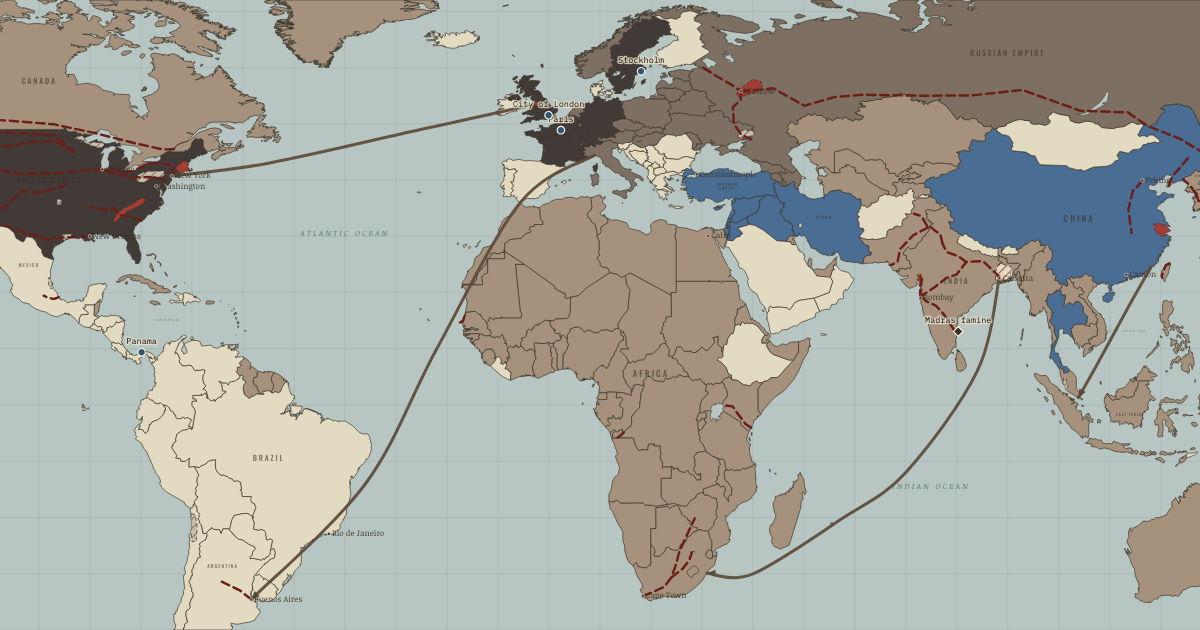
The map above is the world of The industrial world, August 1914 — The industrial world goes to war.
Part of IB History: The Industrial Revolution →
BRIEF EXPLANATION — THE ESSENTIAL ARGUMENT
The Industrial Revolution answered the question this atlas began with in a way that reshaped the whole world, and its balance sheet is the subject of this epilogue. Britain industrialised first because high wages, cheap coal, Atlantic trade and a culture of invention met there; continental Europe, the United States and Japan followed, each borrowing machines and inventing institutions; and by 1914 the industrial countries dominated the world’s output, finance and armed force. Their populations had grown, and their real wages, meaning pay measured by what it could buy, had risen after about 1850. The City of London, the capital’s financial district and the Wall Street of its day, had lent about £4 billion abroad, around two-fifths of all foreign investment in the world. The countries that industrialised first had become the world’s workshop, its banker and its strongest military powers at once.
The losers were just as real, and many of them appear on the map as memorials. Enslaved people of African descent grew the cotton of the first factories, hand weavers from Lancashire to Bengal lost their trades, colonised peoples supplied raw materials on terms set by others, and famines such as that of 1876–78 around Madras killed millions while the market kept carrying grain to those who could pay. Workers organised in response, founding the Second International, an alliance of socialist parties, in Paris in 1889. The arrows trace the migrations of the age, in which some 50 million Europeans left home and over a million Indians left under indenture, a contract that bound a labourer to an employer for years in return for the passage. Another bill was only beginning to arrive. In 1896 the Swedish chemist Svante Arrhenius, in Stockholm, calculated that burning coal could warm the planet, a cost of industrialisation that every later generation would inherit.
The full story
Measured by output, the Industrial Revolution produced a small group of clear winners. In 1750, by the economic historian Paul Bairoch’s estimates, Europe and the United States made under a quarter of the world’s manufactured goods, and China and India together about 57 per cent; by 1900 they made about 85 per cent, while China’s share fell to about six per cent and India’s to under two. Britain, the pioneer, had become the world’s banker: by 1914 the City of London, its financial district, had invested about £4 billion abroad, in railways, mines and loans to foreign governments. Within the industrial countries the gains spread slowly but widely after 1850, as real wages, pay measured by what it could buy, rose and working hours fell. The Panama Canal, opened in August 1914, was that confident world’s last great work. The lead fed on itself, because the profits of industry paid for the loans, railways and fleets that extended it across the globe.
Organised labour was how many workers claimed a share of the new wealth, and by 1914 it had become a political force across the industrial world. British trade unions grew from the skilled trades of the 1850s, through the dock strike of 1889 that organised unskilled workers, to about four million members by 1914. In Germany the Social Democratic Party, a Marxist workers’ party that the chancellor Otto von Bismarck had banned from 1878 to 1890, became the largest party in the Reichstag, the elected national parliament, in 1912, and in 1889 socialist parties from about twenty countries met in Paris to found an alliance, the Second International, which called for an eight-hour day and made 1 May an international workers’ day. Governments answered with repression and with reform. Bismarck’s Germany introduced state insurance against sickness, accidents and old age in the 1880s, and Britain followed with old-age pensions in 1908 and national insurance in 1911, which paid sick and unemployed workers from contributions by workers, employers and the state. Industrial capitalism survived its critics partly by adopting some of their demands.
Outside the industrial core the balance was harsher, and two costs stand out because they are still unfolding. The first is inequality between regions. Colonies and economies forced open by treaty supplied cotton, jute for sacks, rubber, tin and grain on terms set by others, and when harvests failed the market could fail them too: in the famine of 1876–78 in southern and western India, centred on Madras, between about 5.5 and 10 million people died while grain kept moving to market and abroad. Poverty and cheap steamship passages drove millions abroad: some 50 million Europeans left for the Americas and Australia, and over a million Indians under indenture, a contract binding labourers to plantations for years. The second cost is the climate. Coal had freed industry from the limits of the land, yet in 1896 the Swedish chemist Svante Arrhenius in Stockholm calculated that doubling the carbon dioxide in the air would warm the earth by several degrees. The energy that made the industrial world rich had begun to change the planet.
DEEP EXPLANATION — EVIDENCE & INTERPRETATION
Winners and losers inside the industrial countries
Within the industrial countries the distribution of gains changed over the period, and economists have argued about the shape of that change. The economist Simon Kuznets suggested in 1955 that inequality first rises during industrialisation, as some sectors and regions race ahead, and then falls as workers move into higher-paid jobs and gain political power. The British evidence partly fits this pattern. Real wages, meaning pay adjusted for the cost of living, grew slowly before 1850 and much faster afterwards, and average heights, a sign of childhood nutrition and health, began to rise again for those born after mid-century. Yet the ownership of wealth became more concentrated than ever: the economist Thomas Piketty’s reconstructions suggest that around 1910 the richest one per cent held about two-thirds of all private wealth in Britain. Women’s experience differed by class and place, since mill work gave many young women wages of their own while law and custom kept married women dependent. The middle classes of clerks, engineers, teachers and shopkeepers grew faster than any other group. Historians therefore describe gains that were real, broad and late for most workers, alongside concentrations of property that the twentieth century’s wars and taxes would only partly reverse.
Famine, markets and empire: a contested link
How far markets and empire turned droughts into mass death is one of the sharpest debates about this period. The historian Mike Davis’s Late Victorian Holocausts (2001) linked the great famines of 1876–79 and 1896–1902 in India, China and Brazil to droughts caused by El Niño, a periodic warming of the Pacific that weakens the monsoon rains. He argued that the droughts became mass death because colonial and market policies left peasants without reserves and governments refused adequate relief. In India Lord Lytton, the viceroy who ruled it for Britain, kept relief minimal, the official Sir Richard Temple set a ration below what labourers needed, and grain continued to be exported. Estimates of deaths in the Indian famine of 1876–78 range from the official 5.5 million, now considered an undercount, to Davis’s upper figure of about 10 million. Economic historians such as Cormac Ó Gráda and Tirthankar Roy accept the scale of the disaster but criticise Davis’s highest estimates and his framing, noting that pre-colonial India also suffered famines and that the Famine Codes adopted after 1880, rules telling officials when to declare a famine and open relief works, reduced later mortality. The economists Robin Burgess and Dave Donaldson found that railways, by moving grain into stricken districts, reduced the effect of droughts on death rates by the early twentieth century. The debate is about responsibility, since all sides agree that policy choices shaped who died.
Coal, carbon and the long bill
The fuel that freed industry from the land also began to change the air. Britain mined about 287 million tons of coal in 1913, its all-time peak, and industrial cities lived under smoke: London’s winter fogs killed hundreds in bad weeks, and Britain’s Alkali Act of 1863 became one of the world’s first laws against industrial air pollution. In Japan the Ashio copper mine poisoned the Watarase valley. The global effect was invisible at the time. The Swedish geologist Arvid Högbom estimated in 1894 that coal burning was beginning to match natural sources of carbon dioxide, and the chemist Svante Arrhenius used his figures in 1896 to calculate that doubling atmospheric carbon dioxide would raise temperatures by about five to six degrees, an overestimate later revised. Measurements of ancient air trapped in polar ice show carbon dioxide rising from about 280 parts per million before industrialisation to about 300 by 1914; it passed 400 in the 2010s. The atmospheric chemist Paul Crutzen proposed in 2002 that a new age in the earth’s history, the Anthropocene or human age, began in the late eighteenth century with the engineer James Watt’s steam engine. The Industrial Revolution’s final bill is still being paid.
Key places on the map
On this day
Why it happened
Coal-powered productivity. The industrial countries’ wealth rested on machines driven by coal, which multiplied what each worker could produce. Britain mined about 287 million tons of coal in 1913, its all-time peak, and exported about a third of it to fuel other nations’ ships and factories. Countries with coal, capital and skills pulled ahead, and countries without them, or prevented from using them, fell behind. Energy was the foundation of the whole divergence.
Diffusion through states and markets. Industrialisation spread fastest where states could protect new industries, build railways and educate engineers, as in Germany, the United States and Japan. Late starters borrowed Britain’s technology and invented their own institutions, from Germany’s investment banks, which lent long-term to industry, to the model factories built by Japan’s Meiji government, the modernising regime that took power in 1868. The result by 1914 was an industrial core of several countries competing for markets, resources and colonies. Adapting borrowed methods to local conditions decided which followers succeeded.
Empire and unequal exchange. Colonial rule and unequal treaties, agreements forced on weaker states that fixed low tariffs, or import taxes, kept much of Asia and Africa in the role of supplier of raw materials and buyer of manufactures. Low tariffs, guaranteed returns for foreign investors and forced labour regimes such as the Congo Free State, the private colony of King Leopold II of Belgium, channelled the gains toward the industrial powers. The map’s tan and blue show how far that system reached by 1914. Political power decided who would capture the gains of the new technology.
Workers and voters organised. The losers of early industrialisation inside Britain did not remain powerless. Luddites, who smashed machines, Chartists, who demanded votes for working men, trade unionists and socialists built organisations that won the vote, legal unions and the first welfare laws, and similar movements spread across Europe, the United States and Japan. Their pressure explains why industrial societies grew more equal in income, though not in wealth, after the middle of the century. Reform came from below as well as from above.
THE TURNING POINT
The City of London, 1914. The City of London, the capital’s financial district, is the hinge of the epilogue because it shows what the first industrial nation had become. By 1914 Britain earned more from lending, shipping and insurance than it needed to pay for its imports, and its investors held about £4 billion abroad, from Argentine railways to South African mines. Britain, once called the workshop of the world, had become its banker, while Germany and the United States made more goods. In August 1914 that interconnected system went to war with itself, and the First World War showed what industrial economies could do when they turned their factories to destruction.
What it changed
An industrial war. The industrial powers’ greatest new capacity in 1914 was for total war, waged with a nation’s whole economy, and in August they turned their steel, chemicals, railways and factories against each other. The First World War mobilised whole economies for machine guns, heavy artillery and poison gas on a scale the American Civil War had only foreshadowed, and estimates of military deaths run from about 9 to 11 million. The industrial powers had never traded more with one another than in 1913, so the war showed that economic interdependence alone could not keep the peace.
Catching up, slowly. The Great Divergence, the gap between the industrial West and the rest of the world, began to narrow only in the late twentieth century. After 1945 many former colonies sought to industrialise behind tariffs, taxes on imports, and from the 1950s Japan, then South Korea, Taiwan and finally China followed the path of earlier latecomers such as Germany: state guidance, protection and exports. Their success shows that the divergence of the nineteenth century rested on circumstances, such as capital, technology and the power to set tariffs, that later policy could change.
The carbon century. Coal, and then oil, powered the twentieth century. Carbon dioxide in the atmosphere, about 280 parts per million before industrialisation, had reached about 300 by 1914 and passed 400 in the 2010s. The first scientists to connect burning coal with a warmer planet, such as the Swedes Arvid Högbom and Svante Arrhenius, worked in the industrial world this atlas describes, and the costs they glimpsed are now global.
DISCUSSION QUESTION — Who gained most from the Industrial Revolution by 1914, and was the price worth paying?
The clearest winners by 1914 were the owners of capital and the populations of the industrial core, who were richer, healthier and more numerous than any earlier society, and whose working classes had begun, after 1850, to share in the gains. The clearest losers were those who paid without benefiting: enslaved people whose cotton fed the first mills, handworkers from Lancashire to Bengal whose trades vanished, colonised peoples supplying raw materials on others’ terms, and the dead of famines and forced labour. Judging whether the price was worth paying raises a problem historians cannot settle with evidence alone, because the people who paid and the people who gained were mostly different, and often separated by generations and continents. Two observations help to settle it. Much of the cost came from political choices, such as slavery, empire and minimal famine relief, which were not inevitable parts of industrial technology. The gains also spread, eventually, far beyond the first industrial countries. A defensible judgement is that industrialisation was a transformation worth having, achieved at a price that was far higher than it needed to be and paid by the wrong people.
An interesting fact
Svante Arrhenius was not alarmed by his own calculation. At the rates of coal burning in his day, he expected a doubling of carbon dioxide to take something like three thousand years, and in his popular book Worlds in the Making (1908) he suggested that a warmer climate might bring milder, steadier weather and richer harvests to the colder parts of the earth, Sweden included. He did not foresee the growth of coal and oil burning in the twentieth century, which has raised carbon dioxide by about half in little more than a century and a half. Arrhenius got the direction of change right and the timetable badly wrong, because he could not foresee how fast industry would keep growing.
Related
THE FREE PRINTABLE STUDY GUIDE
Join the Dispatch — a short welcome series, then a letter when a new atlas opens — and the printable study guide for The Industrial Revolution is yours now, free.
NO TRACKING · YOUR ADDRESS IS USED FOR THE DISPATCH AND NOTHING ELSE · UNSUBSCRIBE ANYTIME