Indian independence · CHAPTER 15 ·
India under Nehru
Chapter 15 of Indian Independence & Partition, 1857–1964: “Building the Republic”
India’s constitution, drafted under B. R. Ambedkar, came into force on 26 January 1950, giving every adult the vote and abolishing untouchability. In the first general election of 1951–52 about 173 million voters were registered and Congress won 364 of 489 seats, while language movements pressed for new states.
Chapter 15 is part of membership. WW2 is free — every chapter. Try chapters 1–2 of any 2 other atlases (3 with a free account). Opening a new atlas uses one of them. Membership opens all 21 — Join.
Free printable Indian independence study guide, sent by email ↓
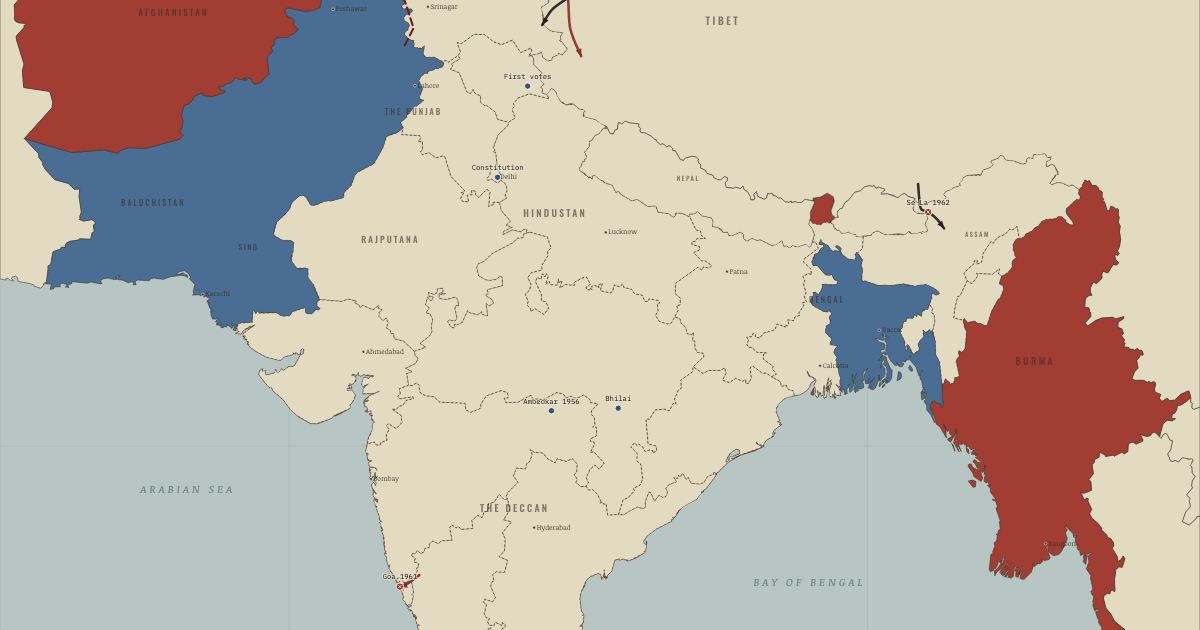
The map above is the world of India, May 1964 — Nehru’s India.
Part of IB History: Indian Independence and Partition →
BRIEF EXPLANATION — THE ESSENTIAL ARGUMENT
The question facing the republic proclaimed on 26 January 1950 was what freedom, won in 1947, would deliver to some 360 million people, most of them poor and unable to read. Its first answer was a constitution, the rulebook that sets out how a state is governed and what rights its citizens hold. It was drafted under B. R. Ambedkar, a lawyer born into a Dalit, or “untouchable”, caste. It gave every adult the vote, because a freedom movement that had claimed to speak for all Indians could not now exclude most of them. It also abolished untouchability, the caste custom that barred millions from temples, wells and schools as polluting, much as segregation laws once barred Black Americans. It also made India a union of states, a federation in which states run their own affairs under a national government, much like the United States. In 1951–52 India held the largest election the world had yet seen, with 173 million registered voters, and Congress, the party that had led the freedom movement, won it under Jawaharlal Nehru, prime minister since 1947. Nehru set out to prove that a poor country could be both democratic and independent of the great powers, through Five-Year Plans, programmes of state investment in dams and steel planned much like a company’s five-year business plan, and through non-alignment, staying out of both blocs of the Cold War, the rivalry between the United States and the Soviet Union, much as a neutral country refuses to join either side of a feud.
The republic’s hardest internal test came over language, and it passed the test by giving way. After Potti Sriramulu died fasting for a Telugu-speaking state in 1952, Nehru conceded Andhra, and in 1956 the states were redrawn by language, which the pale lines on the map show. India took the last French enclaves by negotiation in 1954 and Goa by force in 1961, because Portugal refused to talk. The border with China proved harder. In 1962 China defeated India in a short war over Aksai Chin, a high, almost empty plateau between Kashmir and Tibet, and the hills north of Assam. When Nehru died in May 1964, poverty was still widespread, Kashmir unresolved and Aksai Chin in Chinese hands. Independence had delivered a working democracy and a federation that held, and it had not yet delivered prosperity or secure borders.
The full story
The constitution that came into force on 26 January 1950, the supreme law setting out how India would be governed and what its citizens could claim, turned a colony of subjects into a republic of citizens, and its choices were bolder than most observers expected. Its drafting committee, chaired by B. R. Ambedkar, a Dalit from one of the castes Hindu custom had branded “untouchable”, gave the vote to every adult over twenty-one when most Indians could not read. It listed rights that courts could enforce, abolished untouchability in Article 17 and reserved seats in parliament for the lowest castes and for tribal peoples, much like a modern quota. The first general election, held between 25 October 1951 and 21 February 1952, tested the gamble. About 173 million registered voters chose a parliament at some 196,000 polling booths, with a separate ballot box marked by a party symbol for each candidate so that people who could not read could still choose. Congress won 364 of 489 seats with 45 per cent of the vote, and a population outsiders thought unready for democracy proved that it could run one.
Language was the issue that most threatened the new union, and the way Nehru’s government gave way to it is the turning point of this chapter. Nehru feared that states drawn by language would revive the divisions of 1947, but the Telugu speakers of Madras state would not wait. When Potti Sriramulu died on 15 December 1952 after fasting for 58 days, riots spread through the Telugu districts, and four days later Nehru announced the state of Andhra, created in October 1953. The States Reorganisation Act, in force from 1 November 1956, created 14 states drawn largely by language, much as Quebec is defined by French, and 6 union territories governed directly from Delhi, as Washington, D.C. is run by the federal government. The pale lines on the map are those internal borders. The union bent to identity and survived, the reverse of 1947, when identity had been answered with partition.
Abroad and in the economy, Nehru’s India pursued independence by other means, with mixed results. The Second Five-Year Plan (1956–61), a programme of state investment, put public money into heavy industry, with steel plants built by the Soviet Union at Bhilai, West Germany at Rourkela and Britain at Durgapur, and non-alignment let India take aid from both sides of the Cold War. Portugal refused to negotiate, and in December 1961 some 45,000 Indian troops took Goa in two days. Relations with China broke down over Aksai Chin, a plateau where China had built a road, and over the McMahon Line in the east, the Himalayan boundary a British official had agreed with Tibetan delegates in 1914 and China never accepted. After India pushed small posts into disputed ground from late 1961, China attacked on 20 October 1962, and the arrows show its advance before the ceasefire of 21 November. When Nehru died in May 1964, literacy had risen from 18 to 28 per cent in a decade, yet hunger, caste and Kashmir remained, and making freedom pay had only begun.
DEEP EXPLANATION — EVIDENCE & INTERPRETATION
How the first election was made possible
The first general election is usually told as a triumph of the voters, and recent research shows it was also a triumph of administration that began before the constitution existed. Ornit Shani, in How India Became Democratic (2017), traced how officials of the Constituent Assembly Secretariat began compiling a roll of every adult from November 1947, in the middle of the refugee crisis of Partition, and how citizens’ groups and refugees wrote in to demand that their names be included. The Chief Election Commissioner, Sukumar Sen, a civil servant trained in mathematics, then organised polling in 68 phases over four months, beginning in the snowbound valleys of Himachal Pradesh in October 1951. About 2.8 million women had been registered only as someone’s wife or mother, without names of their own, and their entries were struck off when no names could be recorded, which shows both how new the idea of the individual voter was and how seriously officials applied it. Ramachandra Guha has called the election the biggest gamble in history, and the gamble paid partly because it was prepared like an engineering project. Indian democracy was built from the electoral roll upward.
Why Nehru feared linguistic states, and why they held
Nehru’s resistance to linguistic states rested on the experience of 1947, and the history since 1956 is the best evidence for judging whether he was right. Congress had promised language provinces as early as 1920, when it reorganised its own provincial committees by language, yet in 1949 a committee of Nehru, Vallabhbhai Patel and Pattabhi Sitaramayya advised delay, fearing that loyalty to a language would compete with loyalty to the nation. The movements that followed showed how strong that loyalty was: the Telugu campaign, the Samyukta Maharashtra movement for a Marathi state with Bombay as its capital, whose protests were met by police firing and which remembers 106 dead, and later the campaign for a Punjabi-speaking state. Political scientists such as Paul Brass have argued that conceding language states strengthened the union, because it gave regional elites a stake in the federation and channelled their energies into state politics. Critics point to the minorities stranded inside each new state and to lasting disputes such as Belgaum and Chandigarh. The record suggests that accommodating language made India more governable, since a state that lets its citizens be both Tamil and Indian gives them little reason to choose between the two.
Who started the war of 1962?
The war with China remains one of the most argued episodes of the Nehru years, partly because India’s own inquiry, the Henderson Brooks–Bhagat report of 1963, has never been officially released. The journalist Neville Maxwell, in India’s China War (1970), argued that India provoked the war: it refused to negotiate over a border it had defined on its own, and from December 1961 its Forward Policy pushed small posts into territory China held, which left Beijing little choice but to strike. Later historians, among them Srinath Raghavan in War and Peace in Modern India (2010), accept that the Forward Policy was reckless and the army unready, yet argue that Nehru’s diplomacy was more flexible than Maxwell allowed and that China’s decision owed much to the Tibetan revolt of 1959, the Dalai Lama’s flight to India and Beijing’s own calculations. The military facts are not in dispute. India lost 1,383 soldiers killed and nearly 4,000 captured against 722 Chinese dead, and the Defence Minister, V. K. Krishna Menon, was forced out of the cabinet in November. The defeat ended the belief that non-alignment alone could keep India safe, and the republic began rebuilding its army within months.
Key places on the map
On this day
Why it happened
Partition’s legacy: a state that feared its own divisions. The republic’s founders wrote the constitution in the shadow of 1947, and their fear of further fragmentation shaped it. Partition had shown how identity, once mobilised, could break a country, so the constitution gave the centre strong powers, including the right to redraw states and to take over a state government in an emergency. The integration of more than 550 princely states by 1949, carried through by Vallabhbhai Patel and V. P. Menon, had already shown what a determined centre could achieve. The new state was federal in form and centralising in instinct.
Universal suffrage as a deliberate gamble. Universal suffrage was a deliberate gamble, because the late Raj had trusted the vote to only a small minority chosen by wealth. The Act of 1935, under which Congress first governed in 1937, had given it to about 35 million people chosen by property and education. The Constituent Assembly decided to give it to every adult at once, without tests of literacy or property, because a movement that had claimed to speak for all Indians could not now exclude most of them. The decision made India the first large and poor country to attempt democracy on such a scale, before literacy or prosperity had arrived.
The language movements. Language had defined regional identity long before 1947, and Congress itself had promised linguistic provinces since 1920. Telugu, Marathi, Kannada and Malayalam speakers were divided among old provinces and princely states, with the Telugu districts, for example, split between Madras and Hyderabad. After independence they demanded the states that Congress had promised, through petitions, elections and finally the fast of Potti Sriramulu. Their pressure forced a reluctant central government to keep a promise it had hoped to postpone indefinitely.
Cold War choices and the border with China. Nehru’s foreign policy aimed to keep India independent of both Cold War blocs, and its success depended on good relations with China. The Panchsheel agreement of April 1954, built on five principles of peaceful coexistence, accepted Tibet as part of China. India left the boundary unraised, assuming that the McMahon Line of 1914 in the east and its own maps in the west would stand. Three events then turned that assumption into a crisis: China’s road across Aksai Chin, found by Indian patrols in 1957–58; the Dalai Lama’s flight to India in 1959; and India’s Forward Policy of 1961, which pushed small army posts into the disputed ground. From then on each side read the other’s moves as aggression on land it believed its own.
THE TURNING POINT
Madras, 15 December 1952. The death of Potti Sriramulu is the hinge of the republic’s first years because it showed that the new state would yield to democratic pressure over its own internal map. Nehru had delayed linguistic states for five years, and Sriramulu, a former follower of Gandhi, used Gandhi’s own weapon, the fast unto death, to force the question. Within four days of his death and the riots that followed, Nehru conceded Andhra, and within four years the whole map was redrawn. The concession settled the shape of Indian federalism. Identity was to be accommodated inside the union, and that choice is the main reason the boundaries drawn by language on this chapter’s map have mostly held.
What it changed
A democracy that held. India’s democracy proved durable in exactly the years when it was most fragile. The second and third general elections were held on time in 1957 and 1962, and after Nehru’s death power passed peacefully to Lal Bahadur Shastri. In 1957 Kerala elected a Communist government, one of the first anywhere to take office through a free election, and the centre accepted it until it dismissed that government in 1959, an early warning of the power the constitution gave Delhi. Across the decolonising world many new states moved toward one-party or military rule, so India’s survival as a democracy became its most cited achievement.
The unfinished revolution of caste and gender. The constitution abolished untouchability, and the Hindu Code laws of 1955–56 gave Hindu women rights to divorce and to inherit, yet law ran well ahead of society. Ambedkar resigned from Nehru’s cabinet in 1951 when the Hindu Code Bill stalled, and in October 1956 he left Hinduism altogether, converting to Buddhism at Nagpur with several hundred thousand followers. His warning, that political democracy would not survive without social democracy beneath it, remained the republic’s sharpest criticism of itself.
A planned economy and its limits. The Five-Year Plans built an industrial base faster than they fed the country. They raised steel mills, dams and research institutes, and industry grew quickly from a low base, yet national income grew only about 3.5 to 4 per cent a year and farming lagged behind. By the early 1960s India depended on American wheat shipped under PL-480, a United States law that sold surplus grain to poorer countries, and the droughts of 1965–66 would make food the next government’s emergency. The planners had laid the foundations of an industrial state while the villages, where most Indians lived, changed far more slowly.
Borders still in dispute. The republic settled its internal map and left its frontiers in dispute. The war of 1962 left China holding Aksai Chin, about 38,000 square kilometres claimed by India, and the boundary has never been agreed. Kashmir remained divided along the ceasefire line of 1949, and little more than a year after Nehru’s death India and Pakistan went to war again. The map Nehru left in 1964 had a settled interior and contested edges, the reverse of the map of 1857, whose edges were secure and whose interior was in revolt.
DISCUSSION QUESTION — By 1964, had independence delivered what the national movement had promised?
The answer depends on which promise is measured, and the record is strongest on the political promises and weakest on the economic ones. The movement had promised self-government, and India delivered more of it than almost any new state, with a constitution, universal suffrage, three general elections held on time, an independent judiciary and a federation that absorbed the princely states and redrew itself by language without breaking. It had promised to end foreign rule across the subcontinent, and by 1961 the French and Portuguese enclaves were gone. The promise to end mass poverty was not kept, since incomes rose slowly, food shortages still threatened in the 1960s and literacy reached only 28 per cent by 1961. The promise of social equality was kept in law and broken in daily life, as Ambedkar’s conversion in 1956 showed, and the hope of a secure neighbourhood failed in Kashmir and in 1962. Historians weigh these differently, and a strong case can be made that the democratic achievement was the rarer one, because prosperity could still come later while lost freedoms are seldom recovered. Independence creates a state that can deliver, and the delivering is the work of the decades that follow.
An interesting fact
The violet ink that marks the finger of every Indian voter, so that no one can vote twice, was first used in the general election of 1962. It was developed by chemists at the National Physical Laboratory in Delhi, and it has been made ever since by a single company, Mysore Paints and Varnish, founded in 1937 by the Maharaja of Mysore as a lac and paint works. The ink contains silver nitrate, which darkens on contact with skin and light and cannot be washed off for days. Each national election now needs millions of small bottles, and the company has supplied the same ink to elections in many other countries.
Related
THE FREE PRINTABLE STUDY GUIDE
Join the Dispatch — a short welcome series, then a letter when a new atlas opens — and the printable study guide for Indian Independence & Partition is yours now, free.
NO TRACKING · YOUR ADDRESS IS USED FOR THE DISPATCH AND NOTHING ELSE · UNSUBSCRIBE ANYTIME