Mao’s China · CHAPTER 1 ·
Mao’s consolidation and land reform
Chapter 1 of The People’s Republic under Mao, 1949–1976: “Consolidating Victory”
After Mao proclaimed the People’s Republic on 1 October 1949, the PLA still had to take the south-west and Hainan, while the Nationalists withdrew to Taiwan. The Party ruled at first through the “New Democracy” coalition and the Common Program, while land reform assigned class labels that lasted a generation.
WW2 is free — every chapter. Try chapters 1–2 of any 2 other atlases (3 with a free account). Opening a new atlas uses one of them. Membership opens all 21 — Join.
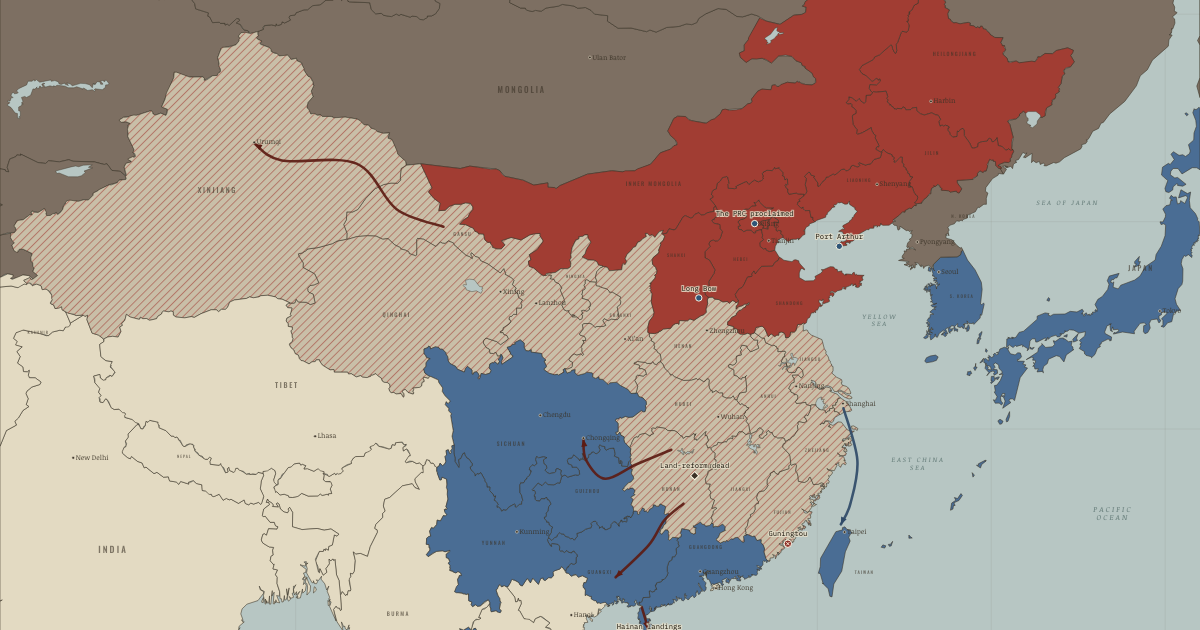
The map above is the world of China, 1 October 1949 — The People’s Republic proclaimed.
Part of IB History: The People’s Republic under Mao →
BRIEF EXPLANATION — THE ESSENTIAL ARGUMENT
The central question of this whole atlas is how Mao Zedong’s Communist Party, fresh from victory in a civil war, turned itself into a state able to reach into every village, workshop and family in China, and what that power did to the people who lived under it. The Party was a disciplined organisation of a few million members that would rule alone, placing its people in charge of every ministry, army unit and workplace, much as a single shareholder controls every branch of a company. The answer begins in the first year, when the Party had to hold a country it had conquered faster than it could govern. When Mao proclaimed the People’s Republic on 1 October 1949, the south-west was still held by the Nationalists, Chiang Kai-shek’s defeated government, and Tibet governed itself. Mao’s first answer was a coalition called “New Democracy”, which promised workers, peasants, small traders and patriotic businessmen a share in the new order under Communist leadership, much as a wartime unity government gathers rival groups behind one leader. It was a coalition built to last only as long as the Party needed allies.
The answer that lasted was land reform, the transfer of farmland from landlords to the peasants who worked it, a change as sweeping as if every rented farm in a modern country were handed to its tenant in a single year. On the map, solid red marks the northern provinces where land reform was already finished, red hatching the provinces where it was still to come, and blue the south-west that the army had yet to take. Under the Agrarian Reform Law of June 1950, cadres, the full-time Party officials who acted as the state’s hands, sorted every village family into a class. They then staged “speak bitterness” meetings, public gatherings where tenants accused their landlords, and these often ended in beatings and executions. By 1953 about 700 million mu, some 47 million hectares and more than two-fifths of China’s farmland, had passed to some 300 million peasants, and most estimates put the dead at between one and two million. The killing bound the villages to the regime, because a peasant who had taken a landlord’s field in front of the whole village now needed the Party to win.
The full story
The new state began as an army that had to become a government, and the map of October 1949 shows how much of the country was still unconquered. The People’s Liberation Army, or PLA, was the ruling Communist Party’s army, much like a party militia grown to national size, and it was about five million strong. The arrows show Liu Bocheng and Deng Xiaoping’s forces driving into Guizhou and Sichuan, where Chongqing fell on 30 November and Chengdu on 27 December, and Lin Biao’s forces sweeping into Guangxi and across the strait to Hainan in April 1950. The Nationalists withdrew to Taiwan with about two million people, and after an assault on Kinmen island failed in October 1949, the chance of finishing the war across the strait slipped away. Until 1954 China was run as six great regions under military-administrative committees, boards of generals and Party officials, so the first rulers of the People’s Republic were its soldiers.
Politically, the Party, which intended to rule alone, governed at first through a coalition that it designed to be temporary. The Common Program of September 1949 served as a stand-in constitution, much like the interim charters new regimes adopt before writing a permanent one. It protected private property and gave posts to the “democratic parties”, small non-Communist parties allowed to survive as junior partners, and three of the six vice-chairmen came from outside the Party. Mao had already set the limit: the people would enjoy democracy, while landlords, “bureaucrat capitalists” tied to the old regime and Nationalist “reactionaries” would face dictatorship, and the Party alone would decide who counted as the people. The coalition also carried real reform. The Marriage Law of May 1950 banned arranged marriages, concubinage and child betrothal and let women sue for divorce, and divorce cases soon ran into the hundreds of thousands a year. In the Central-South region alone, more than 10,000 women were reported killed or driven to suicide in marriage disputes in 1951. Liberation and coercion arrived in the same years, and often in the same village.
In the countryside, land reform, the handing of landlords’ fields to the peasants who farmed them, laid the regime’s foundations by making peasants take part in it. A work team of cadres, full-time Party officials sent from outside, would live with the poorest families and classify every household as landlord, rich peasant, middle peasant, poor peasant or hired labourer, labels written into the records and passed on to children. Then came the struggle meeting, a public denunciation that worked like a trial without lawyers, in which accusers were coached and the crowd acted as jury, and the landlord’s land, tools, houses and grain were shared out. The marker at Long Bow, a Shanxi village where the American William Hinton watched it in 1948, and the memorial in Hunan stand for its two faces: real relief for families who had never owned land, and the deaths of perhaps one to two million people judged to be enemies. Afterwards nobody in a village could stay neutral, and that shared involvement is what made the new state so hard to resist.
DEEP EXPLANATION — EVIDENCE & INTERPRETATION
How violent was land reform, and why?
Historians agree that land reform was violent, and they disagree about how far the violence was planned. The Party’s own rules told work teams to avoid “indiscriminate killing”, yet higher levels judged each village by whether it had struggled its landlords hard enough, and they sent teams back to villages that seemed too gentle. Frank Dikötter, working in provincial Party archives, argues that violence was built into the method, since teams arrived expecting to find enemies and treated reluctance as proof of landlord influence. Brian DeMare stresses performance: land reform was staged like a play, with scripts, rehearsed accusations and an audience that had to take a part. William Hinton’s Fanshen, written by a sympathetic eyewitness, shows a work team correcting its own excesses and peasants arguing about who deserved what. The death toll is uncertain because no complete count was kept and local reports were shaped to please superiors; most estimates fall between one and two million, and some run higher. What the sources share is the mechanism, because violence turned a policy into a shared act, and the shared act bound the village to the state.
New Democracy: a plan or a promise?
Mao had sketched “New Democracy” in 1940 as a long stage in which private enterprise would be allowed to grow under Communist leadership, and the Common Program of 1949 wrote that stage into law. Historians divide over whether anyone meant it to last. One reading, strong in Dikötter’s work, treats the coalition as a deliberate deception, a way to keep factories running and experts at their desks until the Party could do without them. Another, found in the work of Frederick Teiwes and Maurice Meisner, sees a real plan that was cut short. Liu Shaoqi still spoke of consolidating a “New Democratic order”, and Mao attacked that phrase only in 1953, when he announced a “general line” for completing the transition to socialism over three five-year plans. The Korean War, the Soviet example and Mao’s own impatience all shortened the timetable. The evidence fits a middle view, in which the leaders sincerely expected a gradual transition but never intended it to limit the Party’s power, so the coalition lasted exactly as long as it was useful.
Leaning to one side
Mao’s first journey abroad tested what he had meant in June 1949 when he declared that China would “lean to one side”, the Soviet side. He spent two months in Moscow from December 1949, kept waiting for weeks by a Stalin who suspected him of being an Asian Tito, a Communist leader who might defy Moscow as Yugoslavia had done in 1948. The Treaty of Friendship, Alliance and Mutual Assistance, signed on 14 February 1950, promised Soviet help if Japan or its allies attacked China, together with a loan of 300 million US dollars spread over five years. The price is visible on the map: Soviet forces stayed at Port Arthur, the railway across Manchuria remained under joint control until 1952, and joint companies gave Moscow a stake in Xinjiang’s oil and metals. Soviet archives opened in the 1990s, used by Chen Jian and Shen Zhihua, show how unequal the bargaining was. The alliance protected the new state and also tied its economy and strategy to Moscow, which is why its collapse a decade later shook China so deeply.
Key places on the map
On this day
Why it happened
An army that had already won. The Party came to power through the People’s Liberation Army, which had grown to about five million soldiers by 1949 and had destroyed the Nationalist field armies in the great battles of 1948–49. Military victory gave the new state something no Chinese government had possessed since 1911, a single army obeying a single command across almost the whole country. The discipline that had won the war, with a political commissar in every unit, became the template for governing, and generals ran the six great regions into which China was divided until 1954.
A country exhausted by war and inflation. After eight years of war with Japan and three more of civil war, many Chinese cared above all about order, whatever ideology came with it. Prices under the last Nationalist governments had risen so fast that the gold yuan, introduced in August 1948, was worthless within a year. The new government, guided on economics by Chen Yun, brought inflation under control by early 1950 by gathering grain and cloth into state hands and balancing the budget. Stable prices won the regime acceptance in cities that had never supported it.
Land hunger and the landlord’s power. Close to 480 million Chinese lived in the countryside, and in much of the south a minority of landlords owned a large share of the best land, which they rented out for half the harvest or more. Landlords were often also the local moneylenders, tax collectors and militia leaders, so land meant power as well as income. The Communists had learned in their base areas since the 1920s that promising land won recruits, and turning that promise into national law gave poor peasants in every province a reason to back the Party.
The Cold War chose sides early. The United States went on recognising the Nationalist government, and Mao judged that a revolution facing American hostility needed a great-power protector, which led to the Moscow treaty of February 1950. When the Korean War began that June, President Truman sent the Seventh Fleet into the Taiwan Strait and froze the civil war in place. From its first year the new state faced an enemy across the sea, a fact that justified vigilance, secrecy and campaigns against hidden enemies at home.
THE TURNING POINT
Tiananmen, 1 October 1949. The proclamation was the hinge because it turned an insurgent party into a state with the authority to decide who belonged to “the people”. Before October 1949 the Communists governed base areas that they might lose; afterwards they controlled ministries, courts, schools and the national budget, and the Common Program gave their power the form of law. The choice of the Gate of Heavenly Peace, from which emperors had issued their edicts, told the country that a new kind of dynasty had begun. Everything that follows in this atlas, from land reform to the Cultural Revolution, was done in the name of the state proclaimed that afternoon.
What it changed
War arrives before the state is built. The new state had to fight a great power before it had finished building itself. Eight months after the proclamation the Korean War began, and in October 1950 China sent its army across the Yalu, the river border with Korea. War with the United States gave the new government a reason to hunt enemies at home and the public mood in which to do it, so the campaigns of 1950–53 were far harsher than the coalition of 1949 had promised. The war also made loyalty measurable, since every citizen could be asked to denounce, donate or enlist.
Class labels that lasted a generation. The labels fixed during land reform were recorded in household files and inherited by children. A family marked “landlord” in 1951 faced suspicion in school, work and marriage for decades, and in the Cultural Revolution such families were the first victims of village killings. The new state had created a hereditary underclass in the name of abolishing class, and the files that recorded it outlived Mao himself.
The land given was soon taken back. Peasants held their new fields as private owners for only a few years. From 1953 the state bought grain at prices it set, and by the end of 1956 almost every household had been folded into collectives, so the land that had won peasant support passed to the co-operative and, in 1958, to the commune. Ownership had been the reward for supporting the revolution, and it turned out to be a loan.
Two Chinas. The failure at Kinmen and the arrival of the American fleet left the Nationalist Republic of China alive on Taiwan, holding China’s seat at the United Nations. The question of which government spoke for China shaped Beijing’s diplomacy until 1971, when it won the seat, and the strait remains divided today. A failed landing on a small island in 1949 still shapes the politics of East Asia.
DISCUSSION QUESTION — Did land reform secure the countryside for the Party chiefly through the land it gave or through the violence it organised?
Both explanations have strong evidence, and the best answers show how they worked together. The land mattered: about 300 million peasants received fields, tools and grain, and many families remembered fanshen, “turning over”, as the first time they had owned anything, which is why Hinton’s villagers defended the new order. The violence did a different kind of work. Struggle meetings made peasants accuse, vote and sometimes kill, and people who had taken part had every reason to fear the return of the old elite, so their loyalty rested on complicity as well as gratitude. Dikötter weighs the terror heavily, while DeMare and earlier writers give more room to the material gains, and a death toll estimated at one to two million is too uncertain to settle the debate by itself. The next decade adds evidence, because the same peasants lost their land to collectives within five years and resisted mostly in quiet ways, by slaughtering livestock or leaving co-operatives, without open revolt in the Han heartland. That suggests the lasting bond was fear and dependence as much as ownership. The wider lesson is that revolutionary states often secure loyalty by making their supporters share responsibility for what was done.
An interesting fact
Mao’s most quoted sentence of 1949, “The Chinese people have stood up”, belongs to a different day. He spoke it on 21 September, in his opening speech to the Chinese People’s Political Consultative Conference, and popular memory later moved it to the Tiananmen rostrum. The flag raised on 1 October was chosen from nearly 3,000 entries sent in by the public. Its designer, Zeng Liansong, an economics graduate working in Shanghai, had placed a hammer and sickle inside the large star; the committee removed them, leaving the five yellow stars on red that fly today.
Related
THE FREE PRINTABLE STUDY GUIDE
Join the Dispatch — a short welcome series, then a letter when a new atlas opens — and the printable study guide for The People’s Republic under Mao is yours now, free.
NO TRACKING · YOUR ADDRESS IS USED FOR THE DISPATCH AND NOTHING ELSE · UNSUBSCRIBE ANYTIME