Mao’s China · CHAPTER 3 ·
Tibet and Xinjiang under Mao
Chapter 3 of The People’s Republic under Mao, 1949–1976: “Tibet and the Frontiers”
The People’s Republic claimed every frontier once ruled by the Qing. Xinjiang came over without a battle in 1949 and was settled by soldier-farmers, while Tibet, self-governing for nearly four decades, was taken by force and a bargain; revolt spread in 1956, and in 1959 the Dalai Lama went into exile in India.
Chapter 3 is part of membership. WW2 is free — every chapter. Try chapters 1–2 of any 2 other atlases (3 with a free account). Opening a new atlas uses one of them. Membership opens all 21 — Join.
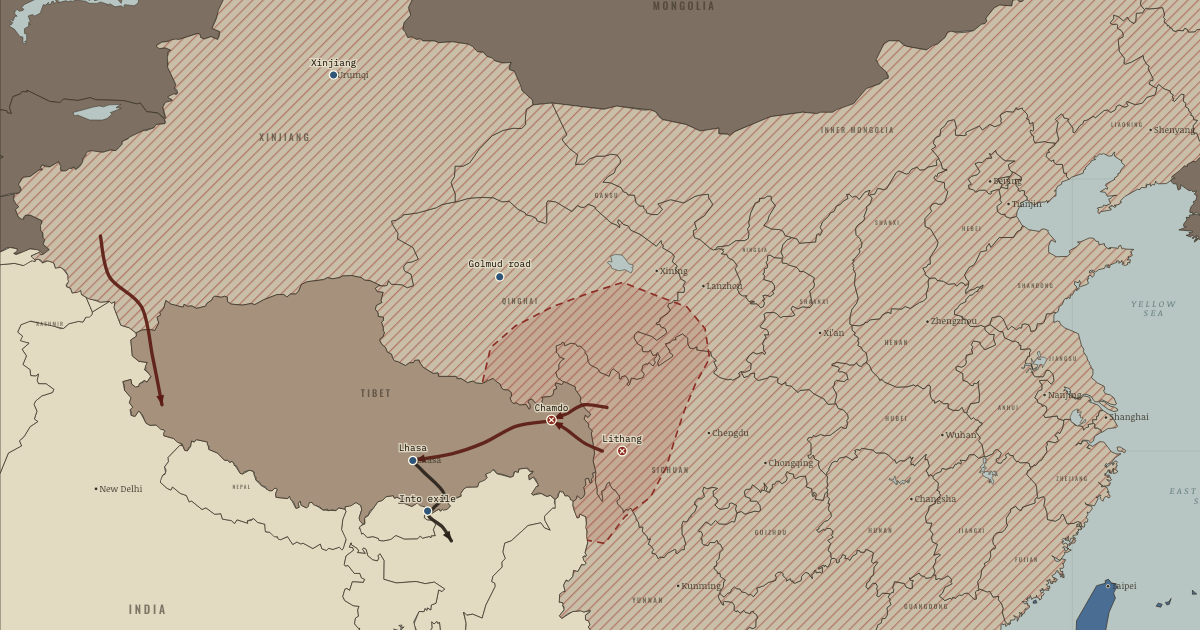
The map above is the world of China, March 1956 — Kham and Amdo in revolt.
Part of IB History: The People’s Republic under Mao →
BRIEF EXPLANATION — THE ESSENTIAL ARGUMENT
The People’s Republic claimed every frontier once governed by the Qing, the Manchu dynasty that ruled China and its frontier peoples from 1644 to 1912, and the way it took them shows whether the new state was a nation or an empire in new clothes. A nation-state presents itself as the homeland of one people, while an empire rules distant peoples with their own languages, faiths and histories, as the Soviet Union ruled the lands of the tsars. Beijing called China a “unified multi-national state” and promised minorities “regional autonomy”, local self-government much like a devolved regional government in which the centre keeps the army and the purse. Here the centre was the Communist Party, the single party that ran every level of government. Xinjiang, in the far north-west, came over without a battle in 1949, and soldiers were settled there to farm and to guard it. Tibet, which had governed itself since 1913, was taken by force: in October 1950 about 40,000 troops of the People’s Liberation Army, the Party’s own army, much like a party militia grown to national size, broke Tibet’s small army at Chamdo. The pattern was set at once, because where local elites gave way Beijing ruled through them, and where they could not, it sent the army.
The bargain that followed, the Seventeen-Point Agreement of May 1951, accepted Chinese rule while leaving in place the government of the Dalai Lama, Tibet’s highest religious teacher and its head of state, a little like a pope who also reigns as king. It held only inside the region shown in tan on the map. The Tibetan lands of Kham and Amdo, east of that line, lay inside the Chinese provinces of Sichuan and Qinghai, so the Party’s campaigns, its nationwide drives against named enemies, reached them in full: first land reform, then collectivisation, the pooling of private farms and herds into units worked in common, much like a compulsory co-operative. In early 1956 Kham rose in revolt, marked by the dashed red zone, and the army bombed the monastery at Lithang. Refugees carried the revolt west, and in March 1959 Lhasa itself rose; the Dalai Lama fled to India along the route the dark arrow traces, and the rising was crushed. The frontier was secured, and the promise of autonomy proved to mean autonomy only for as long as Beijing found it useful.
The full story
The new state inherited a contradiction from the Qing, the Manchu empire that had ruled Mongols, Tibetans, Uyghurs and others beside the Han Chinese until 1912: it claimed an empire’s borders while calling itself the homeland of one nation. The Republic of China that replaced the Qing had lost control of Outer Mongolia, Tibet and much of Xinjiang, and the Communists meant to restore those borders. Xinjiang showed the easy way, because its Nationalist garrison, cut off after Chiang’s government fled, had nothing left to fight for and surrendered in September 1949. In 1954 demobilised soldiers became the Production and Construction Corps, a farming army that ran its own towns, much like the military settler colonies of earlier empires. It settled Han Chinese, over nine in ten of all Chinese, in a region where they had been about 6 percent of the people and where the Uyghurs, a Turkic-speaking Muslim people, were the largest group. The Xinjiang Uyghur Autonomous Region followed in 1955, and since each region’s Communist Party secretary outranked its government, much as a company’s owner outranks its local managers, autonomy put Uyghur faces in office and left power in Han hands.
Tibet was the hard case, because Lhasa had governed itself for nearly four decades and could be recovered only by force and a bargain. The 13th Dalai Lama, Tibet’s religious leader and head of state, a little like a pope who also reigned as king, had expelled the Qing garrison in 1913, and Tibet then ran its own army, currency and foreign relations, though no great power recognised its independence. Without a modern army or an ally, it could not resist in 1950. The arrows show the People’s Liberation Army, the Communist Party’s own army, closing on Chamdo in October 1950, where about 8,000 Tibetan troops were trapped and their governor surrendered. Under the Seventeen-Point Agreement of May 1951, Tibet agreed to “return to the big family of the motherland” and admitted the army, which entered Lhasa that October, while Beijing promised not to alter the political system or the Dalai Lama’s powers. Roads finished in 1954 made that army permanent, which turned a promise into a garrison.
The bargain broke from the east, because Kham and Amdo, the Tibetan lands outside the tan region, were governed as ordinary parts of Sichuan, Qinghai, Gansu and Yunnan. From 1955 their “democratic reforms” brought land redistribution, the disarming of households, attacks on monastery property and collectivisation, the merging of family farms and herds into units worked in common, much like a compulsory co-operative. Kham rose in early 1956; the army bombed Lithang’s besieged monastery, and revolt and repression spread through Amdo in 1958. Refugees poured into Lhasa, and the Chushi Gangdruk resistance formed in 1958 with covert American training. When rumours spread in March 1959 that the Dalai Lama would be detained, crowds surrounded his summer palace; he fled on the night of 17 March, and the army shelled the city three days later. The state had treated Tibetans differently on either side of a provincial line, and that inconsistency is what destroyed its own bargain.
DEEP EXPLANATION — EVIDENCE & INTERPRETATION
Empire or nation-state?
The question of what kind of state the People’s Republic was on its frontiers divides historians as sharply as it divides governments. Beijing’s position is that Tibet and Xinjiang have been part of China since the Yuan or Qing dynasties, so 1950 was a reunification. Melvyn Goldstein, whose multi-volume History of Modern Tibet rests on interviews and archives on both sides, concludes that Tibet functioned as a de facto independent state from 1913 to 1950 without ever winning international recognition, which left it legally exposed. Tsering Shakya’s The Dragon in the Land of Snows emphasises Tibetan politics and choices, showing how the Lhasa elite misread both Beijing and the outside world. James Millward’s history of Xinjiang describes a frontier where the Qing had ruled through local elites and the PRC instead settled soldiers and migrants, changing the population itself. Comparing the PRC with the Soviet Union is useful: both kept an empire’s borders while claiming to have abolished empire, and both offered minorities cultural autonomy in exchange for political obedience.
The Seventeen-Point Agreement as a bargain
The agreement of 23 May 1951 is best read as a bargain struck under military pressure, and its terms explain both its survival and its collapse. Tibetan delegates signed in Beijing without authority to concede sovereignty, using seals made for the occasion, and the Dalai Lama accepted the agreement only in October 1951, once the PLA was on the road to Lhasa. In return, Mao gave real concessions: the Dalai Lama’s government, the monasteries and the aristocratic estates were left in place, and reforms were not to be compelled. Mao even announced in 1957 that there would be no reform in Tibet during the Second Five-Year Plan, which meant not before 1963, and he reduced the number of Chinese personnel there. Goldstein argues that this “gradualist” policy might have worked if it had been applied to all Tibetan areas. Because Kham and Amdo were treated as ordinary Chinese provinces, the most militant Tibetans became refugees in Lhasa, and the bargain was undermined by the government that had made it.
Counting the cost of 1959
The number of Tibetans who died in the rising and its suppression cannot be fixed, and the reasons for the uncertainty are instructive. Estimates for the fighting in Lhasa itself run from roughly 2,000 to 10,000 dead. A political report of the PLA’s Tibet Military District, dated 1960 and later cited by the Dalai Lama and by historians, claimed that 87,000 “enemies” had been “eliminated” in central Tibet between March 1959 and October 1960, a term that covered the killed, wounded and captured. Exile organisations have published far higher totals for the whole period of Chinese rule, which most historians treat as unverifiable. The sources are all partisan: Chinese military reports counted enemies to show success, refugee testimony recorded personal losses, and no independent observer was present. What is beyond dispute is the outcome. About 80,000 Tibetans followed the Dalai Lama into exile, the old government was dissolved, and most monasteries were emptied within a few years, so the dispute over numbers does not change the verdict that 1959 ended the Tibet of the 1951 bargain.
Key places on the map
On this day
Why it happened
The Qing borders as a national claim. Both the Nationalists and the Communists treated the borders of the Qing empire at its height as the rightful borders of China, so Tibet’s self-government after 1913 looked to them like a theft committed during China’s weakness. The new state wanted to show that the century of humiliation was over, and restoring the frontier was the most visible proof. The claim also had a strategic edge, because Tibet bordered India and its plateau commanded the approaches to south-west China.
A Tibet that could not defend itself. Lhasa had a small army of about 8,000 to 10,000 men, few modern weapons and no allies willing to fight for it. Britain, its old patron, had left India in 1947, and the new Indian government under Nehru wanted good relations with Beijing. The Tibetan elite had also resisted the military reforms of the 1920s, fearing that a strong army would weaken the monasteries, so in 1950 there was nothing to stop the PLA at Chamdo.
Campaigns built for Han villages. The campaigns that the Party applied across China, from land reform to collectivisation, assumed a society of landlords and tenants that could be reorganised by work teams. In Kham and Amdo they collided with pastoral nomads, powerful monasteries and a people who carried arms. When officials tried to confiscate guns and monastery land in 1955–56, they provoked a revolt that the same methods could not contain. Officials trained to find landlords in Han villages treated lamas and chieftains as class enemies, which turned a reform into an attack on a whole way of life.
Settler colonies and new roads. Beijing secured its frontiers by changing their population and geography. In Xinjiang the Production and Construction Corps, created in 1954 from demobilised soldiers, settled hundreds of thousands of Han migrants over the following decades. In Tibet the highways from Qinghai and Sichuan, opened in December 1954, and a road across Aksai Chin, finished in 1957, allowed troops and supplies to arrive by truck. Each road made the next intervention easier.
THE TURNING POINT
Lithang, February–March 1956. The siege and bombing of Lithang’s monastery marks the hinge because it showed that the 1951 bargain could not survive the Party’s campaigns next door. Until 1956 Beijing could present its Tibet policy as patient and voluntary; after Lithang, refugees from Kham carried news of bombed monasteries and armed resistance into Lhasa, and the most determined fighters organised themselves into an army. Mao’s postponement of reform inside Tibet came too late, because the revolt had already crossed the provincial line. The road from Lithang ran straight to the Lhasa rising of March 1959 and the Dalai Lama’s exile.
What it changed
Tibet transformed after 1959. The rising gave Beijing the reason to end the bargain of 1951. With the old government dissolved, it carried out land reform in Tibet in 1959–61, closed most monasteries, and created the Tibet Autonomous Region in 1965. In 1962 the Panchen Lama, the senior lama who had stayed, sent Zhou Enlai a long petition describing hunger and the destruction of religion in Tibetan areas, and he spent most of the next fifteen years in prison or under detention. The Tibet of the 1951 bargain had ceased to exist within six years.
War with India. The Dalai Lama’s asylum in India, and India’s discovery in 1958 that China had built a road across Aksai Chin, a plateau India claimed, turned the friendship of the early 1950s into a border dispute. Both sides pushed patrols forward, and in October 1962 the PLA attacked, routing Indian forces in the north-east and in Ladakh before withdrawing. The friendship slogan of the 1950s, “Indians and Chinese are brothers”, did not survive the decade.
A government in exile. The Dalai Lama settled at Dharamsala in northern India, where he set up a government-in-exile and later a parliament, schools and monasteries for some 80,000 refugees. Tibet thus acquired an international voice it had lacked in 1950, and the question of Tibet has followed every Chinese government abroad since 1959. Exile turned a regional rising into a lasting international cause.
Xinjiang’s changing population. The Corps and later migration raised the Han share of Xinjiang’s people from about 6 percent in 1953 to roughly two-fifths by the late 1970s. In 1962, in the hungry aftermath of the famine, tens of thousands of Uyghurs and Kazakhs fled across the border into the Soviet Union, a sign of how fragile the frontier settlement still was. Beijing sealed the border, and Xinjiang became one of the front lines of the Sino-Soviet split.
DISCUSSION QUESTION — Was the People’s Republic of the 1950s a nation-state or an empire on its frontiers?
The answer depends on which test is applied. By the test of law and self-description, the PRC was a multi-national state: its 1954 constitution recognised minority nationalities, it created autonomous regions run partly by local officials, and it promoted minority languages in schools and publishing. By the test of power, it behaved much like an empire. Decisions in Lhasa and Urumqi were made by Han Party secretaries and the army, settlers changed the population of Xinjiang, and when Tibetans resisted the campaigns in 1956–59, the state answered with aircraft and artillery. Goldstein shows that Beijing’s policy in Tibet proper was cautious until 1959, while Shakya and other historians stress that the caution existed only where Chinese control was weakest. The Soviet comparison helps, because both states claimed to have ended empire while keeping its borders and its methods. The transferable point is that labels such as “nation” and “empire” describe relationships of power, and a state can be one in its constitution and the other in its practice.
An interesting fact
The Dalai Lama who fled in 1959 had been enthroned as a small child, after a search party of monks found him in 1937 in a farming village in Amdo, one of the eastern Tibetan regions that later rose in revolt. He was born in 1935 in Taktser, in today’s Qinghai province, and in 1950, at the age of fifteen, he took full power nearly three years before the customary age of eighteen because of the Chinese invasion. He has lived in India for more than six decades, far longer than he ruled in Lhasa. In 1954–55 he spent months in Beijing, met Mao several times and was made a vice-chairman of the National People’s Congress, which shows how hard both sides tried to make the bargain work.
Related
THE FREE PRINTABLE STUDY GUIDE
Join the Dispatch — a short welcome series, then a letter when a new atlas opens — and the printable study guide for The People’s Republic under Mao is yours now, free.
NO TRACKING · YOUR ADDRESS IS USED FOR THE DISPATCH AND NOTHING ELSE · UNSUBSCRIBE ANYTIME