Mao’s China · CHAPTER 7 ·
Great Chinese Famine
Chapter 7 of The People’s Republic under Mao, 1949–1976: “The Great Famine”
The famine of 1959–61, the largest in recorded history, was caused by policy. The Great Leap had diverted labour from the fields and replaced family kitchens with mess halls, and the state took grain on the basis of inflated harvest claims; after the Lushan purge of 1959, warnings were silenced.
Chapter 7 is part of membership. WW2 is free — every chapter. Try chapters 1–2 of any 2 other atlases (3 with a free account). Opening a new atlas uses one of them. Membership opens all 21 — Join.
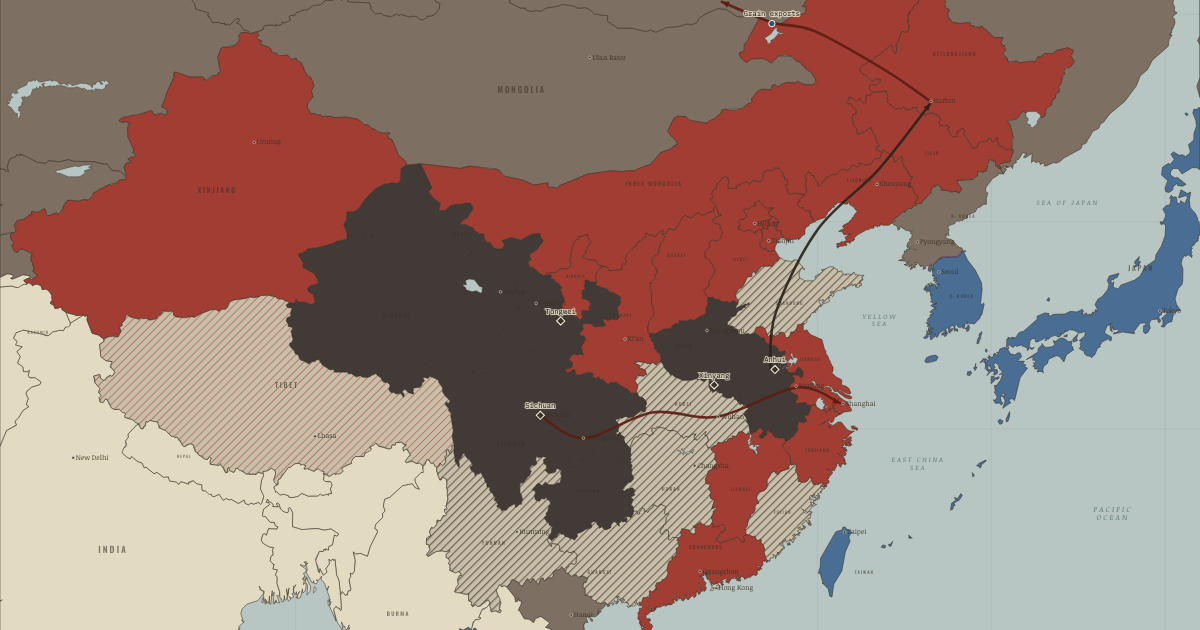
The map above is the world of China, 1960 — The Great Famine at its worst.
Part of IB History: The People’s Republic under Mao →
BRIEF EXPLANATION — THE ESSENTIAL ARGUMENT
The famine of 1959–61 was the largest in recorded history, and it was caused by policy: the state, run at every level by the Communist Party, took food from villages on the basis of harvests that existed only on paper. On the map the charcoal provinces are those where the official death rate in 1960 was three to six times the normal level, and the hatched ones where it roughly doubled. The Great Leap, Mao’s drive of 1958 to transform China through mass labour, had diverted workers from the fields, abolished private plots and replaced family kitchens with communal mess halls, so households had no reserves of their own. Grain procurement, the compulsory sale of grain to the state at a fixed price and in effect a tax paid in grain, was set on the inflated harvest claims of 1958–59. After the Lushan purge of 1959, in which Mao dismissed his defence minister for criticising the Leap, any official who reported shortages risked being labelled a “right opportunist”, a Party member who had lost his revolutionary nerve, much like a defeatist in wartime. A famine made by paper harvests could end only when someone admitted that the paper was false, and that was the one act the system punished.
Estimates of the dead run from about 15 million to 45 million, and the range is wide for reasons the historian has to explain. Demographers reconstruct deaths from flawed censuses and registers, so their totals depend on assumptions about missing records, migration and what the normal death rate would have been; archival historians count from local Party reports that are themselves incomplete. In 1960–61 the Party finally retreated, but for decades it called these the “three years of natural disasters”. The memorial markers on this map stand for villages where most of the dead were never counted by name. The variation between neighbouring provinces with similar land and weather, 68.6 deaths per thousand in Anhui against 18.4 in Jiangsu, shows how much local leadership decided who lived.
The full story
Hunger followed a chain of decisions made during the Great Leap Forward, Mao’s 1958 drive to transform China through mass labour, and each link is visible in the records of the Communist Party, which ran every level of government. The harvest of 1959 fell to about 170 million tonnes, and that of 1960 to about 144 million, against 195 million in 1957, because labour had been taken for furnaces and dams. Yet the state’s procurement, its compulsory purchase of grain at a fixed price, in effect a tax in grain, was the decade’s highest in 1959, close to two-fifths of the real crop, since quotas rested on the Leap’s false figures. When officials in Guangdong reported in early 1959 that peasants were hiding grain, drives to seize “concealed” grain spread. Cadres, the local Party officials who acted as a village’s employer, police and tax office, searched houses and beat those who resisted. The communal mess halls, which had replaced family kitchens in 1958, ran short in the winter of 1959–60, and families who had surrendered their pots and stores had nothing left. The deaths that peaked in late 1959 and 1960 followed from a decision to keep collecting grain after the evidence of hunger was in.
The map’s colours show how much depended on place. Anhui under Zeng Xisheng, Henan under Wu Zhipu, Sichuan under Li Jingquan, and Gansu, Guizhou and Qinghai recorded death rates three to six times the normal level, while provinces with more cautious leaders or more grain fared far better. In Xinyang prefecture in Henan, where officials blocked roads and punished “hiders”, around one million people died in a population of some eight million. Sichuan, the most populous province, went on shipping grain to the cities and for export, along the route the red arrow traces down the Yangtze. The cities were protected by ration cards and by household registration, a permit that tied each person to one place, a little like a passport valid in only one town. China also exported 4.2 million tonnes of grain in 1959, mainly to the Soviet Union, and refugees fled towards the north-east. Where a person lived, and who ruled there, decided who survived.
The retreat came late, and only after the evidence could no longer be ignored. In 1960 a Party investigation exposed the deaths in Xinyang, and in November the “Twelve Articles” restored private plots and small markets and shrank the units that controlled farming. In 1961 the mess halls were closed, and China imported about 5.8 million tonnes of grain from Canada and Australia. Mao never admitted the scale of what had happened. In public the Party blamed drought, floods and Soviet pressure, and the official phrase remained “three years of natural disasters”, although the weather, poor in some regions, cannot explain a famine on this scale. The population, by official figures, fell by about ten million in 1960 alone, and historians’ estimates of the famine’s dead run from about 15 million to 45 million. The famine left a silence in Chinese public life that historians and survivors have spent decades trying to break.
DEEP EXPLANATION — EVIDENCE & INTERPRETATION
Counting the dead: why the estimates differ
The famine’s death toll is estimated, never counted, and the method behind each figure explains most of the gap between 15 and 45 million. Demographers begin with China’s censuses of 1953, 1964 and 1982 and with registration data, reconstruct births and deaths year by year, and then subtract the deaths that would have occurred at a normal rate. Choices at each step move the result. Assume a higher normal death rate, or that some missing people migrated, and the total falls; correct for deaths never registered, especially of infants, and it rises. Using these methods Jiang Zhenghua arrived at about 17 million, Peng Xizhe 23 million, Ansley Coale 27 million, Basil Ashton and his colleagues and Judith Banister about 30 million. Cao Shuji, adding up thousands of county gazetteers, reached 32.5 million, and Yang Jisheng, working from provincial data and interviews, 36 million. Frank Dikötter, counting from Party archives and security reports, argues for at least 45 million premature deaths. A few writers in China have claimed figures under five million, a view demographers reject. The spread of estimates is a disagreement about method, and every serious method places the famine among the deadliest in history.
Why some provinces suffered far more
The provincial pattern on the map is one of the strongest pieces of evidence that the famine was political. Using official death rates, economists James Kung and Justin Lin found that provinces with fewer Party members per head, mostly those taken late in the civil war, pursued the Leap more radically, as if their leaders had to prove their loyalty. Kung and Chen Shuo later showed that provinces led by alternate members of the Central Committee, ambitious men seeking promotion, procured more grain and suffered higher death rates. Dali Yang found that provinces where more peasants ate in communal mess halls had higher mortality. Xin Meng, Nancy Qian and Pierre Yared argue that procurement quotas could not adjust to bad harvests, so the most productive areas paradoxically lost the most food. All these studies use official figures, which undercount deaths, and Tibet has no reliable data at all. Together they suggest that the same national policy produced very different death tolls depending on the incentives and choices of the men who carried it out.
Negligence, ideology or crime?
Historians agree that the famine was made by policy and disagree about how to describe responsibility. Frank Dikötter’s Mao’s Great Famine calls it a mass killing, stressing that perhaps two and a half million people were beaten or tortured to death and that Mao was told of deaths and pressed on. He quotes Mao in March 1959 saying that it was better to let half the people die so the others could eat their fill; the scholar Anthony Garnaut has argued that this remark was about cutting back industrial projects and has been misread. Most historians, including Felix Wemheuer and Cormac Ó Gráda, describe a famine produced by ideology, false information and the protection of cities and exports, in which leaders accepted rural deaths without intending them. The evidence includes Party investigation reports, which record violence, mass flight and, in some places, cannibalism, as well as county gazetteers and survivors’ oral histories. The debate concerns intent, and none of the serious accounts doubts the scale or the human cause.
Key places on the map
Why it happened
Procurement based on false harvests. Grain quotas for 1959 were set on the claims of 1958, when the official harvest was announced as 375 million tonnes against a real figure of about 200 million. Officials who had invented the harvests could not admit it, so they met the quotas by taking seed grain and the food that villages needed to survive. The state therefore took its largest share of the decade in 1959, from villages in the very year they had least.
Households with nothing of their own. The communes had abolished private plots and family livestock, closed rural markets and collected pots and stoves for the furnaces, so food came only from the mess hall. When the halls ran out of grain, families had no reserves, no land of their own to dig and nothing to sell. A system designed to free people from household cares left them with no defence against hunger. Families who had once hidden a little grain for hard years had surrendered their reserves to the collective.
The Lushan purge silenced the alarm. The purge at Lushan made reporting hunger dangerous. After Peng Dehuai was dismissed in August 1959, the campaign against right opportunists punished officials who questioned targets, and millions of cadres were criticised or demoted. Reporting deaths became dangerous, because hunger implied that the Leap had failed. Provincial leaders raised procurement again in the autumn of 1959, exactly when a retreat was most needed, and the worst deaths followed in the next winter and spring.
Cities and exports came first. Household registration and ration cards guaranteed urban residents a minimum supply, so shortages were pushed onto the countryside. China also kept exporting grain, 4.2 million tonnes in 1959, mainly to the Soviet Union, to pay for machinery and repay debts, and it refused foreign food aid. Drought and floods in some regions in 1959–60 made matters worse, but the decisions about who would bear the shortage were political, and they were made in the capital by people who would not go hungry.
THE TURNING POINT
Xinyang, winter 1959–60. Xinyang is the hinge because it was where the leadership could no longer pretend not to know. Henan’s leaders had led the Leap, and in Xinyang prefecture they pressed the campaign against concealment through the winter of 1959–60, searching homes, beating peasants and blocking escape, while about one million people died. When an investigation sent by the centre reported in 1960, the Party had written proof from its own officials. Mao endorsed the purge of the local leaders and, in November 1960, the retreat of the Twelve Articles. The famine did not end at once, but the policy that caused it began to be reversed only after Xinyang.
What it changed
The great retreat. The Party saved the countryside by undoing the Leap. From late 1960 it restored private plots, rural markets and smaller farming units, closed the mess halls and imported grain. Led by Liu Shaoqi, Deng Xiaoping and Chen Yun, the recovery of 1961–65 brought food production back to its 1957 level by about 1965. The managers of the recovery, whose reforms saved lives, would become Mao’s targets in 1966.
A wound in Mao’s authority. Mao withdrew further from day-to-day government and made a limited self-criticism in 1962, while privately blaming lower officials. Leaders who had seen the evidence now doubted his judgement, and Mao came to suspect that they would one day repudiate him as Khrushchev had repudiated Stalin. That fear shaped his decision to attack the Party in 1966. The Cultural Revolution was, among other things, Mao’s answer to the famine’s verdict on him.
Missing births and a lasting scar. Births collapsed during the famine, and demographers estimate around 30 million births lost or postponed in addition to the deaths. The cohort shows as a deep notch in China’s population pyramid even today, and studies of people conceived in 1959–61 have found lasting effects on health and height. The famine marked the bodies of children too young to remember it.
Memory without a monument. Remembering the famine remains a political act in China, because the Party has never published a death toll. Its 1981 Resolution acknowledged “serious losses” and blamed errors, natural calamities and Soviet perfidy together. No national memorial exists, archives have been closed again since the 2010s, and works such as Yang Jisheng’s Tombstone are banned in China. Families have often kept the memory privately, and much of what historians know comes from people who chose to record it at their own risk.
DISCUSSION QUESTION — To what extent was the Great Famine the result of deliberate choices by China’s leaders?
The famine was certainly the result of choices: to set quotas on inflated harvests, to abolish private food, to purge Peng Dehuai and revive the Leap after Lushan, to protect the cities and keep exporting grain, and to refuse foreign aid. Each was taken by people with power, and the provincial variation shown on the map strongly suggests that choices by local leaders mattered far more than the weather. Whether these choices amount to deliberate killing is where historians divide. Dikötter argues that Mao knew of mass deaths and continued, which makes the famine a mass killing; Wemheuer, Ó Gráda and others see leaders who accepted rural deaths as the price of their priorities without seeking them, a famine of ideology and wilful blindness. The evidence of Mao’s private knowledge in 1959–60 is incomplete and disputed, so certainty is impossible. The strongest answer separates the two questions: the deaths were caused by deliberate policies, while the intention to kill is not proven. The general lesson concerns systems that punish bad news, since such systems can kill on a vast scale without any leader needing to want it.
An interesting fact
The most detailed history of the famine was written by a member of the Party who had lost his own father to it. Yang Jisheng, a journalist for the state news agency Xinhua for more than three decades, was a student in 1959 when he went home to his village in Hubei and found his father dying of hunger; he says that at the time he believed the official explanation. He spent more than a decade gathering provincial records and interviews, and published Tombstone in Hong Kong in 2008. He explained the title as a tombstone for his father, for the millions who died, and for the system that caused their deaths.
Related
THE FREE PRINTABLE STUDY GUIDE
Join the Dispatch — a short welcome series, then a letter when a new atlas opens — and the printable study guide for The People’s Republic under Mao is yours now, free.
NO TRACKING · YOUR ADDRESS IS USED FOR THE DISPATCH AND NOTHING ELSE · UNSUBSCRIBE ANYTIME