Meiji Japan and post-Soviet Russia · 1993
Did shock therapy cause Russia’s 1990s economic collapse?
The seminar question: “Did shock therapy cause Russia’s economic collapse in the 1990s, or was it a response to a collapse that had already begun?”
On 2 January 1992 Yegor Gaidar’s government freed most prices at once, betting that one sharp change would hurt less than a slow one. Goods returned to the shops, but prices rose about 2,500% in 1992 and wiped out savings, and from October 1992 voucher privatisation handed most ownership to insiders.
Chapter 10 is part of membership. WW2 is free — every chapter. Try chapters 1–2 of any 2 other atlases (3 with a free account). Opening a new atlas uses one of them. Membership opens all 21 — Join.
Free printable Meiji Japan and post-Soviet Russia study guide, sent by email ↓
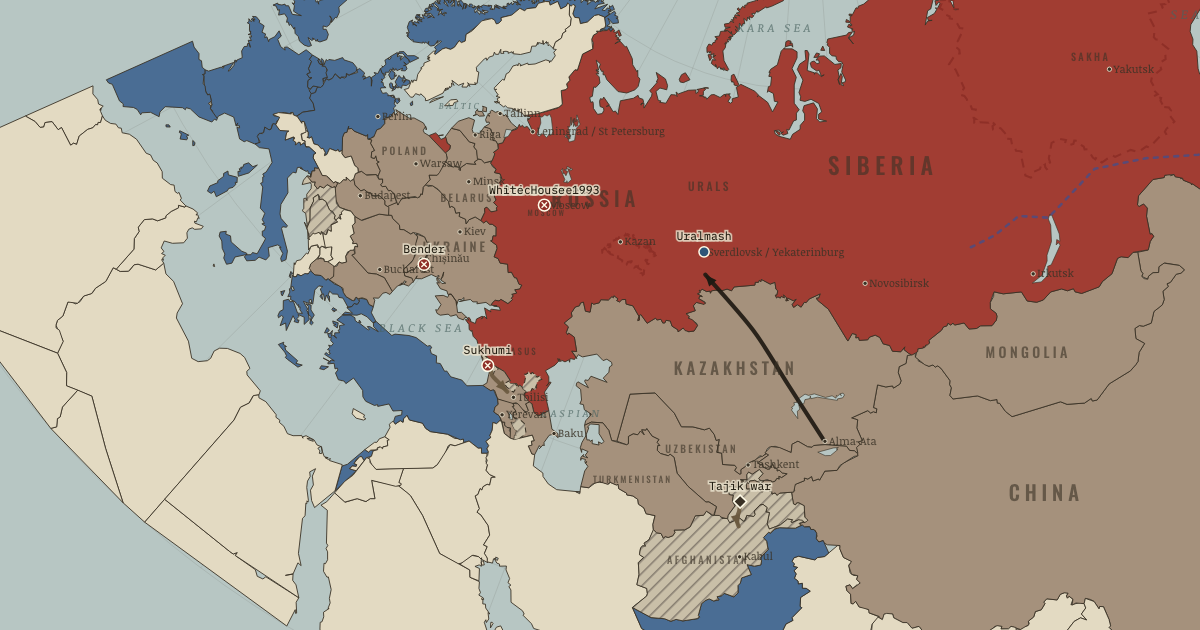
Shock therapy, the plan to bring in market prices and private ownership in one sharp move as a surgeon prefers one operation to many, was chosen because the alternatives looked worse to the men who had to decide. By late 1991 the Soviet state had spent its reserves of gold and foreign currency, shops were nearly empty, and people held far more money than there were goods to buy at fixed prices. Gaidar, aged 35, and colleagues such as Anatoly Chubais, advised by Western economists such as Jeffrey Sachs, argued that only free prices could bring goods back and that reform had to move before the old bureaucracy could regroup. On 2 January 1992 most prices were freed, although energy and some staples stayed controlled. Goods reappeared at prices most people could barely afford, and inflation reached about 2,500% for the year because the central bank kept lending cheaply to failing enterprises. Prices had been freed without control of the money supply, so stabilisation came only years later.
The short answer
- The Soviet economy left too much money and too few goods. Perestroika had left a huge overhang of savings, a budget financed by printing money and an empty network of state shops. Holding prices down only meant longer queues and more rationing, while letting them go meant sudden inflation. Any government in 1992 would have had to choose between these bad options, and Gaidar chose to free prices at once in the belief that delay would only make the shock larger.
- Reformers believed speed protected reform. Gaidar, Chubais and their Western advisers feared that communists and the old ministries would block change if it moved slowly, as they had blocked Gorbachev’s. Fast privatisation was meant to create a class of owners with a stake in the new system, making a return to planning impossible. The goal of irreversibility shaped choices that put speed above fairness or careful design.
- Two branches claimed the same authority. Russia entered independence with a parliament elected in 1990 under Soviet rules and a president elected in 1991, governed by a constitution that gave both of them supreme powers. As inflation and falling living standards made reform unpopular, the parliament turned against the president’s government. Without agreed rules for resolving the conflict, each side used the powers it had until force decided between them.
- The Union’s collapse broke trade and supply. Soviet factories had depended on suppliers spread across fifteen republics, and independence turned these links into foreign trade, often paid in roubles that new states were printing on their own. Until 1993 Russia shared its currency with republics that could create rouble credits, which fed inflation. Output fell as supply chains broke, so part of the decline blamed on shock therapy came from the dissolution of the Union itself.
THE TURNING POINT
Prices freed, 2 January 1992. The freeing of prices is the hinge of Russia’s economic transition because it ended the planned economy in a single day, 2 January 1992. From that morning prices took over from officials the job of rationing goods, and the empty shelves of 1991 filled again. The same decision destroyed most household savings, set off years of high inflation and made the government’s reforms deeply unpopular, which fed the political conflict of 1993. Every later controversy, from vouchers to the oligarchs, grew from choices made in the weeks around this date, when speed seemed the only defence against collapse.
What it changed
A new owning class took shape. Privatisation created millions of nominal shareholders and a much smaller group of managers, bankers and traders who gained real control. The bankers who built fortunes in these years, among them Vladimir Potanin and Mikhail Khodorkovsky, would soon lend money to the state in exchange for its best companies. Ownership had changed hands faster than the laws meant to govern it.
A presidency above parliament. The constitution of December 1993 gave the president power to appoint governments, issue decrees and dissolve the Duma. Yeltsin used these powers to govern through the crises of the 1990s, including the decision to go to war in Chechnya, and his successor inherited a constitutional framework already tilted towards a strong executive.
The borderlands were left to Russia’s soldiers. Ceasefires in Transnistria in 1992, South Ossetia in 1992, Abkhazia in 1994 and Karabakh in 1994 left Russian troops as peacekeepers or garrisons in several successor states. Russia’s role in these conflicts gave it lasting influence over its neighbours, and it set precedents for how Moscow would treat breakaway regions inside its own borders.
The full answer, argued
Critics such as Joseph Stiglitz, Peter Reddaway and Dmitri Glinski argue that freeing prices and selling assets before building institutions caused hyperinflation, theft and a fall in output deeper than the Great Depression in America. Defenders such as Anders Åslund and Yegor Gaidar reply that the Soviet economy was already collapsing by 1991, with empty shops, no reserves and a budget financed by printing money, and that the breakup of the Union broke supply chains no policy could have saved. Some argue that Russia’s reforms were too timid, since inflation continued because the central bank kept printing money. Comparisons cut both ways: Poland’s rapid reforms worked better, while China’s gradualism worked in a very different society. A strong answer distinguishes the collapse that Russia inherited from the way its costs were distributed, and it asks who decided that distribution. The transferable insight is that markets become fair only when the institutions that govern them already exist, however fast or slowly the change is made.
An interesting fact
The economist who ended Soviet price controls came from the heart of Soviet culture. Yegor Gaidar’s grandfathers were Arkady Gaidar, the author of children’s adventure stories that generations of Soviet pupils read in school, and Pavel Bazhov, whose Ural folk tales became a classic Soviet book and a famous ballet score. His father was a naval officer and Pravda correspondent who had reported from Cuba. Gaidar himself worked as an economics editor of the party’s theoretical journal Kommunist, the ideological voice of the Central Committee, before becoming the architect of Russia’s market reforms at 35.
This is the study layer of Shock therapy in Russia, chapter 10 of Remaking the State: Meiji Japan 1600–1912 and Post-Soviet Russia 1964–2000; the full index of the atlas is here.
Related questions
THE FREE PRINTABLE STUDY GUIDE
Join the Dispatch — a short welcome series, then a letter when a new atlas opens — and the printable study guide for Remaking the State is yours now, free.
NO TRACKING · YOUR ADDRESS IS USED FOR THE DISPATCH AND NOTHING ELSE · UNSUBSCRIBE ANYTIME