Refugee crises · 1947
Did the 1944–47 population transfers end ethnic conflict?
The seminar question: “Did the population transfers of 1944–1947 end ethnic conflict in east-central Europe, or did they complete it by other means?”
After the war Poland was moved about 200 kilometres west: the Soviet Union kept its eastern borderlands and Poland received German land. Under the Lublin agreements of September 1944, about 1.2 to 1.5 million Poles and Polish Jews left the Soviet republics, while about 482,000 Ukrainians were sent to Soviet Ukraine.
Chapter 3 is part of membership. WW2 is free — every chapter. Try chapters 1–2 of any 2 other atlases (3 with a free account). Opening a new atlas uses one of them. Membership opens all 21 — Join.
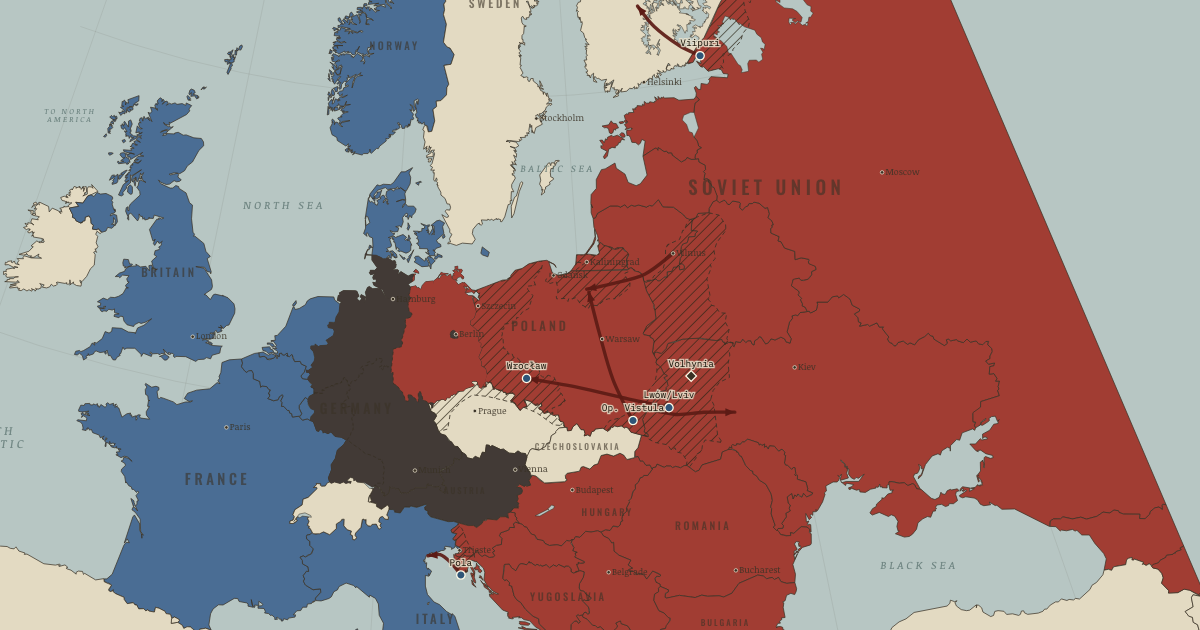
The new Polish state had to fill one territory while losing another, and the arrows from Lwów and Wilno toward Wrocław and Gdańsk show how it did both at once. Under the Lublin agreements of September 1944 between Poland’s communist authorities and three Soviet republics, Poles in the east could register for “evacuation” to Poland, and in practice Soviet pressure, the loss of farms to collectivisation, the merging of private farms into state-run collectives, and fear of Ukrainian insurgents left them little choice. About 780,000 came from Soviet Ukraine alone, and the survivors of Polish Jewry left with them, since the Holocaust had destroyed the communities they came from. Lwów’s university and its Ossolineum library moved to Wrocław, the German city of Breslau, emptied of nearly all its 600,000 Germans. Communist propaganda called the western lands the “Recovered Territories”, presenting them as medieval Polish land returned, so that a population transfer could be told as a homecoming.
The short answer
- Poland’s border moved to the Curzon Line. Stalin insisted on keeping the eastern Polish lands the Soviet Union had seized in 1939, and at Yalta Roosevelt and Churchill accepted a border close to the Curzon Line with compensation in the west. Nearly half of pre-war Poland changed hands, including the Polish cities of Lwów and Wilno. Once the line was fixed, the people on the wrong side of it became a problem that both governments chose to solve by moving them.
- The war of 1943 in Volhynia. Wartime ethnic violence destroyed belief in coexistence. In 1943–44 Ukrainian nationalist insurgents killed tens of thousands of Polish civilians in Volhynia and eastern Galicia, and Polish units killed thousands of Ukrainians in reprisal. The violence convinced both peoples, and the authorities that now ruled them, that coexistence had failed. Population exchange looked like the humane alternative to more massacres, which is why even many victims of forced removal saw it as a kind of safety.
- Communist nation-building. The new communist government in Warsaw lacked popular legitimacy and sought it in nationalism, presenting itself as the builder of a Poland for Poles alone. Ethnic homogeneity fitted Stalin’s preference for clear borders and loyal populations, and it gave the regime land to distribute to settlers. Removing Germans in the west and Ukrainians in the south-east served the same project of a state whose nation and territory finally coincided.
- Treaties that ceded land. Peace treaties gave borderland people a choice that most resolved by leaving. Finland lost Karelia under the Moscow Armistice of 1944 and the Paris treaty of 1947, and Italy lost Istria, Fiume and Zara to Yugoslavia under its own Paris treaty that February. Neither treaty required anyone to leave, but both gave people a choice between a new state and their home. The scale of departure in each case shows how few people believed they could remain safely as minorities under a victorious neighbour.
THE TURNING POINT
Operation Vistula, 28 April 1947. Operation Vistula is the hinge of this chapter because no border moved and no treaty required it, yet the Polish state deported about 140,000 of its own citizens two years after the war had ended. The killing of General Świerczewski supplied a pretext, but the plan to disperse Ukrainians so thinly that they could never again form a community went far beyond fighting an insurgency. The operation shows that the logic of 1945 had become self-sustaining: once states believed that security meant homogeneity, they continued to move people even when no outside power asked them to.
What it changed
A Poland of Poles. Poland emerged as one of the most ethnically uniform states in Europe, although before the war about a third of its citizens had not been Poles. The cost was paid by Germans, Ukrainians, Lemkos and Polish easterners alike, and by the destruction of multi-ethnic cities such as Lwów and Wilno. When the 1990 border treaty that closes this atlas made the result permanent, it also ended any hope among the uprooted of reclaiming their old homes.
Integration at home as a model. Finland’s resettlement of 410,000 Karelians within a few years, paid for by its own landowners and taxpayers, showed that a poor state could absorb a huge displaced population if it treated them as citizens with claims. West Germany’s Equalisation of Burdens law of 1952 applied similar thinking on a far larger scale, as chapter 6 shows. Integration at home was the solution Europe found for its citizens, and it was not on offer to stateless DPs.
Exiles in Trieste and beyond. Many Istrian exiles waited for years in camps around Trieste and in Italian cities before resettling in Italy or emigrating to Australia, the Americas and elsewhere. The Free Territory of Trieste, divided between Allied and Yugoslav administration, was settled only in 1954, when Italy took the city and Yugoslavia the hinterland, setting off a last wave of departures from the Yugoslav zone. Magazzino 18, a warehouse in Trieste’s old port, still holds the furniture many of them never reclaimed.
Displaced persons who would not go east. Many of the Ukrainians, Poles and Balts already in German camps in 1945 came from the very regions now annexed by the Soviet Union. Since their homes now lay inside the USSR, “going home” meant becoming Soviet citizens, and most refused. Their refusal shaped the DP camps and the Cold War politics of asylum described in chapter 4, where the right to refuse return became the core of refugee protection.
The full answer, argued
The case that transfers ended conflict is that the borders drawn in 1945 have held: Poles and Ukrainians, Finns and Russians, Italians and Yugoslavs did not fight over these lands again, and Finland showed that resettlement could be humane when the state treated evacuees as citizens. The case that transfers completed the conflict is that they achieved the goal the 1943 massacres in Volhynia had pursued, which was a territory cleared of the other nation, and that Operation Vistula moved people with no war or treaty to require it. Snyder’s reading suggests both are true, since peace came through the success of separation. That conclusion is uncomfortable, because it implies that ethnic cleansing can produce stability, and historians answer it by counting the cost in lives, property and destroyed communities and by noting that the peace also rested on Soviet power. The insight for Paper 1 is that “solving” displacement by drawing new borders tends to create the next displaced population.
An interesting fact
Lwów carried one of its most famous objects west with it. The Racławice Panorama, a circular painting about 15 metres high and 114 metres long completed in 1894 to mark the centenary of Tadeusz Kościuszko’s victory over Russian troops in 1794, was shipped from Lwów to Wrocław in 1946. Communist authorities, wary of a patriotic picture of Poles defeating Russians, kept it rolled up in storage for almost four decades. It went on public display in a purpose-built rotunda in Wrocław only in 1985, and it remains one of the city’s most visited sights.
This is the study layer of Polish population transfers, chapter 3 of Uprooted: Refugees in Europe 1945–1960 and Indochina 1975–1990; the full index of the atlas is here.
Related questions
THE FREE PRINTABLE STUDY GUIDE
Join the Dispatch — a short welcome series, then a letter when a new atlas opens — and the printable study guide for Uprooted is yours now, free.
NO TRACKING · YOUR ADDRESS IS USED FOR THE DISPATCH AND NOTHING ELSE · UNSUBSCRIBE ANYTIME