Refugee crises · 1951
Was the Refugee Convention humane or a Cold War tool?
The seminar question: “To what extent was the 1951 Refugee Convention a humanitarian achievement rather than an instrument of the Cold War?”
Between 1947 and 1951 Europe’s response to displacement moved from relief to resettlement and legal status. The International Refugee Organization, boycotted by the Soviet bloc, resettled about 1,039,000 people overseas by the end of 1951, and in Geneva on 28 July 1951 the Refugee Convention was adopted.
Chapter 5 is part of membership. WW2 is free — every chapter. Try chapters 1–2 of any 2 other atlases (3 with a free account). Opening a new atlas uses one of them. Membership opens all 21 — Join.
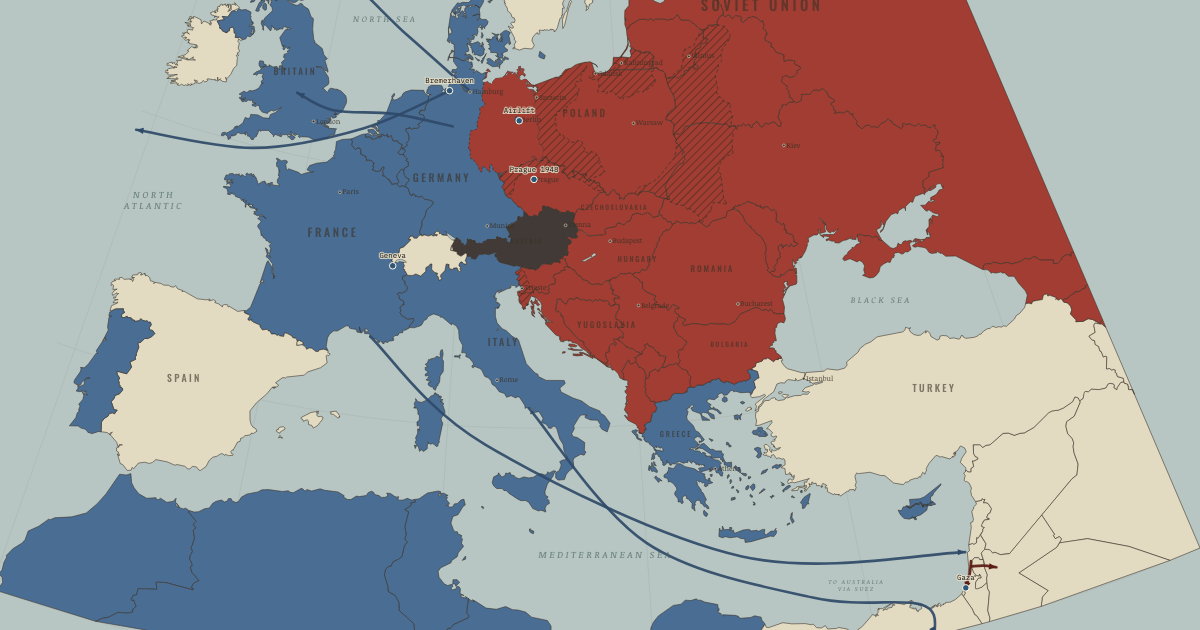
The IRO, the UN agency that succeeded the wartime relief agency UNRRA in 1947, was created because repatriation, sending people home, had run its course, and it turned refugee policy into a form of labour migration through resettlement, permanent settlement in a third country. Most of the million people still in camps in 1947 refused to return east, while Australia, Canada, Britain and Latin America needed workers. Selection teams sought the young, the healthy and the skilled, so Balts and single men were in demand while the old, the sick and large families waited. Australia required its displaced persons (DPs), the uprooted civilians of the camps, to work for two years wherever the government sent them, and the United States admitted refugees under the Displaced Persons Act of June 1948, which President Truman called “flagrantly discriminatory” because its cut-off date of 22 December 1945 excluded most Jews who had fled Poland in 1946. By 1952 about 394,000 DPs had sailed for the United States. Resettlement gave a million people a future, and it showed that receiving states chose refugees in their own interest.
The short answer
- The last million would not go home. Relief had to become resettlement because the last million would not go home. By 1947 the DPs still in camps were mostly people who refused return to communist states, and Western governments had stopped forcing them. A population that could neither stay in a ruined Germany nor go home needed a third country, so the relief agency of 1945 gave way to a resettlement agency. The change of purpose was the IRO’s whole reason for existence.
- Labour shortages overseas. Post-war Australia, under the slogan “populate or perish”, Canada, Britain and Latin American states needed workers for mines, farms, forests, railways and textile mills. Displaced persons were young, available and anti-communist, and could be bound to contracts. Self-interest turned the receiving states into eager recruiters, which is why resettlement moved a million people so quickly and why selection favoured the fit and skilled.
- The Cold War. The communist takeover in Czechoslovakia in February 1948, the Berlin blockade and the founding of two German states in 1949 made people fleeing the East politically valuable to the West. The Soviet bloc boycotted the IRO and called its clients traitors. In this climate a refugee became, in Western eyes, someone fleeing persecution by a state, a definition that the Convention then wrote down.
- Displacement was not ending. New crises in Palestine, India, Korea and China showed by 1950 that displacement was a recurring feature of the post-war world. A temporary agency could not keep closing and reopening, so the UN created a High Commissioner and a treaty that defined rights. The founders still hoped the problem would end soon, which is why UNHCR received a three-year mandate and the Convention a cut-off date.
THE TURNING POINT
Geneva, 28 July 1951. The adoption of the Refugee Convention is the hinge of this chapter because it turned protection from an act of charity by armies and agencies into an obligation of states. After Geneva a refugee had a definition, papers, rights to work and to go to court, and above all the guarantee in Article 33 not to be returned to persecution. The same text drew lines in time and place that excluded most of the world’s displaced people of the day. Both halves of that bargain mattered for Indochina, where the rule against return was cited by all sides and the states of first asylum had not signed.
What it changed
A definition that travelled. The Convention’s definition of a refugee, persecution for one of five reasons, became the global standard after the 1967 Protocol removed its limits. The United States adopted it in the Refugee Act of 1980, partly in response to the Indochinese crisis, and the screening of boat people after 1988 applied the same test to decide who could stay. That adoption tied the largest country of resettlement to a definition Europe had written for itself.
The first-asylum gap. The Convention bound states that signed it, and none of the states of first asylum in Southeast Asia except, from 1981, the Philippines ever did. When boats reached Malaysia, Thailand or Indonesia, the rule against return was therefore a moral argument backed by diplomacy and money. Without a treaty to bind them, those states could decide for themselves when they had reached their limit, as they did in June 1979.
Germans integrated at home. Excluded from the international regime, the German expellees became the responsibility of the two German states. West Germany answered with housing, jobs and the Equalisation of Burdens law of 1952, East Germany with land reform and official silence. Chapter 6 compares the results, which make Germany a case of integration by citizenship. The contrast with the stateless DPs shows how much a passport decided a displaced person’s fate.
UNHCR’s first emergency. The agency expected to close in 1953 was given new mandates and found its role in 1956, when about 200,000 Hungarians fled across the border. Its quick recognition of them as Convention refugees, even though the revolution happened after 1951, showed how the time limit could be stretched when states wanted to help. Flexibility in favour of people fleeing communism would become a habit of the agency’s Western donors.
The full answer, argued
The humanitarian case is strong: for the first time states accepted binding duties toward non-citizens, and Article 33’s ban on returning refugees to persecution has protected millions since. The Convention also drew directly on the memory of Nazi persecution and of the forced returns of 1945–47. Yet its timing and shape served Western interests. A definition based on persecution by a state fitted people escaping communist regimes, the Soviet bloc stayed outside the system, and the time and place limits kept Western commitments small while excluding Palestinians, Indians and Pakistanis, and Chinese in Hong Kong. A careful judgement holds that the two motives were fused: Western states created rights they believed in, for the people they wanted to protect, on terms they could control. The insight for comparison with Indochina is that the strength of refugee law depends on who has signed it, and in Southeast Asia in 1979 the answer was almost no one.
An interesting fact
The refugee’s travel document created by the 1951 Convention has a famous ancestor. In 1922 Fridtjof Nansen, the Norwegian explorer serving as the League of Nations’ first High Commissioner for Refugees, introduced an identity certificate for Russians left stateless by the revolution and civil war. More than fifty governments came to recognise these “Nansen passports”, and holders included the composer Igor Stravinsky, the painter Marc Chagall and the ballerina Anna Pavlova. Nansen received the Nobel Peace Prize in 1922, and UNHCR’s Nansen Refugee Award, given each year since 1954, still carries his name.
This is the study layer of 1951 Refugee Convention, chapter 5 of Uprooted: Refugees in Europe 1945–1960 and Indochina 1975–1990; the full index of the atlas is here.
Related questions
THE FREE PRINTABLE STUDY GUIDE
Join the Dispatch — a short welcome series, then a letter when a new atlas opens — and the printable study guide for Uprooted is yours now, free.
NO TRACKING · YOUR ADDRESS IS USED FOR THE DISPATCH AND NOTHING ELSE · UNSUBSCRIBE ANYTIME