Refugee crises · 1945
Did war or peace cause Europe’s refugee crisis of 1945?
The seminar question: “Was Europe’s refugee crisis of 1945 created more by the war or by the peace that followed it?”
In May 1945 more than 40 million Europeans were away from home. About 11 million were ‘displaced persons’, civilians stranded outside their own country, 7 to 8 million of them in Germany, which had run its war economy on seized labour. From January 1945 millions of German civilians also fled west ahead of the Red Army.
WW2 is free — every chapter. Try chapters 1–2 of any 2 other atlases (3 with a free account). Opening a new atlas uses one of them. Membership opens all 21 — Join.
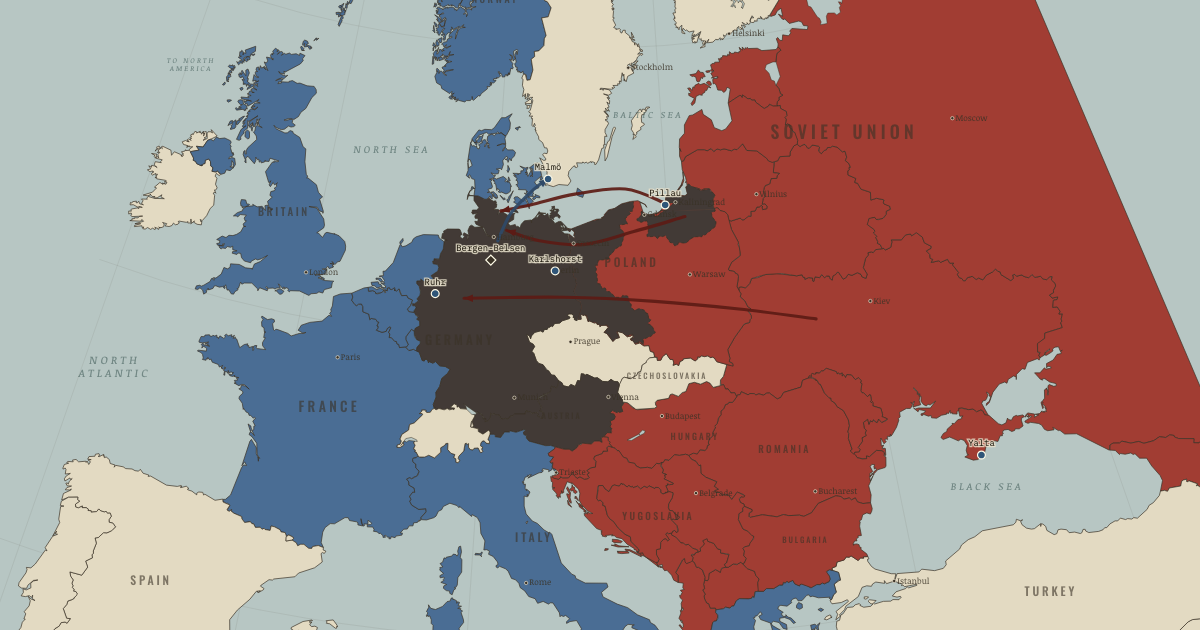
The largest group of uprooted people in May 1945 had been brought into Germany on purpose, which is why the problem the Allies inherited was a product of Nazi policy before it was a product of battle. By August 1944 the labour offices of the Reich, as Nazi Germany called itself, counted about 7.6 million foreign civilian workers and prisoners of war, more than a quarter of everyone working in the German economy, and some 2.8 million of them came from the Soviet Union. Most had been rounded up in occupied Poland, Ukraine and Belarus and set to work in mines, farms and arms factories such as those of the Ruhr, the marker in the west. When Allied armies overran Germany these workers were suddenly free, hungry and far from home. Allied planners grouped them under a new label, “displaced persons” or DPs, meaning civilians outside their own country because of the war, much as an aid agency today separates people stranded abroad from people uprooted inside their own state. The label turned a crime into a logistics problem, and that framing shaped what the Allies did next.
The short answer
- An economy run on foreign labour. Nazi Germany fought its war with workers taken from the countries it occupied. By August 1944 about 7.6 million foreign civilians and prisoners of war worked in the Reich, more than a quarter of its labour force, and most had been brought by force from Poland and the Soviet Union. The arrangement made the DP crisis inevitable, because a defeat would free millions of people hundreds of kilometres from home at once, in a country with no food to spare.
- Nazi population engineering in the East. The regime treated people as movable parts of a racial plan. It expelled about 920,000 Poles from the western Polish lands annexed in 1939 and settled more than 300,000 ethnic Germans from the Baltic states, eastern Poland and Romania in their homes and farms by 1941. Moving peoples to make borders match nations was therefore a Nazi practice before it became an Allied one, and many of the settlers were among the first Germans to flee in 1945.
- The Soviet advance and the ban on evacuation. A ban on evacuation turned the Soviet advance into a disorderly mass flight. When the Red Army broke into East Prussia and Silesia in January 1945, Nazi party chiefs such as Erich Koch had forbidden civilians to leave, calling it defeatism. Evacuation therefore began late, in deep winter, along roads and across a frozen lagoon already under fire. Millions fled in conditions that killed tens of thousands, and whole districts emptied before any Allied decision about borders had been taken.
- Decisions already taken at Yalta. Decisions taken before the war ended set the scale of the displacement that followed it. The Allied leaders met at Yalta in February 1945 and settled two questions that would uproot millions after the fighting stopped. They agreed that Poland’s eastern border would follow roughly the Curzon Line, with compensation in the west, and they signed accords to return each other’s liberated citizens. Both decisions treated people as following borders and nationality, and they turned the end of the war into the start of a second, planned displacement.
THE TURNING POINT
Berlin-Karlshorst, 8 May 1945. The surrender signed in a requisitioned officers’ mess in Karlshorst is the hinge of this chapter because it changed what millions of people were in law and in the eyes of their rulers. Overnight forced labourers, camp survivors and prisoners became “displaced persons”, people whom the victors were obliged to feed and eventually send somewhere, while German refugees became the defeated state’s own problem. From this moment displacement stopped being a by-product of the fighting and became a matter of policy, decided by governments that now controlled every border on the map, and the decisions they made would set the next ten years of movement.
What it changed
Germans next in line. The Germans who had stayed in the eastern territories, and the German minorities of Czechoslovakia and Hungary, became the next population to be moved. Within weeks of the surrender local authorities began driving them out, and in August 1945 the Allies at Potsdam accepted their “transfer” as policy. The next chapter follows the largest forced migration of the post-war period and asks who bears responsibility for it.
Repatriation and the last million. Repatriation succeeded on a huge scale and then stalled. Nearly six million DPs went home by the end of September 1945, but more than a million would not or could not, and Soviet demands for the return of its citizens collided with their refusal. The camps built for weeks of transit became communities that lasted for years, as chapter 4 shows.
Borders that people would follow. The Yalta formula moved Poland’s borders west and assumed that people would follow their nation. That assumption produced the population exchanges between Poland and Soviet Ukraine, Belarus and Lithuania, and similar moves in Finland and Istria. Chapter 3 maps how a line on a conference table became millions of journeys, and how each journey made room for another.
A new relief bureaucracy. UNRRA, created in 1943 to feed liberated Europe, found itself running hundreds of camps under military control. Its successes and failures led directly to the International Refugee Organization in 1947 and the UN High Commissioner for Refugees in 1950, the institutions whose rules later governed the Indochinese crisis. Each new body was given a narrower and more legal task than the last, moving from feeding people to defining who deserved protection.
The full answer, argued
The case for the war is strong for the people already uprooted by May 1945: about 7.6 million forced labourers and prisoners had been brought into the Reich by Nazi policy, and millions of Germans fled the front in the winter of 1945 because of the fighting itself. Yet the peace made decisions that moved even more people. The Yalta border formula, the Potsdam acceptance of “transfers” and the agreements to repatriate Soviet citizens turned displacement into deliberate policy, and the expulsion of Germans alone, at 12 to 14 million people, outnumbered the DPs of 1945. A balanced judgement is that the war created the emergency while the peace chose its scale and shape, since governments now decided who could return, who must leave and who would be counted as a refugee. The transferable insight, which the Indochina chapters confirm, is that the end of fighting rarely ends displacement, because victory hands borders and populations to new rulers with plans of their own.
An interesting fact
The labour that created the DP problem was paid for only fifty-five years later. In August 2000 the German parliament created the foundation Remembrance, Responsibility and Future, funded equally by the federal government and German companies with 10.1 billion marks. Between 2001 and 2007 it paid about 4.4 billion euros to more than 1.6 million surviving forced labourers in nearly a hundred countries, most of them in Poland, Ukraine, Russia and Belarus. Many applicants proved their claims with the identity papers and DP registration cards they had kept since 1945.
This is the study layer of Refugee crisis in Europe after WW2, chapter 1 of Uprooted: Refugees in Europe 1945–1960 and Indochina 1975–1990; the full index of the atlas is here.
Related questions
THE FREE PRINTABLE STUDY GUIDE
Join the Dispatch — a short welcome series, then a letter when a new atlas opens — and the printable study guide for Uprooted is yours now, free.
NO TRACKING · YOUR ADDRESS IS USED FOR THE DISPATCH AND NOTHING ELSE · UNSUBSCRIBE ANYTIME