Refugee crises · 1947
Why did the Allies abandon forced repatriation by 1947?
The seminar question: “Why did the Western Allies abandon forced repatriation by 1947, and what does the change reveal about how refugee protection is created?”
Camps for displaced persons were meant to be waiting rooms for a few weeks but became communities for years. By late September 1945 nearly six million people had left the western zones, and the Soviet Union recovered about 5.35 million citizens, some by force. About a million people were still in the camps in 1947.
Chapter 4 is part of membership. WW2 is free — every chapter. Try chapters 1–2 of any 2 other atlases (3 with a free account). Opening a new atlas uses one of them. Membership opens all 21 — Join.
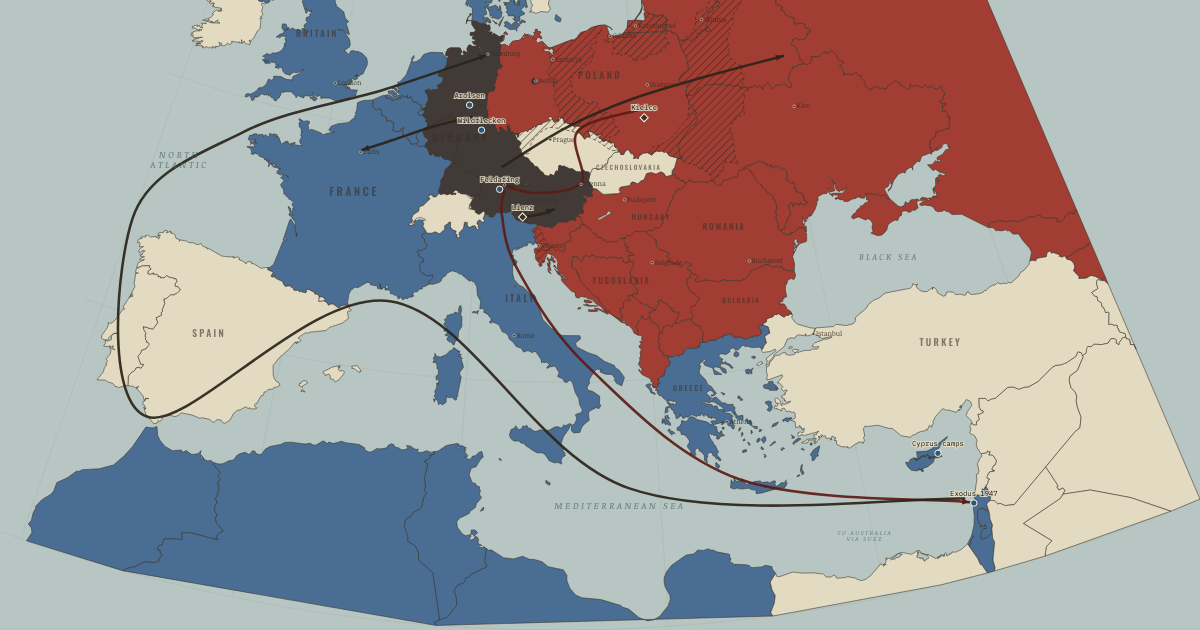
Repatriation, the return of people to their country of citizenship, was the Allies’ answer to displacement, and for most displaced persons (DPs), the civilians stranded abroad by the war, it worked quickly. French, Belgian and Dutch workers went home within weeks, and by the end of September 1945 nearly six million people had left the western zones. The Soviet case was different, because the Yalta accords of February 1945, signed at the Allied summit in the Crimea, bound Britain and the United States to return Soviet citizens and Stalin treated anyone who had lived under German rule as suspect. At Lienz on 1 June 1945 British troops forced Cossacks, Russian frontier horsemen who had fought for Germany, and their families onto lorries for handover to the Soviets, and at Dachau in January 1946 eleven of 399 former Soviet soldiers killed themselves rather than board a train. Such scenes pushed Western governments to narrow and then abandon forced return, and the right not to be sent back began as a lesson learned in these camps.
The short answer
- Yalta’s promise of return. The Allies had agreed at Yalta to return each other’s citizens, and repatriation was the simplest way to empty Germany of millions of foreigners it could not feed. The policy succeeded for most western Europeans but bound the British and Americans to hand over Soviet citizens whatever their wishes. The coercion it required discredited forced return in Western eyes and turned refusal into a recognised category.
- Soviet rule over the DPs’ homes. Many of the remaining DPs came from eastern Poland, the Baltic states and western Ukraine, lands the Soviet Union had annexed in 1939–40 and kept in 1945. For them going home meant becoming Soviet citizens under a regime that had deported their neighbours in 1940–41. Their refusal was rational, and it meant that the post-war border changes of chapter 3 were also the root of the “last million”.
- The Holocaust and post-war antisemitism. Jewish survivors found no future in post-war Poland. Some three million Polish Jews had been murdered in the Holocaust, and those who returned found strangers in their homes and hostility in their towns. The Kielce pogrom of July 1946, a mob attack in which at least 42 Jews were killed, convinced many that there was no future for them in Poland. Flight to the American zone was a choice to wait for a new home in Palestine or overseas, and the camps filled again a year after the war.
- Britain’s limits on Palestine. British limits on entry to Palestine turned survivors into clandestine migrants. Britain’s White Paper of 1939 had capped Jewish immigration to Palestine at 75,000 over five years, and after the war London allowed only about 1,500 certificates a month to avoid inflaming Arab opinion. The gap between the number of survivors who wanted to go and the number allowed in created the illegal immigration of 1945–48, the interceptions at sea and the camps on Cyprus.
THE TURNING POINT
The Harrison Report, August 1945. Earl Harrison’s report is the hinge because it changed the basis on which help was given. Until August 1945 DPs were sorted by nationality, so a Polish Jew shared a camp with Polish Catholics, some of them hostile, and was expected to go home to Poland. Harrison argued that Jews must be recognised by what had been done to them, and Truman ordered Eisenhower to act; Feldafing, opened as an all-Jewish camp in May 1945, became the model for separate camps across the zone. Defining a group by its persecution was the idea that the 1951 Refugee Convention would later make universal, so a report about one group in one zone anticipated the core of modern refugee law.
What it changed
Survivors to Israel. The founding of Israel emptied the Jewish camps. When the British Mandate ended in May 1948, the new State of Israel opened its doors to the Jewish DPs, and most of the camp population left within three years; the International Refugee Organization alone helped about 132,000 to go. The same war displaced about 700,000 to 750,000 Palestinians, a parallel exodus that chapter 5 places within the limits of the new refugee regime.
From UNRRA to the IRO. UNRRA, dominated by American funding and criticised in Washington for helping repatriation to communist states, was wound up and replaced in 1947 by the International Refugee Organization, which the Soviet bloc refused to join. The new body’s main task was resettlement abroad, a change in purpose that the Cold War made possible and that chapter 5 follows. Relief had assumed that displacement was temporary; resettlement accepted that for many people it was permanent.
The right not to be returned. Western refusal to continue forced repatriation became the principle written into Article 33 of the 1951 Convention: no state may return a refugee to a territory where their life or freedom would be threatened. The experience of Lienz and Dachau sits behind that clause, which governs every case in this atlas. It protects people from return to danger, yet it says nothing about who must let them in, a gap that Southeast Asia would expose.
An echo in Hong Kong. Forty-four years after Lienz, Hong Kong put screened-out Vietnamese on a dawn flight to Hanoi, and the same arguments about consent, persecution and the duty of host states returned. Chapter 11 shows how the principle born in the DP camps was tested when the people returning were judged to be migrants instead of refugees. The comparison shows that the principle survived, while the definition of who it protected narrowed.
The full answer, argued
Moral revulsion mattered: soldiers at Lienz, Dachau and Plattling saw people kill themselves rather than return, and officers and chaplains protested through their own chain of command. Information mattered too, as reports of executions and the Gulag reached the West. Yet strategy explains the timing, because by 1946–47 the wartime alliance was collapsing and people fleeing Soviet rule began to look like evidence for the Western case in the Cold War. Lobbying by DP communities and their diasporas in America added political weight. The best answer therefore weighs principle against interest and concludes that protection grew where the two met, since neither revulsion alone in 1945 nor strategy alone would have overturned a signed agreement so quickly. The transferable insight is that refugee rights are rarely created by law alone: they emerge when a humanitarian scandal coincides with a political interest, and they weaken when the interest fades, as the screening and return of Vietnamese in the late 1980s would show.
An interesting fact
Wildflecken produced one of the best-known books of the 1950s. Kathryn Hulme, an American who helped run the camp for UNRRA, described it in The Wild Place (1953), which won the Atlantic non-fiction prize. There she befriended a Belgian nurse, Marie Louise Habets, who had left a convent during the war, and Hulme turned Habets’s life into the novel The Nun’s Story (1956). The book became the 1959 film starring Audrey Hepburn, so millions of cinema-goers met a story that had begun among Polish DPs in a Bavarian army camp.
This is the study layer of Displaced persons camps after WW2, chapter 4 of Uprooted: Refugees in Europe 1945–1960 and Indochina 1975–1990; the full index of the atlas is here.
Related questions
THE FREE PRINTABLE STUDY GUIDE
Join the Dispatch — a short welcome series, then a letter when a new atlas opens — and the printable study guide for Uprooted is yours now, free.
NO TRACKING · YOUR ADDRESS IS USED FOR THE DISPATCH AND NOTHING ELSE · UNSUBSCRIBE ANYTIME