Refugee crises · 1945
Were the Allies responsible for the expulsion of Germans?
The seminar question: “How far should the Allied powers share responsibility for the expulsion of Germans with the governments that carried it out?”
Between 12 and 14 million Germans fled or were driven out of the lands east of the Oder and Neisse and from Czechoslovakia, Hungary and other states after 1945. At Potsdam in August 1945 the Allies accepted this ‘transfer’, asking that it be orderly and humane, but the expulsions had begun before any agreement and were neither.
WW2 is free — every chapter. Try chapters 1–2 of any 2 other atlases (3 with a free account). Opening a new atlas uses one of them. Membership opens all 21 — Join.
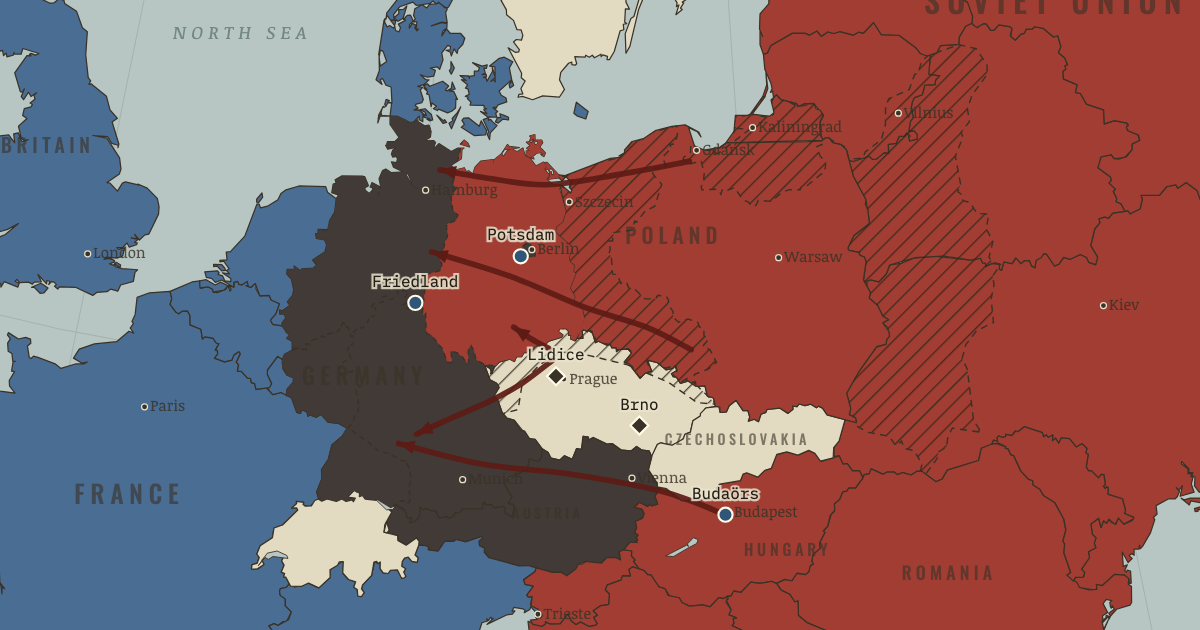
The Allies accepted mass expulsion because they had drawn a single lesson from the 1930s, which was that national minorities gave aggressors their pretext. Hitler had used the Sudeten Germans, the German-speaking minority along Czechoslovakia’s borders, to break the country in 1938 and the German minority in Poland to justify war in 1939, so Czech and Polish exiles in London argued from 1942 onwards that only removal would make their states safe. Winston Churchill agreed in the House of Commons in December 1944, telling members that expulsion was the most “satisfactory and lasting” method and that “a clean sweep will be made”. Planners pointed to the 1923 Treaty of Lausanne, under which about 1.2 million Orthodox Christians left Turkey and about 400,000 Muslims left Greece, as proof that a population exchange, the compulsory swap of minorities between states, rather like a land swap applied to people, could bring peace. Transfer therefore looked to its sponsors like prevention, and its humanity was assumed in advance.
The short answer
- The lesson drawn from Munich. Mixed borderlands looked like the cause of the last war. In 1938 Hitler used the grievances of the three million Sudeten Germans to dismember Czechoslovakia, and in 1939 he invoked the German minority in Poland to justify invasion. To Czech and Polish leaders, and soon to the British, the conclusion was that mixed borderlands invited the next war. Removing the minority looked like a permanent cure, and that reasoning turned an act of retribution into a security policy that the great powers could endorse.
- Six years of occupation. The memory of occupation made collective guilt seem plausible to Poles and Czechs in 1945, even though individual Germans had acted in very different ways. German rule in Poland and Bohemia killed about six million Polish citizens, half of them Jews, destroyed villages such as Lidice in reprisal and planned to deport or eliminate Slavic populations. Many local Germans had served the occupation, and in 1935 about two-thirds of Sudeten German voters had backed Konrad Henlein’s pro-Nazi party, so many Poles and Czechs came to see the whole minority as the occupiers’ partners.
- Poland moved west. Once the Allies at Yalta gave Poland’s eastern provinces to the Soviet Union, Poland needed land for its people and compensation for its losses. At Potsdam the Oder–Neisse lands were placed under Polish administration “pending the final determination” of the border, and Warsaw set out to make that provisional line permanent by filling it with Poles and emptying it of Germans. The expulsion was thus also a consequence of Poland’s own uprooting in the east.
- Allied consent and the Lausanne precedent. Great-power consent made expulsion look respectable. Churchill told the House of Commons in December 1944 that expulsion was the most “satisfactory and lasting” method, and Allied planners cited the Greek–Turkish exchange of 1923, which moved about 1.6 million people, as a model that had brought peace. Great-power consent gave Polish and Czechoslovak governments international cover, and the expectation that transfer could be managed humanely made it easier for London and Washington to approve.
THE TURNING POINT
Potsdam, Section XIII, 2 August 1945. Section XIII of the Potsdam agreement is the hinge because it converted local, often violent expulsions into an internationally recognised policy. Three powers stated that the transfer of Germans from Poland, Czechoslovakia and Hungary “will have to be undertaken”, and with that sentence the question changed from whether Germans would leave to how and when. The request for orderly and humane conduct had almost no means of enforcement, while the acceptance of transfer had every means, since the occupying armies controlled the receiving zones. The rest of the expulsion was administration, and administration on that scale was always going to be counted in millions.
What it changed
A sixth of West Germany. The expellees became a sixth of West Germany’s people. The census of September 1950 counted 7.9 million of them, 16.5 percent of its population, crowded at first into rural Bavaria, Lower Saxony and Schleswig-Holstein. Their integration through housing programmes, the Equalisation of Burdens law of 1952 and the post-war boom became one of the Federal Republic’s founding achievements, the subject of chapter 6. The expellees also became voters with their own party and lobby, which kept the lost east alive in West German politics for a generation.
Room for Poles from the east. The emptied towns of Silesia and Pomerania were refilled by Poles from central Poland and by Poles leaving the eastern provinces that the Soviet Union had annexed. Breslau became Wrocław within three years. The settlers arrived in houses with German furniture still inside, and many lived for years expecting to be moved again. Chapter 3 follows this second chain of movement, which shows that one expulsion made room for another.
Outside the refugee regime. Because expellees arriving in Germany held German citizenship, the international agencies treated them as Germany’s own responsibility, and the 1951 Refugee Convention excluded people who enjoyed the rights of nationals in their country of residence. The largest displaced population of post-war Europe was thus never a “refugee” in international law, a fact chapter 5 explains. Their absence from the law shows that the refugee regime was built around people who had lost the protection of a state, and Germany had to protect its own.
A memory still contested. Expellee associations became a lobby in West German politics, and the question of whether to remember German suffering without diminishing German guilt shaped relations with Poland and the Czech Republic for decades. The border treaty of 1990 and the Berlin documentation centre that opened in 2021 are the epilogue’s markers of that argument. Each step toward reconciliation required Germans to hold their own losses and their own responsibility in view at the same time.
The full answer, argued
The case for shared responsibility rests on Potsdam: Britain, the United States and the Soviet Union stated that the transfer “will have to be undertaken”, the Allied Control Council fixed quotas for 6.65 million people, and Churchill had endorsed a “clean sweep” months before. Without that consent Poland and Czechoslovakia could hardly have expelled millions into zones the Allies controlled. On the other side, the wild expulsions of 1945 began before Potsdam on the initiative of national authorities, decrees such as Czechoslovakia’s citizenship law of August 1945 were national choices, and the Allies did ask for a pause that was ignored. A judgement in the spirit of R. M. Douglas would say that responsibility was shared but unequal in kind: the Allies legitimised and organised, while national governments initiated and executed. The deeper insight is that international consent can turn ethnic cleansing into policy, a pattern worth testing against the Geneva bargains of chapter 10.
An interesting fact
Bavaria received more Sudeten Germans than any other part of Germany, and in 1954 the Bavarian state government formally declared itself the patron of the Sudeten German community. Bavarian politicians still describe the Sudeten Germans as the state’s “fourth tribe”, alongside the Old Bavarians, Franconians and Swabians, and the Sudeten German Day held every Whitsun remains a fixture of Bavarian political life. Towns such as Neugablonz, built on the site of a wartime explosives works near Kaufbeuren, were founded by expellees from Gablonz (Jablonec nad Nisou), who rebuilt their glass and costume-jewellery trade there.
This is the study layer of Expulsion of Germans after WW2, chapter 2 of Uprooted: Refugees in Europe 1945–1960 and Indochina 1975–1990; the full index of the atlas is here.
Related questions
THE FREE PRINTABLE STUDY GUIDE
Join the Dispatch — a short welcome series, then a letter when a new atlas opens — and the printable study guide for Uprooted is yours now, free.
NO TRACKING · YOUR ADDRESS IS USED FOR THE DISPATCH AND NOTHING ELSE · UNSUBSCRIBE ANYTIME