Norse and Aztecs · 1515
How far did chinampas make Tenochtitlan possible?
The seminar question: “How far did the chinampas, as opposed to tribute and trade, make Tenochtitlan possible?”
Chinampas were raised fields built in the shallow fresh lakes of Xochimilco and Chalco from mud and plants anchored by willows, where water softened frost. With a market and imperial tribute, they helped feed Tenochtitlan’s perhaps 200,000 people after the Triple Alliance took Xochimilco around 1430 and Chalco by about 1465.
Chapter 9 is part of membership. WW2 is free — every chapter. Try chapters 1–2 of any 2 other atlases (3 with a free account). Opening a new atlas uses one of them. Membership opens all 21 — Join.
Free printable Norse and Aztecs study guide, sent by email ↓
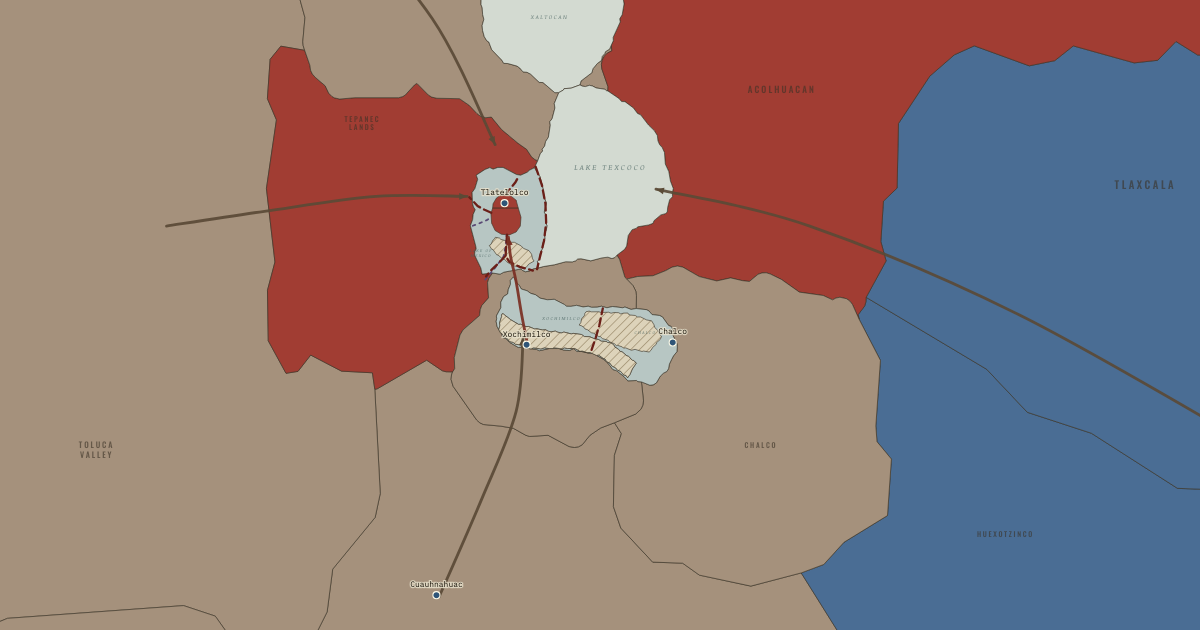
The chinampa, a raised field built up from the lake bed like a garden bed standing in water, was an innovation in soil and water management, refined over centuries before the Mexica took control of it. Farmers dug canals by hand in the shallow southern lakes and piled the mud and plant matter into long rectangular beds, held in place by stakes and by willows called ahuejotes whose roots bound the edges. Seedlings were raised in nurseries of mud cut into small blocks and then transplanted, so a field could grow several crops a year. Studies summarised by José Luis de Rojas and Juan José Batalla estimate maize yields of about 3,000 kilograms per hectare on chinampas, against 1,000–1,400 on ordinary fields. The water also moderated temperatures, reducing the risk of frost that threatened rain-fed maize, so the chinampa answered the basin’s chief climatic hazard directly.
The short answer
- Frost and unreliable rain threatened ordinary fields. At over 2,200 metres, rain-fed maize risked early frost in September and depended on summer rains that could fail, as they did in 1452–54. Chinampas avoided both dangers, since water seeped up from below and the lake moderated the night-time cold. The technique was therefore an adaptation to the basin’s particular climate, turning the lake’s shallow margins into the safest farmland available, much as irrigation protects modern farmers against a dry season.
- The dike freshened water for new fields. Chinampas need fresh water, because salt kills crops, so they flourished in the spring-fed southern lakes and could spread around Tenochtitlan only after Nezahualcoyotl’s dike separated the western lagoon from salty Lake Texcoco around 1449. On the map, chinampa fields appear in the lagoon south of the city by 1469. Hydraulic engineering and farming innovation reinforced each other, since each made the other more valuable. The chinampa boom of the later fifteenth century was therefore a by-product of flood control.
- Conquest gave the state control of the best water. Control of the freshwater lake towns tied farming to conquest. The alliance conquered Xochimilco and the lake towns around 1430 and the Chalco confederation by about 1465, after decades of war. Control of these towns gave the Mexica state access to the largest freshwater farming zones in the basin and the labour of the people who worked them, so that agricultural expansion followed military victory. Imperial power and chinampa farming grew together, each paying for the expansion of the other.
- A growing city needed food on a scale no island could supply. Tenochtitlan’s population grew from a few thousand in the 1300s to perhaps 150,000–200,000 or more by 1519, crowded onto about 13.5 square kilometres of island. Even the most intensive farming in the lake could not feed such numbers, so the city drew on markets and tribute from far beyond the basin. Growth itself drove the search for new sources of food, which pulled the empire outward toward the warm, wet lowlands of the Gulf coast.
THE TURNING POINT
The conquest of Xochimilco, c. 1430. The alliance’s conquest of Xochimilco and the neighbouring lake towns soon after 1428 is the hinge of this chapter because it put the basin’s most productive farmland under the control of the state that most needed it. Chinampas had been built by local communities for generations, but now a powerful centre could direct labour, expand the fields and take their produce as tribute. That combination of an old technique with new political power created the food supply that allowed Tenochtitlan to grow into one of the largest cities in the world.
What it changed
One of the world’s largest cities. The food system made possible one of the largest cities on earth, since by 1519 Tenochtitlan and Tlatelolco together probably held 150,000–200,000 people or more, larger than any city in Spain at the time. The scale astonished the Spaniards who arrived in November 1519, and Chapter 10 shows how its planners organised such numbers on an island, with water, streets, canals and waste all managed together as a single system.
A food supply tied to empire. Because the city depended on tribute and trade from distant provinces, any disruption of the empire threatened its food. Provinces that resented tribute could rebel, and enemies could cut supply routes. In 1521 the alliance’s former subjects joined the Spaniards and blockaded the lake, so the dependence that had fed the city became a weapon against it, as Chapter 11 explains.
A technique that outlived the empire. The chinampas of Xochimilco survived the conquest and are still farmed in parts of southern Mexico City today, where they form part of a UNESCO World Heritage site and supply vegetables and flowers. The longevity of the technique contrasts with the fall of the empire that expanded it, a pattern the epilogue explores, in which a farming technique outlasts the state that once commanded it.
The full answer, argued
The chinampas were essential but not sufficient, and the evidence supports a balanced answer. Their high, frost-protected yields, perhaps three times those of rain-fed fields, and the expansion of the southern chinampa zone after the conquests of Xochimilco and Chalco, gave the city a reliable food supply close to home that could be delivered fresh by canoe. Jeffrey Parsons estimated that they could feed perhaps 100,000 people or more. Yet most estimates put the city at 150,000–200,000 or higher, so a large share of its food must have come through the Tlatelolco market and from tribute, including grain bins, beans and cotton from distant provinces. Uncertainty about chinampa area, city size and tribute volumes means that precise shares cannot be calculated. The transferable insight is that great cities rest on several food systems at once, and their resilience depends on how many of those systems can fail before the city goes hungry.
An interesting fact
Mexica money could be forged, even though it grew on trees. Cacao beans were used as small change in the markets of the basin, and the Florentine Codex, compiled under the friar Bernardino de Sahagún in the sixteenth century, describes dishonest cacao sellers who removed the contents of the beans and filled the empty shells with earth or other material so that they passed for good money. Counterfeiting coins is usually associated with metal currency, yet the Mexica faced the same problem with beans, which shows that cacao functioned as real money worth cheating with.
This is the study layer of Aztec chinampas, chapter 9 of Climate and Innovation: The Norse and the Aztecs, c. 790–1521; the full index of the atlas is here.
Related questions
THE FREE PRINTABLE STUDY GUIDE
Join the Dispatch — a short welcome series, then a letter when a new atlas opens — and the printable study guide for Climate and Innovation is yours now, free.
NO TRACKING · YOUR ADDRESS IS USED FOR THE DISPATCH AND NOTHING ELSE · UNSUBSCRIBE ANYTIME