Refugee crises · 1979
Did the 1979 Geneva meeting solve the boat-people crisis?
The seminar question: “How far did the Geneva meeting of July 1979 solve the boat-people crisis?”
At the UN’s call, 65 governments met in Geneva on 20–21 July 1979 and raised resettlement pledges from about 125,000 to 260,000 places. Southeast Asian states agreed to let boats land, Vietnam promised to curb illegal departures, and the Orderly Departure Program flew about 620,000 approved emigrants out of Vietnam by 1997.
Chapter 10 is part of membership. WW2 is free — every chapter. Try chapters 1–2 of any 2 other atlases (3 with a free account). Opening a new atlas uses one of them. Membership opens all 21 — Join.
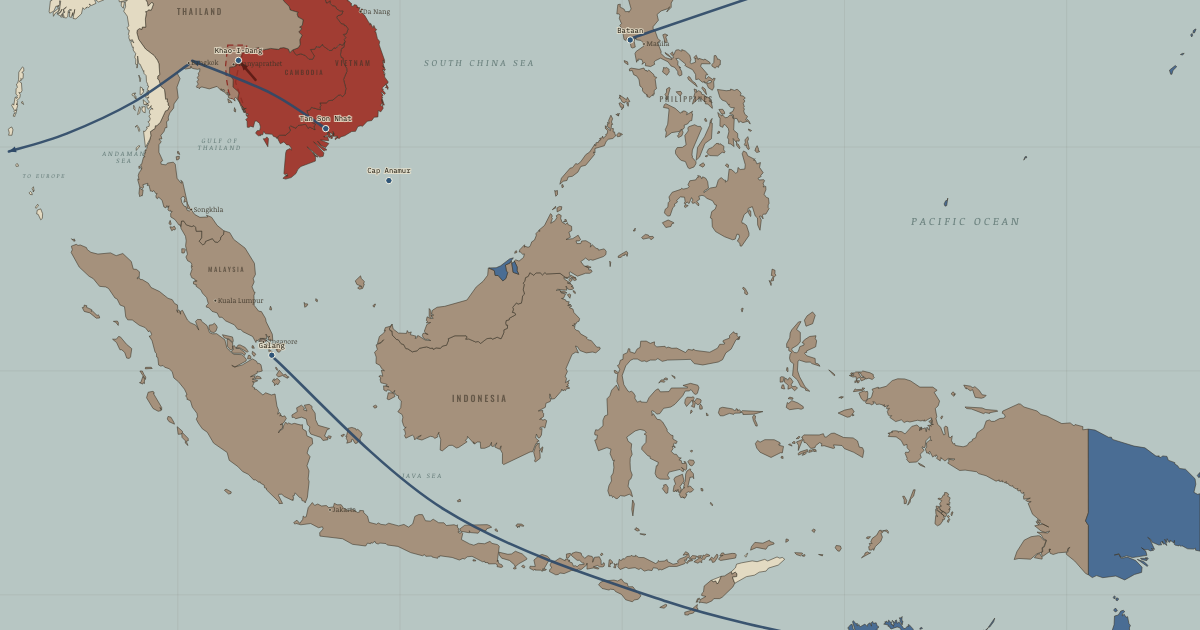
The Geneva meeting of July 1979, a UN conference, worked because each side got something it needed. The states where boats first landed received a promise that refugees would not stay, the West an end to images of boats towed out to sea, and Vietnam received relief from international condemnation in return for promising to “make every effort to halt illegal departures”. Monthly resettlement, the permanent admission of refugees to third countries, rose from about 9,000 before the meeting to about 25,000 after it, while arrivals fell sharply as Vietnamese police stopped boats leaving. The Orderly Departure Program, set up by a memorandum between Vietnam and UNHCR, the UN’s refugee agency, on 30 May 1979, offered a legal alternative: approved emigrants, often relatives of earlier refugees, were flown out from Tan Son Nhat airport near Saigon. It moved about 620,000 people by 1997, most to the United States. Critics noted the price of the bargain, since curbing departures meant that a state was preventing its own citizens from fleeing.
The short answer
- The threat at the shoreline. The push-backs of June 1979 and the ASEAN declaration that no new arrivals would be accepted made the cost of inaction visible: boats would sink with people the West had promised to help. First-asylum states had used their one source of leverage, the power to refuse, and Western governments could no longer delay. The Geneva meeting was called within weeks because the alternative was mass death at sea.
- Debts of a lost war. For the United States, and to a lesser extent France and Australia, the refugees were former allies, employees and their families. American leaders spoke of a moral obligation, and the large Vietnamese community created after 1975 lobbied for relatives. Cold War politics added a further motive, since people fleeing a communist state confirmed the West’s judgement of it. Duty and interest pointed the same way.
- Public pressure in the West. Television pictures of overcrowded boats and reports of piracy moved Western publics. In France, intellectuals of left and right joined the campaign “A Boat for Vietnam”, and in West Germany a citizens’ committee chartered the Cap Anamur to rescue people at sea. Public sympathy gave governments the political room to raise their quotas, much as it had for Hungarians in 1956.
- Hanoi’s interest in a deal. Vietnam was isolated after its invasion of Cambodia and its war with China, and its economy depended on aid. Condemnation at Geneva threatened what little support it had, while orderly departure let it control who left and keep the remittances that relatives abroad would send. Agreeing to curb departures cost Hanoi little and earned it a place inside the international arrangement.
THE TURNING POINT
Geneva, 20–21 July 1979, and the camp at Galang. The Geneva meeting is the hinge of this chapter, and Galang shows it on the map. Before Geneva, refugees landing in Indonesia waited in makeshift camps with no guarantee of moving on; after it, Indonesia gave an island south of Singapore to a processing centre where people were registered, interviewed by resettlement officers and prepared for new countries. The camp embodied the bargain: asylum in the region was temporary, and the West had promised to make it so. It reopened the shores within weeks, and it also made first asylum conditional on resettlement, a condition that would be tested once Western generosity ran out.
What it changed
Leaving by aeroplane. Orderly departure turned part of the exodus into regulated emigration. The programme grew from a trickle in 1980 to its peak of about 86,000 departures in 1991, carrying relatives of earlier refugees, former re-education prisoners and Amerasian children. It showed that a refugee crisis could be partly turned into regulated emigration, a lesson the 1989 plan of action repeated, as chapter 11 shows. For families it often meant years of paperwork, interviews and bribes before the flight.
A refugee law for the United States. The Refugee Act of 1980 remains the basis of American refugee admissions. Its adoption of the Convention definition linked the United States to the international regime it had refused to sign in 1951, a link that the epilogue uses to compare how the two crises changed refugee law. Europe’s crisis had produced the Convention; Indochina’s brought its largest resettlement country under it.
Processing centres become a system. Galang, Bataan and Phanat Nikhom became long-term institutions, with schools, clinics and courses in the languages of the resettlement countries. They also became places where people waited for years when their cases were refused, a problem that grew in the 1980s and that the screening of chapter 11 tried to solve. A camp built for transit became, for the refused, a place of indefinite detention.
The border camps endure. Hundreds of thousands of Cambodians stayed in camps along the Thai border, governed partly by resistance factions and supplied by the United Nations Border Relief Operation from 1982. Their decade of waiting, and their return home in 1992–93, is part of chapter 11’s story of camps without exits. Their fate depended on a peace settlement for Cambodia, which took twelve years to arrive.
The full answer, argued
In the short term it succeeded on its own terms: the shores reopened, resettlement rose to about 25,000 a month, arrivals fell from over 50,000 a month to under 10,000, and the Orderly Departure Program began to offer a safe alternative to the sea. Yet much of the fall came from Vietnam’s police stopping boats, which protected lives at sea by restricting the right to flee, and the deal did nothing for the Cambodians at the Thai border. It also rested on a promise that resettlement countries would keep taking everyone who arrived, a promise that weakened as the 1980s went on and as later arrivals were seen as economic migrants. A fair judgement is that Geneva managed the emergency without settling the problem, buying a decade of order at the cost of making asylum conditional. The insight for the comparison with Europe is that burden-sharing works when the burden looks finite, as Hungary’s did in 1956, and falters when it seems endless.
An interesting fact
The boat people brought two old enemies together. Jean-Paul Sartre and Raymond Aron, friends as students at the École normale supérieure in the 1920s, had been bitter political opponents for three decades when they appeared side by side at a Paris press conference on 20 June 1979 to support the campaign “A Boat for Vietnam”, which chartered the hospital ship Île de Lumière. Photographers captured them shaking hands, and on 26 June the two went to the Élysée Palace together to ask President Valéry Giscard d’Estaing to admit more refugees. A quarrel inside Médecins Sans Frontières over the ship led Bernard Kouchner to leave and found Médecins du Monde in 1980.
This is the study layer of 1979 Geneva conference on refugees, chapter 10 of Uprooted: Refugees in Europe 1945–1960 and Indochina 1975–1990; the full index of the atlas is here.
Related questions
THE FREE PRINTABLE STUDY GUIDE
Join the Dispatch — a short welcome series, then a letter when a new atlas opens — and the printable study guide for Uprooted is yours now, free.
NO TRACKING · YOUR ADDRESS IS USED FOR THE DISPATCH AND NOTHING ELSE · UNSUBSCRIBE ANYTIME