Mao’s China · 1976
Should Mao be judged by what he built or what it cost?
The seminar question: “Should Mao’s rule be judged chiefly by what it built or by what it cost?”
Mao died in 1976 after twenty-seven years in which his party-state reached every village, unified China and raised life expectancy, but also produced the famine and the Cultural Revolution. Estimated deaths from his campaigns and the famine range from about 17 to 50 million; the Gang of Four fell on 6 October 1976.
Chapter 12 is part of membership. WW2 is free — every chapter. Try chapters 1–2 of any 2 other atlases (3 with a free account). Opening a new atlas uses one of them. Membership opens all 21 — Join.
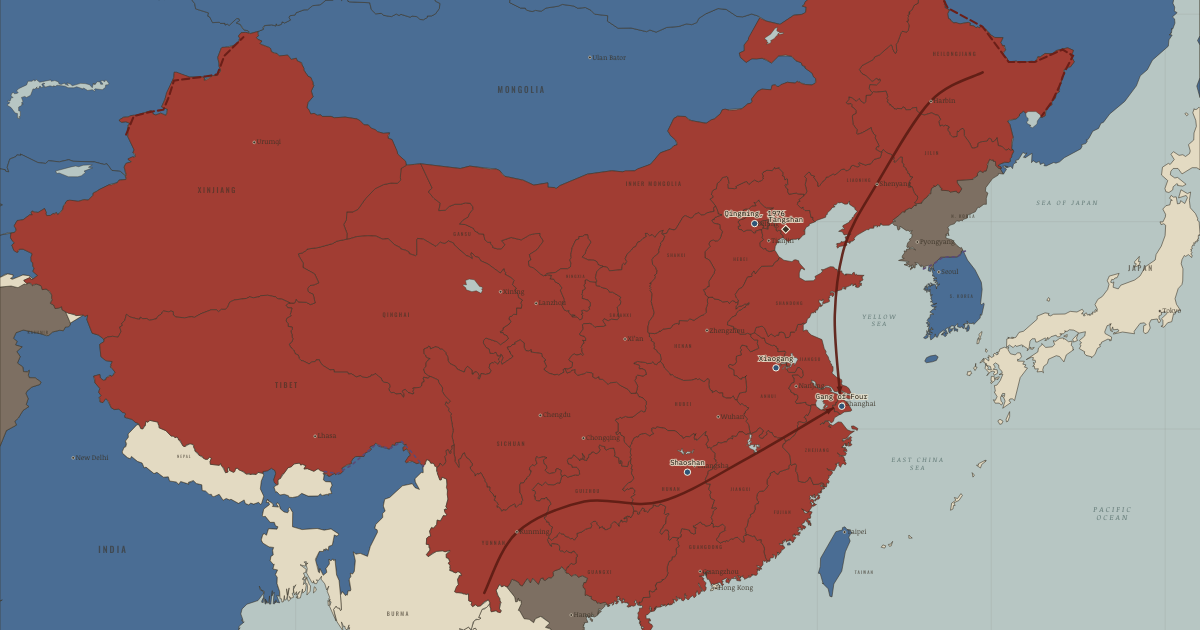
The answer to this atlas’s question is that Mao’s party-state reached every village through the Party’s local organisation, the campaigns and an army loyal to the leader. The same machinery unified China and raised life expectancy, and it also produced the famine and the Cultural Revolution, Mao’s assault on his own party from 1966, because nothing inside it could stop a mistake made at the top. A party-state is one in which a single party controls the government at every level, much like a company whose owner appoints every manager, and the campaigns were bursts of mass mobilisation that made citizens accuse and police one another. The chart below counts their cost: one to two million dead in land reform, roughly 700,000 to two million in the campaign against counter-revolutionaries, 15 to 45 million in the famine, and roughly 750,000 to two million in the Cultural Revolution. Altogether somewhere between about 17 million and 50 million people died, and every figure is a range because the regime never fully counted its victims.
The short answer
- A succession Mao never settled. Mao had destroyed two chosen successors, Liu Shaoqi and Lin Biao, and in his last years he balanced radicals against veterans without letting either win. He chose Hua Guofeng in 1976 because Hua belonged to neither camp. When Mao died, no institution had the authority to decide between the factions, so the succession was decided by whoever controlled the guards and the army. A regime that had no rule for passing power on had to settle the question by force.
- Zhou Enlai’s death and popular anger. Zhou Enlai had become a symbol of moderation and competence, and the radicals’ attempts to limit public mourning for him in January 1976 angered millions. At the Qingming festival in April, wreaths and poems in Tiananmen Square attacked Jiang Qing and praised Zhou and Deng. The protest showed that many people blamed the radicals for a decade of chaos and wanted it to end. Mourning a dead leader was one of the few forms of political expression the system could not easily forbid.
- Veterans who had survived the purges. Many of the officials purged in 1966–68 had returned to work after Lin Biao’s fall, among them Deng Xiaoping, while army elders such as Marshal Ye Jianying, sidelined since 1967, regained influence. They distrusted the radicals, controlled much of the army, and were ready to act once Mao was gone. In 1975 Deng had already shown, in the railways, the steel industry and the army, what restoring order would look like. Their return made a different future possible.
- Exhaustion after a decade of campaigns. A decade of campaigns had worn out the society that was supposed to sustain them. By 1976 output was falling, the universities barely functioned, and the sent-down youth wanted to go home, while the campaigns of the 1970s, such as “Criticise Lin Biao, Criticise Confucius”, mobilised little enthusiasm. A society tired of struggle meetings, the public denunciations that every campaign used, gave the post-Mao leaders broad support when they ended them. Even inside the Party, many officials had been both perpetrators and victims of the campaigns, and they wanted security more than revolution.
THE TURNING POINT
6 October 1976. The arrest of the Gang of Four is the hinge because it ended the Maoist project without a mass movement and without a shot. Hua Guofeng, Ye Jianying and Wang Dongxing used the leadership’s guard unit to detain the radicals at a Politburo meeting, and the radicals’ base in Shanghai stood down within days. The coup opened the way for Deng Xiaoping’s return and the reforms of 1978. It also showed that power in Mao’s system had always rested on the army and the security forces, whatever the language of mass revolution claimed.
What it changed
The communes dismantled. Mao’s successors undid his central rural institution within six years. From 1978, beginning with secret contracts such as Xiaogang’s, households took responsibility for farming plots again, and by 1984 the communes had been abolished. Grain output rose sharply once households could keep what they grew above the quota, and rural incomes rose faster in the early 1980s than in any period of the Mao years. The Party had rediscovered the household farming that Mao rejected in 1962, and the reforms began in the province where the famine had been worst.
Verdicts reversed. The new leaders cleared many of Mao’s victims, selectively. The “rightists” labelled in 1957 were rehabilitated from 1978, Liu Shaoqi was posthumously cleared in 1980, and the Gang of Four were tried on television in 1980–81, with Jiang Qing sentenced to death, commuted to life imprisonment. The famine’s victims received no such public acknowledgement, and its archives remain restricted. The post-Mao state chose which of the era’s victims it could afford to remember.
A generation comes home. The return of the sent-down youth, the urban young sent to villages after 1968, created a labour problem that helped open the door to private business. Most of those still in the countryside, close to nine million at the end of 1977, came back between 1978 and 1980, and the cities could not employ them all, so the state allowed small private shops and stalls, the first private enterprise since the 1950s. Others passed the restored university examination of 1977 and joined the professions, so the returning generation supplied both the first private traders and the first graduates of the reform era.
Mao still on the gate. The state still honours Mao in its most visible places. His portrait hangs above Tiananmen, his face is on every regular banknote issued since 1999, and his body lies in a mausoleum on the square, while Shaoshan, his birthplace, receives millions of visitors a year. His legacy is official, contested and selective, which is why the history mapped here is still argued over inside and outside China.
The full answer, argued
The case for judging by achievement rests on real evidence: a unified country after a century of division, heavy industry and nuclear weapons, life expectancy that rose by roughly twenty-five years, widespread literacy, and a state strong enough to support the growth that followed after 1978. The case for judging by cost is overwhelming in scale, since the campaigns and the famine killed somewhere between about 17 million and 50 million people, most of them in a famine caused by policy, and persecuted tens of millions more. Historians such as Dikötter and Chang and Halliday put the cost first; Meisner and Short weigh the achievements more heavily; Walder’s analysis of the party-state, and Drèze and Sen’s comparison with India, both point to the same system as the source of the gains and the deaths. That last point changes the question, because the achievements and the deaths were two products of one system, which means that neither can be offered as the price of the other. Many later achievements, from rural health to industry, were also attained elsewhere without famine. The most defensible judgement is that the regime’s capacity was real and its lack of accountability made that capacity lethal, and the general lesson for students of authoritarian rule is that power without correction magnifies both success and error.
An interesting fact
The portrait of Mao above the Gate of Heavenly Peace is about six metres high and weighs around one and a half tonnes, and it is replaced with a freshly painted copy every year before National Day on 1 October. Since 1977 the copies have been painted by the artist Ge Xiaoguang. In 1980, when the reformers were reconsidering Mao’s record, the Italian journalist Oriana Fallaci asked Deng Xiaoping whether the portrait would stay. Deng answered that it would be kept there forever, because Mao had been a founder of the Party and the state, and his mistakes did not cancel that.
This is the study layer of Death and legacy of Mao Zedong, chapter 12 of The People’s Republic under Mao, 1949–1976; the full index of the atlas is here.
Related questions
THE FREE PRINTABLE STUDY GUIDE
Join the Dispatch — a short welcome series, then a letter when a new atlas opens — and the printable study guide for The People’s Republic under Mao is yours now, free.
NO TRACKING · YOUR ADDRESS IS USED FOR THE DISPATCH AND NOTHING ELSE · UNSUBSCRIBE ANYTIME