Refugee crises · 1978
Did economics or ethnic persecution drive the Hoa exodus?
The seminar question: “To what extent was the exodus of the Hoa caused by economic policy rather than ethnic persecution?”
After 1975 Vietnam sent hundreds of thousands of former officers and officials to ‘re-education’ camps without trial and moved city dwellers to New Economic Zones. In March 1978 it abolished private trade, hitting hardest the Hoa, Vietnam’s roughly 1.3 million ethnic Chinese, many of them traders in Saigon’s Cholon district.
Chapter 8 is part of membership. WW2 is free — every chapter. Try chapters 1–2 of any 2 other atlases (3 with a free account). Opening a new atlas uses one of them. Membership opens all 21 — Join.
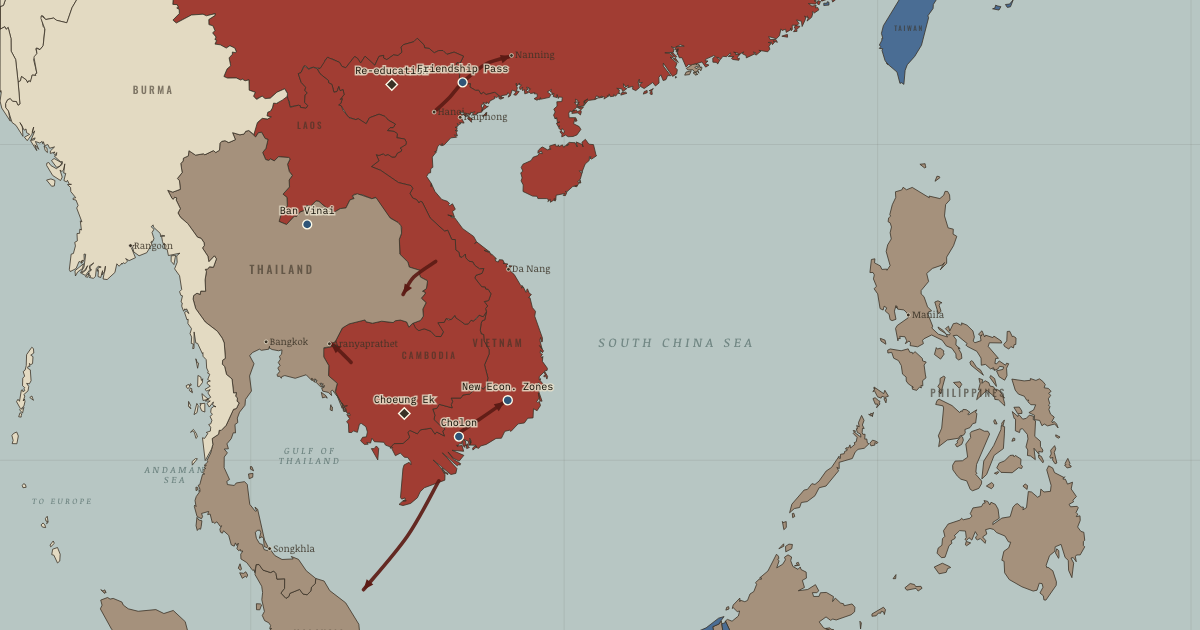
Vietnam’s new rulers set out to transform the South, and each policy produced its own group of people with reasons to leave. Former officers, officials and others linked to the fallen South Vietnamese government were ordered to report for re-education, detention with forced labour and political lessons, expecting a few weeks; many stayed for years, and senior officers for as long as seventeen. UNHCR, the UN’s refugee agency, later wrote that more than a million people passed through the camps, while the scholars Gareth Porter and James Roberts argued that the long-term prisoners numbered 200,000 to 300,000. City dwellers judged unproductive or politically suspect were sent to New Economic Zones, new farming settlements cut from forest and scrub in the Central Highlands and the south, the short red arrow on the map, where many lacked tools and farming skills. Families lost breadwinners to the camps and homes to the zones, and the children of the old regime were barred from university. Those with no future in the new order began to look to the sea.
The short answer
- Punishing the old regime. Hanoi treated those linked to the Saigon government as a danger to the revolution, and re-education was its instrument. Detention without trial for years, the loss of property and the exclusion of their children from education left these families with no future in Vietnam. Many who had stayed in 1975 because they could not leave decided by 1978 that leaving was worth the risk of the sea.
- Socialist transformation of the South. The collectivisation of farming, the closure of private businesses and the forced move of city dwellers to New Economic Zones were meant to build a planned economy, and they impoverished and alienated much of the urban South. Shortages worsened after floods and failed harvests in 1977–78. Policies aimed at a class created refugees across that class, from small traders to doctors.
- The break between Vietnam and China. Great-power rivalry turned a minority into suspects. By 1978 Vietnam had aligned with the Soviet Union, joined its economic bloc and gone to war with Cambodia, China’s ally. China cut aid and protested the treatment of the Hoa, and Hanoi came to see its ethnic Chinese as a security risk. Great-power rivalry thus turned a domestic minority into the main source of refugees, and it would lead to open war in February 1979.
- Terror in Democratic Kampuchea. The Khmer Rouge programme of forced labour, purges and the elimination of class and ethnic enemies killed about a fifth of Cambodia’s people between 1975 and 1979. Its sealed borders kept most victims inside, while purges in the eastern zone in 1978 drove some cadres and civilians into Vietnam. The catastrophe built up a vast hidden displacement that would pour toward Thailand once the regime collapsed.
THE TURNING POINT
Cholon, late March 1978. The raids on Cholon and the abolition of private trade are the hinge because they turned a slow trickle of escapes into an organised exodus. About 15,000 boat people had reached neighbouring countries in 1977; in 1978 the number roughly quadrupled, and most of them were Hoa. The policy combined an economic programme with an ethnic target and a state willing to profit from departures, which made flight both necessary and possible. From this point the crisis stopped being a by-product of the 1975 victory and became a deliberate outflow that neighbouring states would see as a policy aimed at them.
What it changed
The boats multiply. The exodus became a mass movement by sea. Departures grew from a few thousand a year to tens of thousands a month by early 1979, many in vessels that officials had sold or licensed. The arrivals overwhelmed camps in Malaysia, Hong Kong, Indonesia and Thailand, and the next chapter shows how those first-asylum states reacted when they believed they were being made to absorb another country’s minority.
War with China. China’s anger over Cambodia and the Hoa led to its invasion of northern Vietnam in February 1979. The war sharpened suspicion of the remaining northern Hoa, most of whom then left by sea for Hong Kong, the arrow that chapter 9 draws along the coast past Hainan. A war between two communist states thus became, at one remove, a refugee crisis for a British colony.
Cambodia’s hidden displacement surfaces. The fall of the Khmer Rouge released a displacement that terror had kept hidden. When Vietnam’s army overthrew Democratic Kampuchea in January 1979, hundreds of thousands of starving Cambodians moved toward the Thai border. The famine and the border camps that followed, from Khao-I-Dang to Site 2, became the second great refugee crisis of the region, traced in chapters 10 and 11. Unlike the boat people, most of these Cambodians were kept at the border and never resettled.
Laos empties slowly. Laos emptied slowly across the Mekong, a river border that was easy to cross and hard to guard. About 360,000 people from Laos reached Thailand between 1975 and 1995, roughly one in ten of the population. Many Hmong in camps such as Ban Vinai resisted resettlement in the West for years, hoping to go home, and their fate under the 1989 plan of action is part of chapter 11. Their reluctance shows that resettlement, the West’s favourite solution, was not what every refugee wanted.
The full answer, argued
The economic case is strong: the abolition of private trade in March 1978 struck the commercial class of the South, which was largely Hoa, and many ethnic Vietnamese traders were also ruined and left. Yet ethnicity and security clearly mattered too. In the North, where Hoa were mostly workers and fishermen, there was no commercial class to target, yet about 160,000 crossed into China after being treated as a fifth column; and in the South officials let ethnic Chinese buy their way out while restricting others. The break with China in 1978 turned a class policy into one with an ethnic edge. A balanced judgement is that economic transformation created the pressure and Sino-Vietnamese rivalry decided who would bear it. The insight for Paper 1 is that displacement often occurs where two causes overlap, and that governments can present an ethnic outcome as a neutral policy, much as Potsdam spoke of orderly transfer.
An interesting fact
Ban Vinai was famous for its embroidery. Hmong women there turned their traditional needlework, paj ntaub or “flower cloth”, into a new form, the story cloth, stitching scenes of village life, the war and the flight across the Mekong onto fabric that could be sold to relief workers and visitors. Missionaries and aid agencies helped market the cloths abroad, and the income supported families for years. Story cloths made in the Thai camps are now held in museum collections in the United States and remain one of the main records the Hmong made of their own exodus.
This is the study layer of Re-education camps and Hoa exodus, chapter 8 of Uprooted: Refugees in Europe 1945–1960 and Indochina 1975–1990; the full index of the atlas is here.
Related questions
THE FREE PRINTABLE STUDY GUIDE
Join the Dispatch — a short welcome series, then a letter when a new atlas opens — and the printable study guide for Uprooted is yours now, free.
NO TRACKING · YOUR ADDRESS IS USED FOR THE DISPATCH AND NOTHING ELSE · UNSUBSCRIBE ANYTIME