Meiji Japan and post-Soviet Russia · 1991
Did the nations or Russia itself destroy the Soviet Union?
The seminar question: “Was the Soviet Union destroyed more by the nations on its edges or by Russia at its centre?”
In 1989–91 the Soviet republics turned their paper rights into real power. The Baltic Way chain of August 1989 and the opening of the Berlin Wall came before Lithuania declared independence in March 1990, and after the failed coup of August 1991 the Union broke into fifteen states.
Chapter 9 is part of membership. WW2 is free — every chapter. Try chapters 1–2 of any 2 other atlases (3 with a free account). Opening a new atlas uses one of them. Membership opens all 21 — Join.
Free printable Meiji Japan and post-Soviet Russia study guide, sent by email ↓
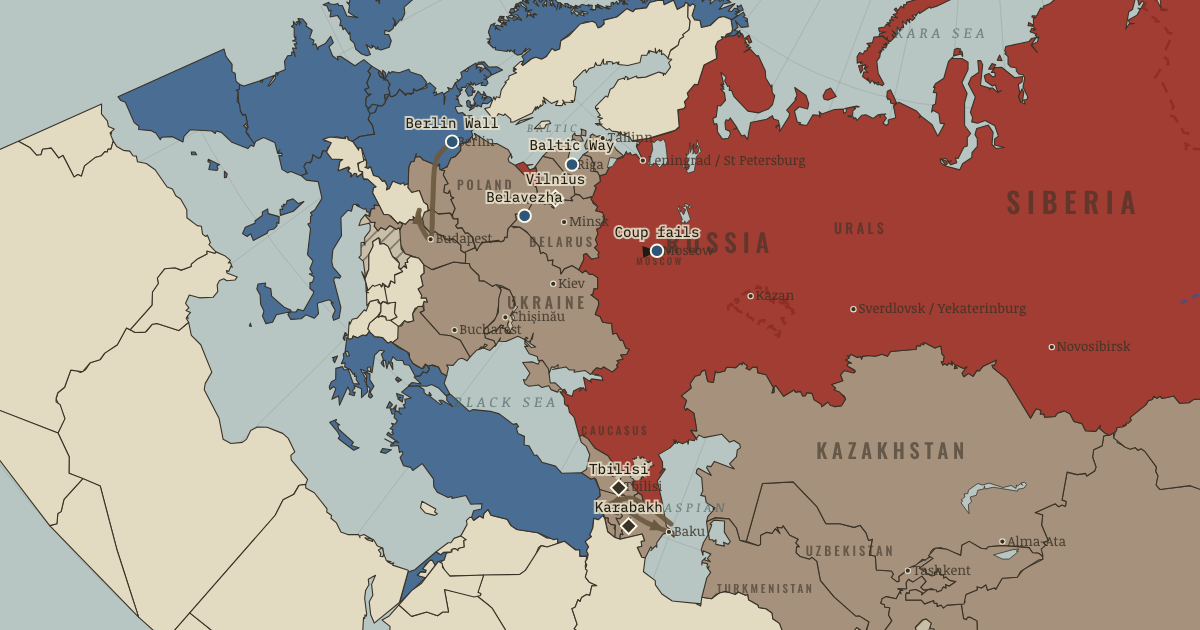
Eastern Europe went first, because its regimes had always depended on the threat of Soviet tanks. In 1989 Gorbachev made clear that Moscow would no longer intervene to save its allies, a change his spokesman joked was the “Sinatra doctrine”, letting each country do it “my way”. Poland’s communists lost semi-free elections in June to Solidarity, the independent trade union that had become a national movement, and Hungary opened its border with Austria, so thousands of East Germans crossed to the West along the route of the arrow on the map. Mass protests followed in East Germany, and on 9 November the Berlin Wall opened. Within weeks communist rule ended in Czechoslovakia, Bulgaria and Romania, and the bloc states turn tan on the map of December 1989. Germany was reunited in October 1990. Regimes built on the promise of Soviet force fell within months once that promise was withdrawn.
The short answer
- Glasnost and elections gave nations a voice. Openness allowed Balts, Georgians, Armenians and others to discuss deportations, annexations and the suppression of their languages, and the elections of 1989–90 gave their movements parliaments to control. Grievances that had been unspeakable became the platforms of elected governments. Gorbachev had expected reform to renew loyalty to the Union, and in several republics it produced demands to leave it.
- Moscow renounced force in Eastern Europe. Gorbachev had already announced cuts to Soviet forces in Europe at the United Nations in December 1988, and in 1989 he refused to intervene as communist governments fell from Warsaw to Bucharest. The peaceful collapse of the bloc showed nations inside the Union that Moscow might not use force against them either. Each example of restraint abroad made the threat of repression at home less credible.
- The economic crisis destroyed the centre’s case. By 1990–91 shortages, rationing and the collapse of supply chains made the claim that the Union delivered prosperity impossible to sustain. Republics hoarded food and fuel, withheld taxes and printed their own coupons and later currencies. Leaving the Union began to look like a way to escape a sinking economy, and the centre lacked the money to buy loyalty.
- Russia’s leaders wanted Moscow’s power for themselves. Yeltsin, expelled from the Politburo in 1987, built his comeback on the Russian republic, whose parliament, presidency and treasury he used against the Union government. Russian nationalists and democrats alike argued that Russia subsidised the other republics. When the central state weakened, Russia’s elected leaders had both the motive and the means to replace it with their own.
THE TURNING POINT
The White House, 19–21 August 1991. The coup’s defeat is the hinge because it destroyed in three days the institutions that held the Union together. The KGB, the army leadership and the Communist Party had compromised themselves, and Yeltsin, the man who had stood against them on a tank, now held the initiative. Republican leaders who had hesitated concluded that a Union run from Moscow could be seized by force again, so staying in it now looked more dangerous than leaving. Within days he suspended the party’s activities in Russia, the Baltic states won recognition, and most remaining republics declared independence. A plot to save the Union ensured that it would not survive the year.
What it changed
Fifteen states with inherited borders. The internal borders drawn by Soviet planners became international frontiers overnight, leaving about 25 million ethnic Russians outside Russia and many minorities inside new states that did not want them. Crimea, transferred to Ukraine in 1954, became part of an independent Ukraine. Questions of citizenship, language and military bases would shape relations among the successor states for decades.
Frozen conflicts on the edges. Wars over Karabakh, Abkhazia, South Ossetia and Transnistria, hatched on the map, began as the Union weakened and continued after it dissolved. Russian troops and arms played a role in most of them. Ceasefires in 1992–94 left breakaway regions outside the control of the states they legally belonged to, conflicts later called “frozen” because they were halted without being solved.
Russia inherited the Union’s seat, weapons and debts. The Russian Federation took over the Soviet seat on the United Nations Security Council, its embassies and most of its foreign debt, and by 1996 all Soviet nuclear warheads had been moved to Russian territory. Russia also inherited the Soviet economic crisis, now concentrated in a single government that had promised its people a rapid transition to a market economy.
The full answer, argued
The case for the borderlands is clear in the sequence of events: the Baltic popular fronts, the Karabakh crisis and Georgian protests opened the question of secession, Lithuania declared independence first, and Ukraine’s 90% vote made a Union without it impossible. Mark Beissinger shows how these mobilisations built on each other. The case for the centre is equally strong. Russia’s declaration of sovereignty, its withholding of taxes, Yeltsin’s defeat of the coup and his initiative at Belavezha ended the Union, and Central Asian leaders were left with independence they had barely sought. Serhii Plokhy stresses the decisive role of Russia and Ukraine together. A good answer argues that the borderlands made the crisis and the centre decided its outcome, and it explains why Russia’s elite saw more to gain from leaving than from ruling. The transferable insight is that empires often end when their core decides that the costs of holding the periphery are no longer worth paying.
An interesting fact
The end of the Soviet Union reached Washington at least as fast as it reached the Soviet president. After signing the agreement that dissolved the Union in a hunting lodge in the Białowieża forest on 8 December 1991, Boris Yeltsin telephoned the American president, George Bush, while the Belarusian leader Stanislav Shushkevich tried to reach Gorbachev. Yeltsin got through first, and Gorbachev was angered to learn that Washington already knew, although Shushkevich later insisted that the two calls were almost simultaneous. Whatever the exact sequence, the leaders of three Soviet republics had ended the Union and told a foreign president as quickly as the man who still nominally governed it.
This is the study layer of Collapse of the Soviet Union, chapter 9 of Remaking the State: Meiji Japan 1600–1912 and Post-Soviet Russia 1964–2000; the full index of the atlas is here.
Related questions
THE FREE PRINTABLE STUDY GUIDE
Join the Dispatch — a short welcome series, then a letter when a new atlas opens — and the printable study guide for Remaking the State is yours now, free.
NO TRACKING · YOUR ADDRESS IS USED FOR THE DISPATCH AND NOTHING ELSE · UNSUBSCRIBE ANYTIME