WWI · EPILOGUE ·
Europe’s new borders after WWI
Chapter 15 of The Great War, 1871–1923: “The New Map of Europe”
Between 1919 and 1923 the treaties with Germany’s allies redrew Europe: Saint-Germain left a small Austrian republic, Trianon gave Transylvania, Slovakia and Croatia to Hungary’s neighbours, and Sèvres divided the Ottoman lands. Where the treaties stopped, armies took over, as Poland’s war with the Red Army in 1920 showed.
Chapter 15 is part of membership. WW2 is free — every chapter. Try chapters 1–2 of any 2 other atlases (3 with a free account). Opening a new atlas uses one of them. Membership opens all 21 — Join.
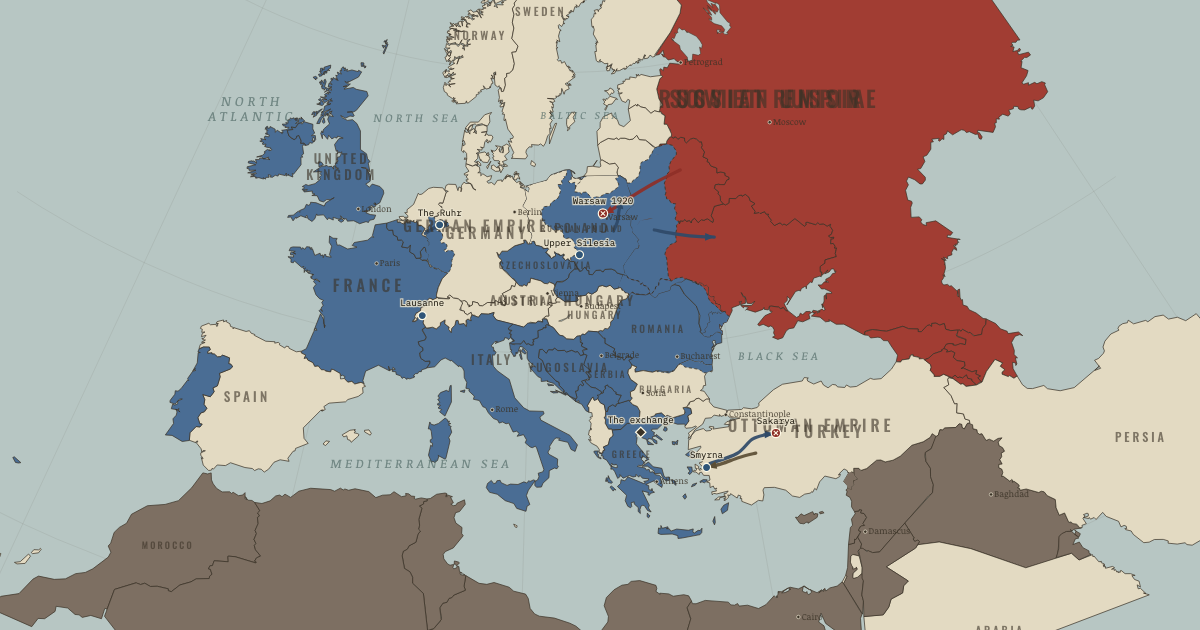
The map above is the world of Europe, July 1923 — The map of 1923.
Part of IB History: The First World War →
BRIEF EXPLANATION — THE ESSENTIAL ARGUMENT
This final chapter asks why the map of Europe drawn between 1919 and 1923 looked complete and permanent, yet settled so little of what the war had opened. The answer is that armies drew many frontiers as much as diplomats did, and the lines that lasted were the ones with force behind them. Where the losers were too weak to resist, the lines stuck however bitterly they were resented. Of the five peace treaties, from Versailles for Germany to Sèvres for the Turkish-ruled Ottoman Empire, the harshest was Hungary’s Treaty of Trianon, which took nearly three-quarters of the kingdom’s land and left some three million Hungarians in neighbouring states. Revisionism, the drive to overturn the treaty borders, became the programme of every Hungarian government, much as a party forced into a contract spends years trying to break it. Poland fixed its eastern border by defeating the Red Army of communist Soviet Russia outside Warsaw in 1920, so a battle settled what the peace conference could not.
Turkey, the one loser that tore up its treaty, proves the rule. Sèvres had handed parts of Anatolia, the Asian heartland of modern Turkey, to Greece and the Allies, the victors of 1918, but Turkish nationalists under Mustafa Kemal defeated the Greek army and won a new peace at Lausanne in 1923. Lausanne’s price was a forced exchange of about 1.6 million Orthodox Christians and Muslims between Turkey and Greece. Where the victors had to enforce the map, they split. French and Belgian troops occupy the Ruhr, Germany’s coal-and-steel heartland, on the map of 1923 because Germany had fallen behind on reparations, war-damage payments imposed much as a court awards damages. Britain refused to join them. The map looked final, yet Germany and Soviet Russia rejected it and the victors would not defend it together, so it lasted barely fifteen years.
The full story
The treaties with Germany’s allies applied the principle of self-determination, the idea that each nation should govern itself, much like a referendum on independence, but in ways that favoured the victors, paying their allies in the losers’ land. Saint-Germain, the treaty with Austria, left a small German-speaking republic of about six and a half million people and forbade it to unite with Germany. Trianon, the treaty with Hungary, gave Transylvania to Romania, Slovakia to Czechoslovakia, and Croatia and the Vojvodina to the new Kingdom of the Serbs, Croats and Slovenes, later called Yugoslavia. Neuilly took Bulgaria’s Aegean coast, and Sèvres divided the lands of the Ottoman Empire, the Turkish state ruled by a sultan or emperor, among Britain, France, Italy and Greece. Each treaty also made the loser accept the League of Nations, the new body meant to settle disputes much like the United Nations today, yet barred the defeated from joining at first, which let them treat the League as the victors’ club.
Where the treaties stopped, armies took over, and the map of eastern Europe was finished by force between 1919 and 1922. Poland’s leader, Józef Piłsudski, marched on Kiev in 1920 to build a federation that would hold Russia back. The counterattack of the Red Army, the army of communist Soviet Russia, carried it to the outskirts of Warsaw by August, until a Polish counterstroke from the Wieprz river broke it apart. The Treaty of Riga of 1921 drew Poland’s border far east of the Curzon Line, the frontier the Allies, the victors of 1918, had proposed along the edge of Polish settlement. In Anatolia, the Asian heartland of modern Turkey, Mustafa Kemal, an Ottoman general who rejected the sultan’s surrender, built a nationalist government in Ankara, stopped the Greeks on the Sakarya river in 1921 and drove them out of Smyrna in 1922. The arrows on the map trace both wars, and in each case the final treaty followed the battle line.
The two events of 1923 showed that the settlement held where it matched the facts of power and broke down where it had to be enforced. In the south-east the Treaty of Lausanne replaced Sèvres and returned Eastern Thrace and the whole of Anatolia to Turkey. It also abolished the capitulations, legal privileges that had let foreigners in the Ottoman Empire answer only to their own consuls’ courts, much like diplomatic immunity extended to whole merchant communities. A separate convention turned the flight of Anatolia’s Christians into a permanent exchange of populations. In the west, France and Belgium occupied the Ruhr, Germany’s coal-and-steel heartland, in January 1923 to seize the coal and timber Germany owed as reparations for war damage. Germany answered with passive resistance, a general refusal to work for the occupiers, and paid the strikers by printing money until its currency collapsed. Britain refused to take part, and only the Dawes Plan of 1924, an American scheme that cut Germany’s payments and lent it money, ended the crisis. Enforcement had split the victors, which is why the blue belt of 1923 was weaker than it looked.
DEEP EXPLANATION — EVIDENCE & INTERPRETATION
Five treaties, one method
The peace settlement is usually judged through Versailles alone, yet comparing the five treaties shows that the peacemakers followed one consistent method with uneven results. Each treaty opened with the Covenant of the League of Nations, assigned the loser responsibility for the war’s damage, cut its army, demanded reparations and drew new frontiers on the principle of nationality, adjusted for strategy, economics and the victors’ wartime promises. Alan Sharp argues that the method failed most where the ethnic map was most tangled. Hungary’s new borders left about three million Hungarians outside the country, many of them in compact districts just across the new frontier, because railways, rivers and the claims of Romania, Czechoslovakia and Yugoslavia were given priority over the ethnic line. Neuilly confirmed what Bulgarians called their second national catastrophe in five years. Sèvres was the only one of the five never to take effect, because imposing it would have required a war in Anatolia that the victors were unwilling to fight. Zara Steiner judges the settlement a reasonable attempt to manage an impossible situation, and she locates its decisive weakness in the absence of any power ready to uphold it.
The war that did not end in 1918
Robert Gerwarth has argued that for much of central and eastern Europe the First World War did not end in November 1918. The collapse of the empires opened five more years of revolutions, civil wars and border wars that killed about four million people, more than the combined war dead of Britain, France and the United States. The Polish–Soviet war is the clearest case of a border decided on the battlefield. Norman Davies stresses that both sides fought for more than territory. Lenin hoped the Red Army would carry revolution into Germany, and in July 1920 the commander of its western front, Mikhail Tukhachevsky, told his troops that over the corpse of White Poland lay the road to world conflagration. Erik-Jan Zürcher shows that Mustafa Kemal’s victory depended on Allied divisions as well as Turkish strength, because Italy and France made separate deals with Ankara in 1921 and Soviet Russia supplied it with gold and weapons. In both wars a defeated or excluded power recovered by force what the peacemakers had denied it, and the settlement was rewritten to match the result.
The Ruhr and the problem of enforcement
The occupation of the Ruhr is the best test of the claim that the settlement failed because nobody enforced it, since in 1923 France did enforce it and the result was costly for everyone. Sally Marks showed that the reparations bill fixed in London in 1921, nominally 132 billion gold marks, contained a large block of bonds that the Allies never expected to be paid, so that Germany’s real liability was closer to 50 billion and arguably within its capacity. The German government nonetheless fell behind on deliveries of timber and coal, and the French prime minister, Raymond Poincaré, sent troops to take the coal at its source. Conan Fischer’s study of the occupation shows that passive resistance and French reprisals deepened German hatred of the treaty, while the money printed to pay the strikers destroyed the savings of the German middle class. France obtained the Dawes Plan of 1924, a more realistic schedule backed by American loans, but it lost British goodwill and its own appetite for acting alone. No French government tried to enforce the treaty by force again, which left the pace of revision to Germany.
Key places on the map
On this day
Why it happened
The method Versailles set. The Treaty of Versailles, weighed in Chapter 14, settled Germany’s frontiers and set the method every other treaty followed. That method ran from the Covenant of the League of Nations, its founding charter, to reparations and new borders. This chapter follows that method into central and eastern Europe, where the defeated states were smaller and weaker, the ethnic map was far more tangled, and the victors’ promises to their own allies had to be paid for with the losers’ territory.
Empires that collapsed into a vacuum. Three empires fell within twenty months, from the Tsar’s abdication in March 1917 to the collapse of Austria-Hungary and Germany in November 1918, and the fourth, the Ottoman, was being dismembered. When the armistice was signed nobody controlled the lands between Germany and Russia, and national councils proclaimed new states in Prague, Zagreb, Warsaw and the Baltic capitals before the peacemakers met. Where two new states claimed the same land, as Poland and Lithuania did over Vilnius, armies decided, so the conference often ratified facts on the ground.
Promises made in wartime. The victors had bought allies with promises that the peace now had to honour. Italy had been offered South Tyrol, Istria and much of Dalmatia in the Treaty of London of 1915, Romania had been promised Transylvania in 1916, and Britain had promised Arab independence, a Jewish national home in Palestine and a division of the Middle East with France. Where promises clashed, the strongest claimant usually won, and the losers of these bargains, from Italian nationalists to Arab leaders, joined the defeated states in resenting the settlement.
The Bolshevik challenge. Soviet Russia was excluded from the peace conference and treated as a danger to be contained, while Lenin expected revolution to spread westward. That fear shaped the settlement, because the victors backed strong new states on Russia’s border, accepted Romania’s annexation of Bessarabia and tolerated Poland’s eastward expansion. In 1919 short-lived Soviet republics in Hungary and Bavaria made the danger look real. The new map was designed to contain Moscow as much as Berlin, and Moscow treated it as a hostile wall.
THE TURNING POINT
Lausanne, 24 July 1923. İsmet Pasha’s refusal to sign is the hinge of this chapter. Turkey’s delegate at Lausanne would not accept the capitulations, foreign financial control or reparations, and the conference dragged on for eight months before the Allies gave way. The treaty signed on 24 July 1923 drew a frontier along the line Turkish armies actually held, so no outside power had to enforce it, and it has largely lasted to this day. Its population exchange showed the human cost of making peoples fit borders, a cost the other treaties had tried to avoid with minority guarantees, and its durability exposed what the rest of the peace lacked.
What it changed
Guardians and revisionists. The map of 1923 divided Europe into states that wanted to keep the settlement and states that wanted to overturn it. France allied with Poland in 1921 and went on to sign treaties with the Little Entente of Czechoslovakia, Romania and Yugoslavia, while Germany, Hungary and Bulgaria demanded revision and Fascist Italy, a disappointed victor, increasingly joined them. The guardians were mostly new, small and divided among themselves, while the revisionists included the strongest economy on the continent, so the balance of the map favoured those who wanted to redraw it.
Minorities as pretexts. The new map made national minorities a standing source of conflict. Some 25 to 30 million Europeans lived in someone else’s nation-state, and treaties supervised by the League promised them schools in their own language and equality before the law. The League’s procedures were slow, many complaints were set aside, and governments in Warsaw, Bucharest and Belgrade pressed assimilation. In the 1930s Nazi Germany used the grievances of German minorities in Czechoslovakia and Poland as pretexts for breaking the settlement apart, turning a promise of protection into a weapon against the states that had signed it.
Hyperinflation and the radical right. The Ruhr crisis drove German inflation out of control, until in November 1923 a lifetime’s savings could not buy a loaf of bread. That same month Adolf Hitler, leader of a small Munich party, tried to seize power in the Beer Hall Putsch, an armed coup launched from a Munich beer hall, convinced the republic was about to fall. He failed and went to prison, but the year of occupation and hyperinflation left millions of Germans linking the treaty, the republic and ruin in a single memory.
From Lausanne to the next war. The wars of 1919–1922 hardened the belief that stable frontiers required nations of a single people, and the Lausanne exchange gave that belief international approval. Winston Churchill cited it in 1944 to defend expelling Germans from the lands Poland would gain, a policy carried out in 1945 after Nazi Germany’s war of conquest and occupation. The next war began in 1939 over Danzig, the German port the peace made a Free City, and the Polish Corridor that cut East Prussia off from Germany, fault lines drawn in these years.
DISCUSSION QUESTION — “In 1919–1923 armies drew the map of Europe, and treaties only signed it.” How far do you agree?
The claim fits the east and the south-east best. Poland’s eastern border followed the battle line of 1920, Vilnius and Memel were seized by force, and Lausanne recognised the frontier that Kemal’s army had won, so in these regions the treaties ratified facts made by soldiers. It fits the centre and west less well, where Versailles, Saint-Germain and Trianon drew frontiers that no army fought over in 1919 and the defeated states were too weak to resist. Even there the peacemakers often confirmed decisions taken by others. Plebiscites, votes in which local people chose their state, much like referendums, settled Schleswig and Upper Silesia, and new states had been proclaimed in Prague and Zagreb before the conference met. A careful answer separates the making of borders from their survival, because treaties could draw lines anywhere, while only lines backed by power, or by the consent of the people living along them, lasted. Judged that way, the instability of the 1923 map lay in the gap between borders on paper and anyone’s willingness to defend them, a gap that governments of every era should measure before they sign.
An interesting fact
The Battle of Warsaw was also a victory for codebreakers. From 1919 a small Polish radio-intelligence unit, in which a young lieutenant named Jan Kowalewski played the leading part, read large numbers of Red Army radio messages. In August 1920 Polish commanders therefore knew the positions and orders of Tukhachevsky’s armies, including how thinly his southern flank was held. At the decisive moment, according to one of its operators, a Warsaw radio station also jammed Soviet transmissions by broadcasting passages from the Bible. The same Polish cipher service broke the German Enigma machine in 1932 and handed its methods to Britain and France in July 1939, five weeks before the next war began.
Related
THE FREE PRINTABLE STUDY GUIDE
Join the Dispatch — a short welcome series, then a letter when a new atlas opens — and the printable study guide for WWI is yours now, free.
NO TRACKING · YOUR ADDRESS IS USED FOR THE DISPATCH AND NOTHING ELSE · UNSUBSCRIBE ANYTIME