MAPS OF HISTORY · IB HISTORY · PAPER 1 · POLITICAL AND ECONOMIC TRANSITIONS
IB HISTORY · PAPER 1 · FOCUSED STUDY
Paper 1: Political and Economic Transitions — Meiji Japan and Soviet Union to Russian Federation
Political and Economic Transitions is one of the five Paper 1 Focused Studies of the new IB History course, first examined in May 2028. Paper 1 is the source paper: its questions ask you to read primary sources closely, to judge what each can and cannot tell a historian, and to combine them with your own knowledge. This Focused Study pairs two case studies, Meiji Japan and Soviet Union to Russian Federation, and our atlas Remaking the State: Meiji Japan and Post-Soviet Russia covers both on linked maps, in 12 chapters with 42 primary sources.
How a samurai elite dismantled its own class and built a modern state and empire in forty years, and why the Soviet Union’s reformers lost the union, the economy and then much of the democracy they had opened.
WW2 is free — every chapter. Try chapters 1–2 of any 2 other atlases (3 with a free account). Opening a new atlas uses one of them. Membership opens all 21 — Join.
What this Focused Study asks
Each source set in the atlas is built around one inquiry question, and together they show what this Focused Study asks of you. Keep them in mind as you read: a good answer to any of them needs both the sources and the chapters behind them.
Meiji Japan
- How did Japan’s new leaders justify and impose central authority between 1867 and 1873?
- How far did the Meiji constitution give the Japanese people a share in government?
- Who paid for Japan’s rise to great-power status between 1894 and 1910?
Soviet Union to Russian Federation
- Why did attempts to reform the Soviet economy fail between 1965 and 1991?
- Why did the Soviet Union break apart in 1991?
- Who paid for Russia’s transition to a market economy between 1992 and 1998?
Case study 1: Meiji Japan
Chapters 1–6 of the atlas follow Meiji Japan, from 1600 to 1912. Read them in order: each chapter is a step in one argument, and the map moves with it.
- The Closed CountryCHAPTER 1 · 1600–1853
- The Black ShipsCHAPTER 2 · 1853–1858
- The Fall of the ShogunateCHAPTER 3 · 1858–1869
- Dismantling the Old OrderCHAPTER 4 · 1868–1877
- Building the Meiji StateCHAPTER 5 · 1877–1894
- A Great PowerCHAPTER 6 · 1894–1912
Evidence to use
One point from the IB notes of each chapter, written as a sentence you could use in an answer. Every chapter in the atlas carries four to six.
- After Sekigahara in 1600, Tokugawa Ieyasu left “outer” lords such as the Shimazu of Satsuma and the Mōri of Chōshū armed on the rim of Japan, the grey-tan edges of the 1840 map, which placed the future rebels where they were hardest to control. CH 1
- Commodore Matthew Perry anchored four American warships, two of them steamers, off Uraga on 8 July 1853 and refused to go to Nagasaki, which showed that steam power had made the shogunate’s rules for receiving foreigners impossible to enforce. CH 2
- Western navies punished the domains most committed to expelling foreigners, since British warships shelled Kagoshima in August 1863 and seventeen allied warships silenced Chōshū’s forts at Shimonoseki in September 1864, which convinced both domains to buy Western rifles and steamships. CH 3
- The Charter Oath of 6 April 1868 promised assemblies and “all matters decided by public discussion”, while its pledge to break the “base customs of the past” licensed sweeping change, so the leaders could invoke it for reform long before any assembly met. CH 4
- The Iwakura Mission spent 21 months in the United States and Europe from December 1871, failed to revise the unequal treaties and returned convinced that factories, schools and laws had to come first, which set the order of the reforms that followed. CH 5
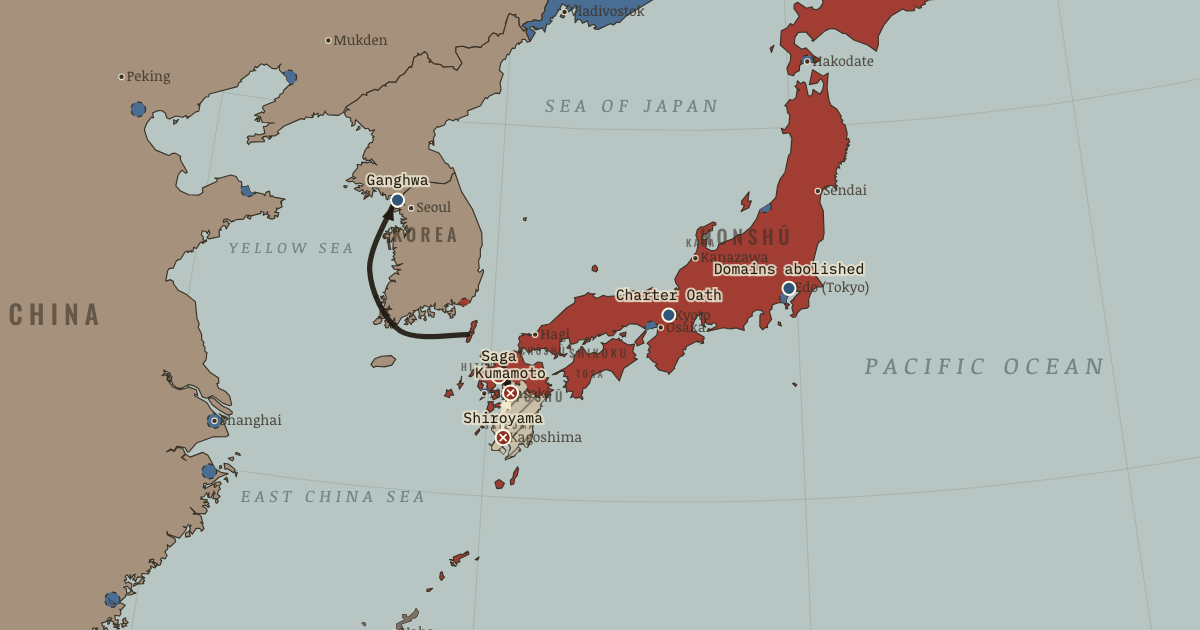
- When a Donghak peasant rebellion led Korea to ask China for troops in 1894, Japan sent a larger force, seized the royal palace in Seoul and declared war in August, because its leaders saw control of the peninsula as vital to Japan’s security. CH 6
Case study 2: Soviet Union to Russian Federation
Chapters 7–11 of the atlas follow Soviet Union to Russian Federation, from 1964 to 1998. Read them in order: each chapter is a step in one argument, and the map moves with it.
- The Stagnant SuperpowerCHAPTER 7 · 1964–1985
- Gorbachev’s GambleCHAPTER 8 · 1985–1989
- The Union UnravelsCHAPTER 9 · 1989–1991
- Shock TherapyCHAPTER 10 · 1992–1993
- A State at War with ItselfCHAPTER 11 · 1994–1998
Evidence to use
One point from the IB notes of each chapter, written as a sentence you could use in an answer. Every chapter in the atlas carries four to six.
- Brezhnev’s promise of “stability of cadres” ended the purges and reshuffles of the Khrushchev years, so by 1980 the average age of the Politburo, the party’s ruling committee, was about seventy. The regime had bought its elite’s loyalty with security. CH 7
- Gorbachev’s campaign against drinking, launched in May 1985, cut one of the budget’s largest sources of income. World oil prices fell at the same moment, from about 27 dollars a barrel in 1985 to around 14 in 1986, so the state printed money. CH 8
- On 23 August 1989, the fiftieth anniversary of the Nazi–Soviet Pact, about two million Estonians, Latvians and Lithuanians formed the Baltic Way, a human chain some 675 km long. The protest turned a buried grievance into a mass demand for independence. CH 9
- On 2 January 1992 Yegor Gaidar’s government freed most prices at once, and goods returned to the shops, yet prices rose about 2,500% over the year and wiped out the savings that Soviet citizens had built up. CH 10
- Tatarstan, where Russians made up about two-fifths of the population, signed a treaty with Moscow on 15 February 1994. The republic stayed inside Russia with control over its oil, budget and much of its law, so bargaining held the federation together. CH 11
Comparing the two case studies
The atlas ends by setting the two case studies side by side in Two Transitions Compared. Comparison is where the Focused Study pays off: the same question asked of two societies shows which explanations travel and which belong to one place.
PAPER 1 · REMAKING THE STATE · CHAPTER 12
Compare and contrast the ways in which the sequencing of political and economic reform shaped the outcomes of the Meiji transition (1868–1912) and the post-Soviet transition (1985–2000).
Both transitions were revolutions from above that ended with a strong executive and a limited democracy, and in both the order of reform shaped the result. Japan built central authority, revenue and an army before granting limited participation, so it gained state capacity at the expense of democracy. Russia opened politics and markets before it could tax or judge, then rebuilt capacity by narrowing its new freedoms.
Both states grew strong by taking power back from the regions.
The two cases placed participation at opposite ends of the sequence.
Russia built markets before the institutions that govern them, and Japan reversed that order.
The evidence for each point, the counter-argument and the judgement are in the IB notes of chapter 12 in the atlas. Read the chapter first: Two Transitions Compared.
Key concepts
The course asks you to think with six concepts. Each chapter’s IB notes name the two or three it supports best; here they are across the atlas, most used first.
- Causation · 7 CHAPTERS
Why something happened: the long-term conditions, the triggers and the choices behind it, and which of them mattered most. For example: The Closed Country, The Black Ships, The Fall of the Shogunate, The Stagnant Superpower. - Change · 5 CHAPTERS
What was different afterwards, how quickly it changed, and for whom. For example: The Fall of the Shogunate, Dismantling the Old Order, Building the Meiji State, Gorbachev’s Gamble. - Consequence · 4 CHAPTERS
What followed from an event or decision, intended and unintended, in the short and the long term. For example: Dismantling the Old Order, A Great Power, Shock Therapy, A State at War with Itself. - Continuity · 3 CHAPTERS
What stayed the same through an apparent upheaval, and why it survived. For example: The Closed Country, The Stagnant Superpower, Two Transitions Compared. - Significance · 3 CHAPTERS
Why an event, person or idea matters, judged by its effects and by how it has been remembered. For example: A Great Power, The Union Unravels, Two Transitions Compared. - Perspectives · 3 CHAPTERS
How people at the time, and historians since, have seen the same events differently, and why. For example: The Black Ships, Building the Meiji State, Shock Therapy.
Source-analysis practice
This is one complete source set from the atlas, free to use. It is built around one inquiry question: How did Japan’s new leaders justify and impose central authority between 1867 and 1873? Read the sources first and note who made each one, when and why. Then answer the questions in writing, and only afterwards open the guide under each question, which describes what a strong answer does.
TEXT · CHAPTER 3
Memorial returning governing power to the emperor (Taisei hōkan)
- CREATOR
- Tokugawa Yoshinobu, the fifteenth shogun
- DATE
- 14th day of the 10th month of Keiō 3 (November 1867)
- ORIGIN
- Memorial submitted to the imperial court in Kyoto; Japanese text as printed in the government’s official collection of laws (Hōrei zensho)
Context. Yoshinobu, shogun since early 1867, sent this memorial to the court in Kyoto in the hope of keeping a leading place in a new council of lords. The Hōgen and Heiji disorders were wars of the 1150s that brought the warrior houses into national power.
Translation: Maps of History, from the Japanese text (Wikisource) · original ↗
TEXT · CHAPTER 4
The Charter Oath (Gokajō no goseimon)
- CREATOR
- Sworn by Emperor Mutsuhito; drafted by officials of the new government
- DATE
- 6 April 1868 (14th day of the 3rd month of Keiō 4)
- ORIGIN
- Oath sworn before the gods in the Kyoto palace; text as published in the government’s official collection of laws (Hōrei zensho, no. 156)
Context. The fifteen-year-old emperor swore the oath three months after the coup of January 1868, while the war against the shogun’s supporters was still being fought. Court nobles and lords signed their names beneath it.
Translation: Maps of History, from the Japanese text (Wikisource) · original ↗
TEXT · CHAPTER 4
Proclamation on conscription (Chōhei kokuyu)
- CREATOR
- Council of State (Dajōkan), in the emperor’s name
- DATE
- 28 December 1872 (28th day of the 11th month of Meiji 5)
- ORIGIN
- Government proclamation issued with the imperial edict that announced the conscription law (Council of State notice no. 379)
Context. The proclamation explained the conscription law, which took effect in January 1873, and it was to be read to the people by village heads. The “four classes” were samurai, farmers, artisans and merchants, the official ranking of Tokugawa society.
Translation: Maps of History, from the Japanese text (Wikisource) · original ↗
PICTURE · CHAPTER 4
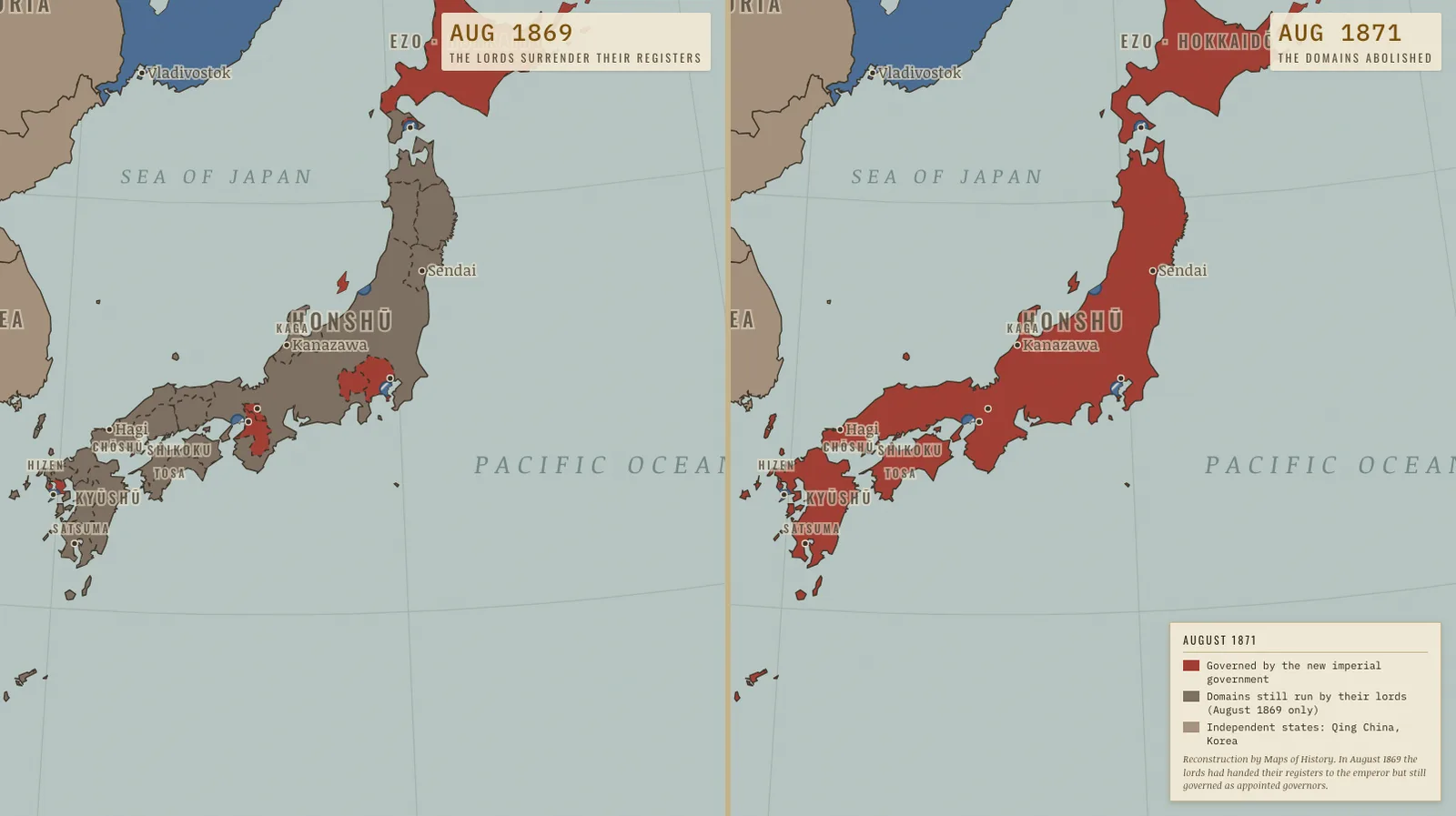
Before and after the abolition of the domains, August 1869 and August 1871
- CREATOR
- Maps of History
- DATE
- Reconstruction made in 2026
- ORIGIN
- Two states of the atlas’s Japan map, drawn from its geodata after Jansen and Beasley
Context. The left map shows Japan after the lords had handed their land registers to the emperor in 1869 but still governed as appointed governors; the right map shows it after the decree of 29 August 1871.
Maps of History (own work); base geography Natural Earth (public domain)
The questions
- QUESTION 1 · COMPREHENSION
According to Source A, why did Tokugawa Yoshinobu return governing power to the court in November 1867?
What a strong answer does
A strong answer identifies the reasons Yoshinobu gives: government and justice have often failed under him, which he blames on his own lack of virtue; and growing relations with foreign countries mean the state’s order cannot be upheld unless government comes from the court alone. The best answers add that he calls for public discussion and unity so that Japan can stand alongside other nations, which fits his hope of leading a council of lords.
- Identifies the admission of failure
- Identifies the foreign threat as a reason
- Notes the call for public discussion and unity
- QUESTION 2 · ANALYSIS
What does Source D suggest about how central authority was imposed between August 1869 and August 1871?
What a strong answer does
In 1869 most of Japan is still grey-brown, run by lords serving as appointed governors, and red covers only former shogunal lands and Hokkaido; by 1871 the whole country is red. Good answers explain that the change came in one step, by decree, and link it to the return of the registers in 1869 and the abolition of 1871 with an imperial guard of 10,000 in Tokyo. The best note that a modern reconstruction simplifies 261 domains and cannot show the debts and stipends that made the decree acceptable.
- Describes the change between the two maps accurately
- Explains that it came by decree in one step
- Adds own knowledge (1869 registers, 1871 decree, imperial guard)
- Notes a limitation of a modern reconstruction
- QUESTION 3 · EVALUATION
With reference to its origin, purpose and content, assess the value and limitations of Source C for a historian studying how the Meiji government justified conscription.
What a strong answer does
Value: an official proclamation of December 1872 shows the arguments leaders chose, the equality of the four classes, the duty to repay the country and the comparison with taxes, so it reveals how a revolution was presented as moral duty. Limitations: its purpose was to persuade, so it shows what leaders intended, and other evidence is needed for how people received it; it omits the exemptions for household heads and those who could pay 270 yen, which put the burden on poor younger sons; and riots against conscription followed in 1873. A strong answer weighs the two.
- Uses the origin and date
- Explains the persuasive purpose
- Draws value from the content
- Uses own knowledge for limitations (exemptions, riots)
- QUESTION 4 · SYNTHESIS
Using the sources and your own knowledge, to what extent did the Meiji leaders build central authority by persuasion between 1867 and 1873?
What a strong answer does
Persuasion is visible in every text: Source A presents surrender as patriotic, Source B promises public discussion in terms almost everyone could accept, and Source C argues from equality and duty. Own knowledge should add the buyout, in which the state took on the domains’ debts and paid the lords an income, and the force behind both: Toba–Fushimi, a Boshin War that killed about 4,000 to 8,000, and the guard of 1871. The best answers conclude that persuasion and payment worked because force had already been shown, and that those persuaded were mainly the elite.
- Uses at least three sources
- Adds own knowledge (Boshin War, buyout, imperial guard)
- Weighs persuasion against payment and force
- Reaches a clear judgement
More source sets in the atlas
The atlas holds 5 more source sets for this Focused Study. Their sources sit in the IB notes of the chapters named below: open a chapter in the atlas and turn on the IB notes switch to read them.
- How far did the Meiji constitution give the Japanese people a share in government? MEIJI JAPAN
Its sources are in the IB notes of chapter 5. - Who paid for Japan’s rise to great-power status between 1894 and 1910? MEIJI JAPAN
Its sources are in the IB notes of chapter 6. - Why did attempts to reform the Soviet economy fail between 1965 and 1991? SOVIET UNION TO RUSSIAN FEDERATION
Its sources are in the IB notes of chapter 7, chapter 8. - Why did the Soviet Union break apart in 1991? SOVIET UNION TO RUSSIAN FEDERATION
Its sources are in the IB notes of chapter 9. - Who paid for Russia’s transition to a market economy between 1992 and 1998? SOVIET UNION TO RUSSIAN FEDERATION
Its sources are in the IB notes of chapter 10, chapter 11, chapter 12.
Practice questions and essay plans
Each question below comes with the outline of a model plan: a thesis that answers the question and the claim each paragraph makes. Try your own plan before you read ours. The first plan comes from chapter 2, a free chapter, and is shown in full. The full plans, with evidence, a counter-argument and a judgement, are in the chapters’ IB notes in the atlas, and the atlas’s own page lists every chapter’s notes: IB notes for Meiji Japan and post-Soviet Russia.
PAPER 2 · REMAKING THE STATE · CHAPTER 2
To what extent did the unequal treaties of 1854–1858 cause the shogunate’s loss of authority?
The treaties caused the shogunate’s loss of authority to a large extent, because the way the 1858 treaty was signed set the shogun against the emperor, and their economic terms spread the damage through inflation. They worked on an older weakness, however, since a divided state without a navy could only concede, and the consultation of 1853 had already invited rivals into national decisions.
The manner of signing did the greatest political damage.
EVIDENCEIi Naosuke had the Harris treaty signed on 29 July 1858 although Emperor Kōmei had refused his approval, then confined great lords and executed activists such as Yoshida Shōin in the Ansei Purge; samurai killed Ii outside Edo Castle in March 1860.
LINKDefiance of the throne gave every opponent a loyal cause, which turned a diplomatic retreat into a crisis of legitimacy.
The economic terms turned resentment into a mass grievance.
EVIDENCEFixed low tariffs, a gold drain caused by a gold-to-silver ratio of about one to five in Japan against one to fifteen abroad, and the debased coinage of 1860 pushed Osaka rice prices up several times over between 1859 and 1867.
LINKSamurai on fixed stipends and urban workers blamed the government that had opened the ports, which fed the slogans of the 1860s.
The treaties exposed a weakness that was older than they were.
EVIDENCEAs chapter 1 shows, the shogunate taxed only its own lands and had no fleet; in 1853 Abe Masahiro asked the daimyo and the court for advice, and most lords advised refusal or delay without offering any ships.
LINKConsultation taught the outer lords and the court that they had a voice, so the treaties struck an authority that was already shared.
Conrad Totman stresses that the shogunate reformed vigorously in these years, opening a naval school at Nagasaki in 1855 and an institute for Western studies in 1856. On this reading its authority was still recoverable in 1858, and the decisive loss came in 1866, when a shogunal army failed to defeat the single domain of Chōshū.
The treaties were the decisive cause, because they converted an old structural weakness into an open quarrel over who had the right to decide for Japan. The economic shock widened support for the opposition, and the defeats of the 1860s completed the collapse. Without the signing of 1858, the shogunate’s critics would have lacked both a cause and a rival authority.
Read the chapter behind this plan: The Black Ships.
PAPER 2 · REMAKING THE STATE · CHAPTER 5
How far was the Freedom and People’s Rights movement responsible for the introduction of the Meiji constitution in 1889?
The movement was largely responsible for the timing of the constitution, because its petitions forced the promise of 1881. The content reflected the aims of the oligarchs, the small circle of leaders who ran the government, however, since they needed institutions the West would accept for treaty revision, and they designed a document that kept power with the emperor’s advisers.
Popular pressure made a constitution unavoidable.
Treaty revision gave the oligarchs their own reason to grant a constitution.
The oligarchs controlled the design and contained the movement.
The evidence for each point, the counter-argument and the judgement are in the IB notes of chapter 5 in the atlas. Read the chapter first: Building the Meiji State.
PAPER 2 · REMAKING THE STATE · CHAPTER 9
Discuss the importance of national popular movements in bringing about the collapse of the Soviet Union between 1988 and 1991.
National popular movements opened the crisis of the Union and made secession thinkable, first in the Baltic states and the Caucasus and finally in Ukraine. The outcome, however, was decided at the centre, where Russia’s elected leaders turned against the Union and the failed coup destroyed its institutions, so popular movements were necessary causes that could not have ended the Union alone.
Baltic popular fronts turned national grievances into mass politics.
Moscow’s inconsistent use of force made the movements stronger.
A popular vote in Ukraine made any Union impossible.
The evidence for each point, the counter-argument and the judgement are in the IB notes of chapter 9 in the atlas. Read the chapter first: The Union Unravels.
PAPER 2 · REMAKING THE STATE · CHAPTER 11
How far was the outbreak of war in Chechnya in December 1994 the result of the weakness of the Russian state?
The weakness of the Russian state explains why Chechnya escaped Moscow’s control after 1991 and why the war went so badly once it began. The outbreak itself owed most to decisions in Moscow and to Chechnya’s particular history, as the treaty with Tatarstan in the same year shows, so weakness set the stage and choices started the war.
A weak centre let Chechnya drift out of Russia.
Decisions in Moscow turned a political problem into a war.
Chechnya’s history made compromise harder than elsewhere.
The evidence for each point, the counter-argument and the judgement are in the IB notes of chapter 11 in the atlas. Read the chapter first: A State at War with Itself.
Revision tools
The atlas ends with a map quiz that asks you to find places and moments on the map itself (part of membership and of the Exam Sprint). The quick quiz and the discussion questions with our answers are free pages on this site, and the printable study guide gathers every chapter’s notes into one document for revision.
The same atlas for other papers
Several chapters also carry IB notes for Papers 2 and 3, and for topics of the old course examined in 2027:
- Paper 2 · Conflict · 3 CHAPTERS
- Paper 2 · Innovation and Transformation · 1 CHAPTERS
- Paper 2 · Authoritarian Rule · 5 CHAPTERS
- Paper 2 · Popular Movements · 2 CHAPTERS
Maps of History is independent and is not affiliated with or endorsed by the International Baccalaureate Organization. IB course names describe alignment only; paper, theme and section names follow the new course outline and may change when the final guide is published.
THE DISPATCH
A short welcome series, then a letter when a new atlas opens — and the printable study guide for Remaking the State is yours now, free.
NO TRACKING · YOUR ADDRESS IS USED FOR THE DISPATCH AND NOTHING ELSE · UNSUBSCRIBE ANYTIME