MAPS OF HISTORY · IB HISTORY · PAPER 2 · INNOVATION AND TRANSFORMATION
IB HISTORY · PAPER 2 · THEMATIC STUDY
Paper 2: Innovation and Transformation
Innovation and Transformation is one of the four Paper 2 Thematic Studies of the new IB History course, first examined in May 2028, and it draws its examples from 750 onwards. The theme is about new techniques and ideas, from farming and engineering to machines and factories: why they appeared, how they remade societies, who resisted them and what they did to daily life. It is organised around four questions, and a strong essay uses examples from more than one region, so under each question below the chapters are grouped by region.
Every chapter listed here carries IB notes in its atlas: evidence to quote, primary sources and a practice question with a model essay plan. Between them they cover twenty-four chapters in three atlases, set in Europe, the Americas, and Asia and Oceania.
WW2 is free — every chapter. Try chapters 1–2 of any 2 other atlases (3 with a free account). Opening a new atlas uses one of them. Membership opens all 21 — Join.
1. Why did innovations emerge?
10 CHAPTERS WITH IB NOTES · 4 REGIONS
Europe
- The Ship and the Sea RoadCLIMATE AND INNOVATION · CHAPTER 2 · c. 790–900
- Why Britain?THE INDUSTRIAL REVOLUTION · CHAPTER 1 · c. 1750
- Cotton and the FactoryTHE INDUSTRIAL REVOLUTION · CHAPTER 2 · 1760–1830
- Steam, Coal and IronTHE INDUSTRIAL REVOLUTION · CHAPTER 3 · 1769–1830
- The Continent FollowsTHE INDUSTRIAL REVOLUTION · CHAPTER 7 · 1815–1870
- The Second Industrial RevolutionTHE INDUSTRIAL REVOLUTION · CHAPTER 8 · 1870–1914
The Oseberg ship, built around 820 and buried in 834, was 21.5 metres long with fifteen pairs of oars, and its clinker hull of overlapping riveted planks flexed with the waves while drawing only about a metre of water.— Climate and Innovation, chapter 2: The Ship and the Sea Road
The Americas
- An Empire Built on a LakeCLIMATE AND INNOVATION · CHAPTER 7 · 1325–1428
- Water: Dikes, Aqueducts and FloodsCLIMATE AND INNOVATION · CHAPTER 8 · 1428–1500
The Basin of Mexico covers roughly 7,500–9,600 square kilometres at about 2,240 metres, and at high water its linked lakes spread over some 1,000–1,500 square kilometres, salty in the east at Texcoco and fresh in the south.— Climate and Innovation, chapter 7: An Empire Built on a Lake
Asia and Oceania
- Japan: Industrialisation from AboveTHE INDUSTRIAL REVOLUTION · CHAPTER 10 · 1868–1914
The Harris Treaty of 1858 opened Japanese ports including Yokohama, fixed Japan’s import tariffs at low rates (about 5 per cent from 1866) and gave foreigners their own courts until 1899.— The Industrial Revolution, chapter 10: Japan: Industrialisation from Above
More than one region
- Climate as a Force in HistoryCLIMATE AND INNOVATION · CHAPTER 1 · c. 950–1450
Michael Mann’s team showed in 2009 that the years 950–1250 were warm around the North Atlantic while parts of the tropical Pacific were cool, so the Medieval Climate Anomaly was a regional pattern with cool areas as well as warm ones.— Climate and Innovation, chapter 1: Climate as a Force in History
2. How did they transform societies?
16 CHAPTERS WITH IB NOTES · 3 REGIONS
Europe
- The Ship and the Sea RoadCLIMATE AND INNOVATION · CHAPTER 2 · c. 790–900
- Iceland: A Society on a Volcanic IslandCLIMATE AND INNOVATION · CHAPTER 3 · 870–1000
- Greenland and VinlandCLIMATE AND INNOVATION · CHAPTER 4 · 985–1050
- What the Norse LeftCLIMATE AND INNOVATION · CHAPTER 6 · c. 1100–1450
- Cotton and the FactoryTHE INDUSTRIAL REVOLUTION · CHAPTER 2 · 1760–1830
- Steam, Coal and IronTHE INDUSTRIAL REVOLUTION · CHAPTER 3 · 1769–1830
- The Railway AgeTHE INDUSTRIAL REVOLUTION · CHAPTER 4 · 1825–1850
- Industrial SocietyTHE INDUSTRIAL REVOLUTION · CHAPTER 5 · 1800–1850
- The Second Industrial RevolutionTHE INDUSTRIAL REVOLUTION · CHAPTER 8 · 1870–1914
Lise Bender Jørgensen calculates that a warship’s woollen sail needed more than 1.5 tonnes of wool and fifty to sixty years of labour, which shows that the Viking ship was the product of an entire farming economy.— Climate and Innovation, chapter 2: The Ship and the Sea Road
The Americas
- Water: Dikes, Aqueducts and FloodsCLIMATE AND INNOVATION · CHAPTER 8 · 1428–1500
- Chinampas: Feeding a CityCLIMATE AND INNOVATION · CHAPTER 9 · c. 1430–1519
- The Planned CityCLIMATE AND INNOVATION · CHAPTER 10 · c. 1430–1519
- America IndustrialisesTHE INDUSTRIAL REVOLUTION · CHAPTER 9 · 1865–1914
The dike held back the salty water of eastern Lake Texcoco, and the western lagoon became fresh enough for new chinampas, so a barrier built against floods also expanded the farmland around the capital.— Climate and Innovation, chapter 8: Water: Dikes, Aqueducts and Floods
Asia and Oceania
- Japan: Industrialisation from AboveTHE INDUSTRIAL REVOLUTION · CHAPTER 10 · 1868–1914
- A Global TransformationTHE INDUSTRIAL REVOLUTION · CHAPTER 11 · 1850–1914
- Building the Meiji StateREMAKING THE STATE · CHAPTER 5 · 1877–1894
The Meiji government opened the Tomioka silk mill in 1872 with French machines and the French engineer Paul Brunat, to train young women in modern silk reeling.— The Industrial Revolution, chapter 10: Japan: Industrialisation from Above
3. How were they resisted?
2 CHAPTERS WITH IB NOTES · 2 REGIONS
Europe
- ResistanceTHE INDUSTRIAL REVOLUTION · CHAPTER 6 · 1811–1848
Parliament made frame-breaking a capital crime in 1812, about 12,000 troops were sent to the disturbed districts, and seventeen men were hanged at York in January 1813.— The Industrial Revolution, chapter 6: Resistance
Asia and Oceania
- A Global TransformationTHE INDUSTRIAL REVOLUTION · CHAPTER 11 · 1850–1914
Dhaka, the centre of Bengal’s muslin trade, fell from perhaps 150,000 people or more in the early 1800s to about 50,000 by 1840 as machine-made British cloth took its export markets.— The Industrial Revolution, chapter 11: A Global Transformation
4. How did they affect people’s lives?
9 CHAPTERS WITH IB NOTES · 3 REGIONS
Europe
- Iceland: A Society on a Volcanic IslandCLIMATE AND INNOVATION · CHAPTER 3 · 870–1000
- Living with the ColdCLIMATE AND INNOVATION · CHAPTER 5 · 1250–1450
- Cotton and the FactoryTHE INDUSTRIAL REVOLUTION · CHAPTER 2 · 1760–1830
- The Railway AgeTHE INDUSTRIAL REVOLUTION · CHAPTER 4 · 1825–1850
- Industrial SocietyTHE INDUSTRIAL REVOLUTION · CHAPTER 5 · 1800–1850
The Althing, founded at Þingvellir in 930, brought 36 and later 39 chieftains together each June, and its lawspeaker recited a third of the law from memory every summer until the law was written down in 1117–18.— Climate and Innovation, chapter 3: Iceland: A Society on a Volcanic Island
The Americas
- Chinampas: Feeding a CityCLIMATE AND INNOVATION · CHAPTER 9 · c. 1430–1519
- America IndustrialisesTHE INDUSTRIAL REVOLUTION · CHAPTER 9 · 1865–1914
Hernán Cortés wrote in 1520 that more than sixty thousand people bought and sold each day in the great market of Tlatelolco, where cacao beans and cotton cloaks called quachtli served as money.— Climate and Innovation, chapter 9: Chinampas: Feeding a City
More than one region
- Two Answers to the EnvironmentCLIMATE AND INNOVATION · EPILOGUE · c. 1450–1521 AND AFTER
- Who Won and Who LostTHE INDUSTRIAL REVOLUTION · EPILOGUE · 1750–1914
Estelle Chaussard’s team showed in 2021 that groundwater pumping makes parts of Mexico City sink by up to about 50 centimetres a year, fastest where the compressible lake clay is thickest.— Climate and Innovation, chapter 12: Two Answers to the Environment
Practice questions and essay plans
Each question comes with the outline of a model plan: the thesis and the claim each paragraph makes. Plan your own answer first, then compare. The first plan comes from a free chapter and is shown in full. The full plans, with evidence, a counter-argument and a judgement, are in the chapters’ IB notes in each atlas.
PAPER 2 · CLIMATE AND INNOVATION · CHAPTER 1
To what extent was climate the main reason for the success and failure of medieval societies in demanding environments?
Climate was a decisive condition but rarely the main reason on its own. The warm centuries opened the North Atlantic to Norse farming and the cold narrowed it again, while frost and drought struck the Mexica, yet in both cases social structure, trade and technology decided whether a climatic shock became a lasting catastrophe or a crisis survived.
Climate widened and narrowed the margin for farming at the edge of the habitable world.
EVIDENCEMidges in Scoop Lake show summers about 1.5 °C warmer in 900–1400, when Greenland was settled in 985 or 986, and Gifford Miller dates the onset of the Little Ice Age to 1275–1300, the decades before the Western Settlement emptied.
LINKThe timing of expansion and retreat fits the climate record too closely to be coincidence.
The same climate produced different outcomes for different societies.
EVIDENCEThe Thule Inuit expanded down Greenland’s west coast after 1300 while the Norse withdrew, and Iceland, with perhaps 40,000–60,000 people, survived the cold that ended Norse Greenland.
LINKTechnology and scale separated the survivors from those who left, which shows that climate worked through the societies it struck.
Societies built buffers that changed the effect of climate shocks.
EVIDENCEDuring the frost and drought of 1450–54, which tree rings confirm, Moctezuma I opened the royal granaries and the rulers lifted tribute for six years, while Greenland had no reserves and depended on one export, walrus ivory.
LINKA buffer turned famine into a crisis survived, which shows the weight of institutions.
Climate determinists can point to Dansgaard’s argument of 1975 that cooling had a strong impact on Norse Greenland, and to Zhao’s 2022 record of drying at Lake 578, which suggests that hay failure alone could have made the colony unviable. On this view human choices only changed the timing of an outcome that climate had already decided.
Climate set the margin within which both societies operated, and in Greenland it narrowed that margin decisively. Yet because the Inuit and the Icelanders survived the same cold and the Mexica survived drought, the main explanation lies in how climate interacted with scale, trade and technology, which decided who could absorb a bad decade.
Read the chapter behind this plan: Climate as a Force in History.
PAPER 2 · THE INDUSTRIAL REVOLUTION · CHAPTER 1
To what extent were economic factors the main reason why industrialisation began in Britain?
Economic factors were the most important reason, because high wages and cheap coal made labour-saving machines profitable in Britain before anywhere else. They worked in combination with an Atlantic economy built on enslaved labour and with a culture of practical science, so economics explains the incentive to invent, while empire and knowledge explain the scale and speed of the response.
Relative prices made British invention pay.
Coal removed the land ceiling of the organic economy.
Knowledge and institutions shaped the response.
The evidence for each point, the counter-argument and the judgement are in the IB notes of chapter 1 in the atlas. Read the chapter first: Why Britain?.
PAPER 2 · REMAKING THE STATE · CHAPTER 5
How far was the Freedom and People’s Rights movement responsible for the introduction of the Meiji constitution in 1889?
The movement was largely responsible for the timing of the constitution, because its petitions forced the promise of 1881. The content reflected the aims of the oligarchs, the small circle of leaders who ran the government, however, since they needed institutions the West would accept for treaty revision, and they designed a document that kept power with the emperor’s advisers.
Popular pressure made a constitution unavoidable.
Treaty revision gave the oligarchs their own reason to grant a constitution.
The oligarchs controlled the design and contained the movement.
The evidence for each point, the counter-argument and the judgement are in the IB notes of chapter 5 in the atlas. Read the chapter first: Building the Meiji State.
PAPER 2 · CLIMATE AND INNOVATION · CHAPTER 12
Compare and contrast the ways in which the Norse in Greenland and the Mexica in the Basin of Mexico responded to the challenges of their environments.
Both societies built systems of innovation to live with demanding climates, and both depended on trade or tribute from beyond their homelands. They differed in scale and strategy: the Norse answered a scattered environment with mobility and adaptation, the Mexica a concentrated one with engineering and empire, and those differences shaped how each system ended.
Both used innovation to extend the limits of farming.
Both depended on resources from beyond home.
They differed sharply in scale and in how they ended.
The evidence for each point, the counter-argument and the judgement are in the IB notes of chapter 12 in the atlas. Read the chapter first: Two Answers to the Environment.
Key concepts
These are the concepts the IB notes of the twenty-four chapters above name most often for this theme, with chapters to read for each.
- Change · 16 CHAPTERS
What was different afterwards, how quickly it changed, and for whom. For example: The Ship and the Sea Road, Iceland: A Society on a Volcanic Island, Living with the Cold, What the Norse Left. - Perspectives · 15 CHAPTERS
How people at the time, and historians since, have seen the same events differently, and why. For example: Climate as a Force in History, Iceland: A Society on a Volcanic Island, Greenland and Vinland, Living with the Cold. - Significance · 14 CHAPTERS
Why an event, person or idea matters, judged by its effects and by how it has been remembered. For example: Climate as a Force in History, The Ship and the Sea Road, Greenland and Vinland, What the Norse Left. - Causation · 12 CHAPTERS
Why something happened: the long-term conditions, the triggers and the choices behind it, and which of them mattered most. For example: Climate as a Force in History, The Ship and the Sea Road, Greenland and Vinland, Living with the Cold. - Consequence · 11 CHAPTERS
What followed from an event or decision, intended and unintended, in the short and the long term. For example: Iceland: A Society on a Volcanic Island, Water: Dikes, Aqueducts and Floods, Chinampas: Feeding a City, Two Answers to the Environment. - Continuity · 3 CHAPTERS
What stayed the same through an apparent upheaval, and why it survived. For example: What the Norse Left, Two Answers to the Environment, The Continent Follows.
More atlases for this theme
The atlases below are filed under Innovation and Transformation. Those marked “IB notes” carry notes in every chapter; the others cover the theme in their chapters, and each has its own IB History page with study notes and essay questions.
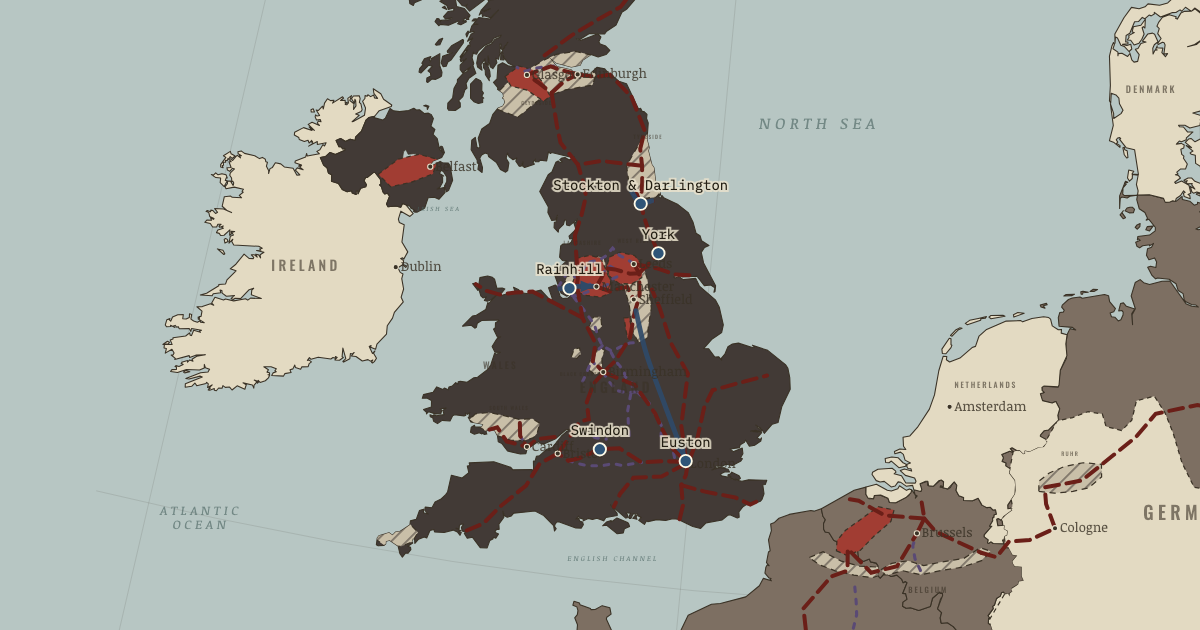
Coal, cotton, steam and the making of the modern world
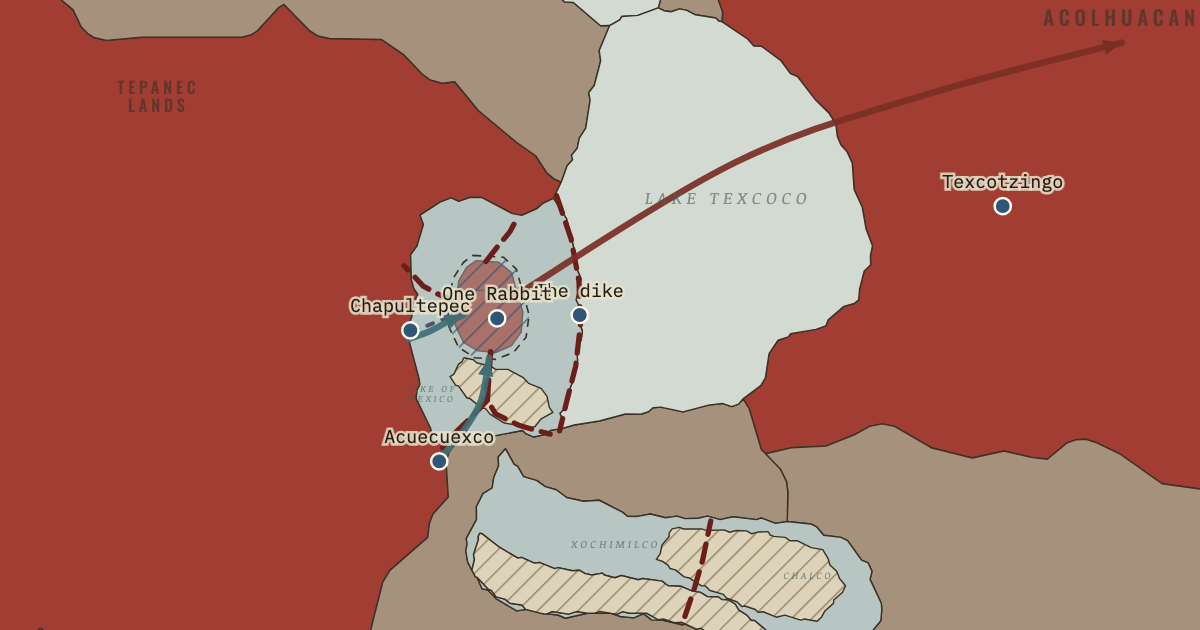
The Norse and the Aztecs
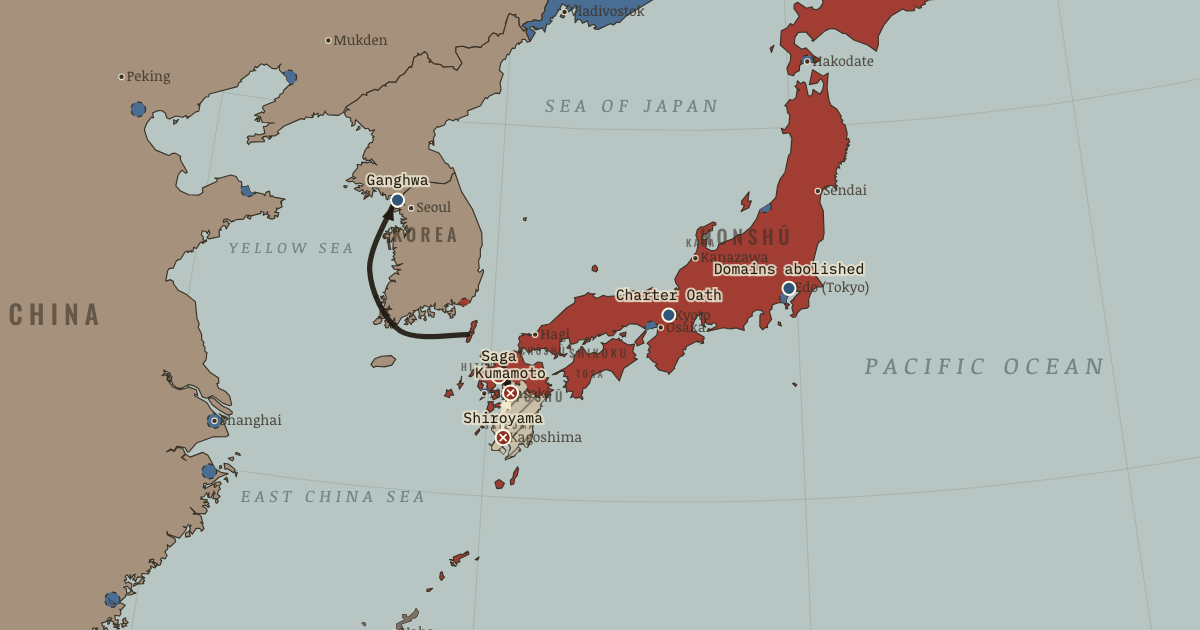
Two transitions from an old order, side by side
On the old course (2027 exams)
Students sitting the old course in 2027 will find the closest match in these world history topics, which our IB notes also tag:
- World history topic 7: Origins, development and impact of industrialization (1750–2005) · 12 CHAPTERS
The Industrial Revolution
The old-course page lists every chapter by topic.
Revision tools
Test yourself on the atlases with IB notes for this theme. Each atlas ends with a map quiz that asks you to find places and moments on the map itself; the quick quiz and the printable study guide are free pages on this site.
- The Industrial Revolution
MAP QUIZ · QUICK QUIZ · PRINTABLE STUDY GUIDE - Climate and Innovation
MAP QUIZ · QUICK QUIZ · PRINTABLE STUDY GUIDE - Remaking the State: Meiji Japan and Post-Soviet Russia
MAP QUIZ · QUICK QUIZ · PRINTABLE STUDY GUIDE
Maps of History is independent and is not affiliated with or endorsed by the International Baccalaureate Organization. IB course names describe alignment only; paper, theme and section names follow the new course outline and may change when the final guide is published.
THE DISPATCH
A short welcome series, then a letter when a new atlas opens — and the printable study guide for The Industrial Revolution is yours now, free.
NO TRACKING · YOUR ADDRESS IS USED FOR THE DISPATCH AND NOTHING ELSE · UNSUBSCRIBE ANYTIME