MAPS OF HISTORY · IB HISTORY · PAPER 1 · INDEPENDENCE AND IDENTITY
IB HISTORY · PAPER 1 · FOCUSED STUDY
Paper 1: Independence and Identity — Haiti and Kenya
Independence and Identity is one of the five Paper 1 Focused Studies of the new IB History course, first examined in May 2028. Paper 1 is the source paper: its questions ask you to read primary sources closely, to judge what each can and cannot tell a historian, and to combine them with your own knowledge. This Focused Study pairs two case studies, Haiti and Kenya, and our atlas Two Roads to Independence: Haiti and Kenya covers both on linked maps, in 12 chapters with 40 primary sources.
How the enslaved of the richest colony on earth made Haiti, and how colonised Kenyans lost a war yet won their independence — and what the way each was won meant afterwards.
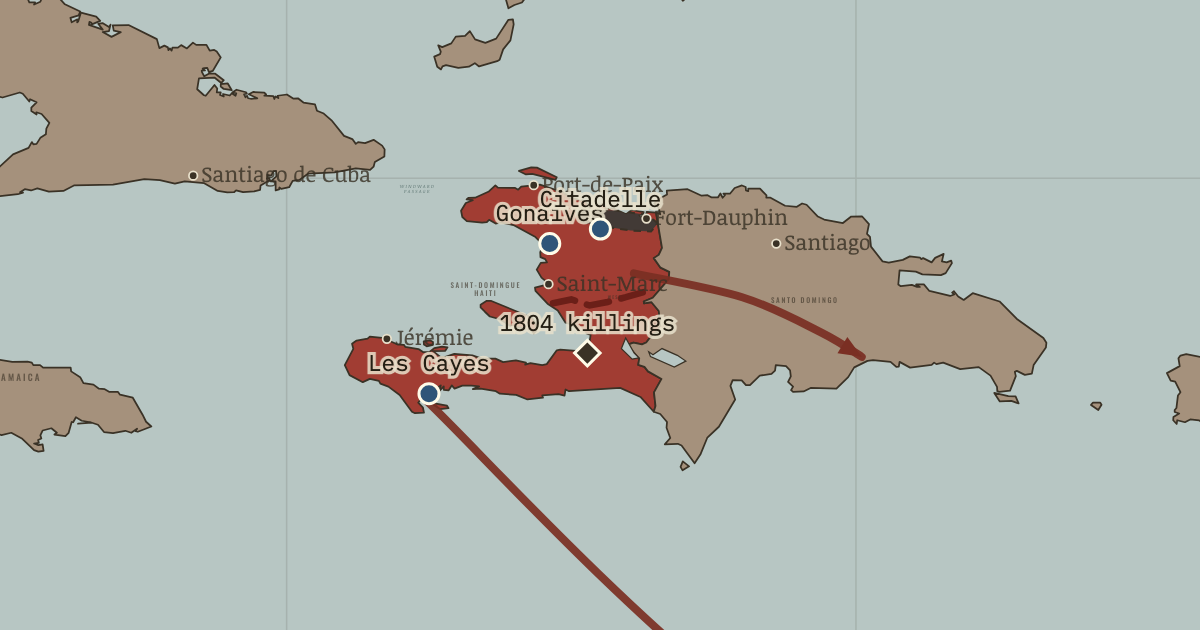
WW2 is free — every chapter. Try chapters 1–2 of any 2 other atlases (3 with a free account). Opening a new atlas uses one of them. Membership opens all 21 — Join.
What this Focused Study asks
Each source set in the atlas is built around one inquiry question, and together they show what this Focused Study asks of you. Keep them in mind as you read: a good answer to any of them needs both the sources and the chapters behind them.
Haiti
- How far did Toussaint Louverture’s leadership define what freedom meant in Saint-Domingue, 1793–1802?
- How did Haiti’s founders define the new nation and its citizens, 1804–1816?
- Why did Haiti accept the indemnity of 1825, and how should its cost be judged?
Kenya
- How did colonial law make land and labour the central grievances of Kenya, 1915–1934?
- How have the violence of the Kenya Emergency and its victims been recorded and remembered?
Case study 1: Haiti
Chapters 1–6 of the atlas follow Haiti, from 1789 to 1947. Read them in order: each chapter is a step in one argument, and the map moves with it.
- Saint-Domingue: The Richest ColonyCHAPTER 1 · 1789
- The Revolution Crosses the AtlanticCHAPTER 2 · 1789–1791
- Toussaint LouvertureCHAPTER 3 · 1793–1801
- Napoleon’s ExpeditionCHAPTER 4 · 1802–1803
- Dessalines and the Making of HaitiCHAPTER 5 · 1804–1820
- The Price of RecognitionCHAPTER 6 · 1825–1947
Evidence to use
One point from the IB notes of each chapter, written as a sentence you could use in an answer. Every chapter in the atlas carries four to six.
- In 1789 Saint-Domingue held about 465,000 enslaved people, some 31,000 whites and 28,000 free people of colour, so the enslaved outnumbered the free by about eight to one, a balance no amount of terror could make secure. CH 1
- The National Assembly’s decree of 15 May 1791 gave full political rights only to men of colour born of a free father and a free mother, a few hundred people, and even that was cancelled on 24 September 1791. CH 2
- Commissioner Sonthonax proclaimed general emancipation in the North on 29 August 1793, and the National Convention abolished slavery in all French colonies on 4 February 1794, the day after seating Jean-Baptiste Belley, a formerly enslaved deputy. CH 3
- General Leclerc sailed from Brest on 14 December 1801, and about 31,000 French soldiers landed in Saint-Domingue in 1802–03, with orders to disarm the colony’s Black army and send its generals to France. CH 4
- On 1 January 1804 at Gonaïves, Dessalines and his generals declared independence, renounced France for ever and named the country Haiti, the first state in the Americas founded by people who had freed themselves from slavery. CH 5
- Charles X’s ordinance of 17 April 1825 granted Haiti “full and complete independence” on condition that it pay 150 million francs in five yearly instalments and halve customs duties on French goods. CH 6
Case study 2: Kenya
Chapters 7–11 of the atlas follow Kenya, from 1895 to 1978. Read them in order: each chapter is a step in one argument, and the map moves with it.
- The White HighlandsCHAPTER 7 · 1895–1939
- War, Land and the OathCHAPTER 8 · 1939–1952
- The EmergencyCHAPTER 9 · 1952–1960
- The Road to UhuruCHAPTER 10 · 1960–1963
- Challenges after IndependenceCHAPTER 11 · 1963–1978
Evidence to use
One point from the IB notes of each chapter, written as a sentence you could use in an answer. Every chapter in the atlas carries four to six.
- The Uganda Railway, built between 1896 and 1901 by 31,983 workers recruited in British India, cost about £5.5 million, far above the estimates presented to Parliament, and officials invited settlers to the highlands to make it pay. CH 7
- About 98,000 Kenyan Africans served in the Second World War, and the 11th (East Africa) Division fought in Burma in 1944–45, where men such as Waruhiu Itote, later “General China”, learned that colonisers could be beaten. CH 8
- Kenyatta and five KAU leaders were tried at Kapenguria from December 1952 to April 1953 and sentenced to seven years’ hard labour; the key witness, Rawson Macharia, swore in 1958 that he had been bribed. CH 9
- The first Lancaster House conference, from January to February 1960, gave Kenya a Legislative Council of 65 seats with an elected African majority, ending the settlers’ political dominance. CH 10
- Somali-speaking northerners who had told a British commission in 1962 that they wanted to join Somalia fought the Shifta War of 1963–67, which ended with the Arusha Memorandum of 28 October 1967. CH 11
Comparing the two case studies
The atlas ends by setting the two case studies side by side in Two Independences Compared. Comparison is where the Focused Study pays off: the same question asked of two societies shows which explanations travel and which belong to one place.
PAPER 1 · TWO ROADS TO INDEPENDENCE · CHAPTER 12
Compare and contrast the ways in which Haiti and Kenya achieved independence.
Both independences grew from colonial systems built on land seized for a privileged class and worked by coerced labour, and both involved violent struggle that divided colonised society. They differed in the manner of victory: Haiti won outright by war and was punished with isolation and debt, while Kenya’s defeated rebellion led to a negotiated transfer that preserved the colonial state.
Similar roots in land and coercion.
Opposite military outcomes.
Different terms of recognition and burden.
The evidence for each point, the counter-argument and the judgement are in the IB notes of chapter 12 in the atlas. Read the chapter first: Two Independences Compared.
Key concepts
The course asks you to think with six concepts. Each chapter’s IB notes name the two or three it supports best; here they are across the atlas, most used first.
- Causation · 6 CHAPTERS
Why something happened: the long-term conditions, the triggers and the choices behind it, and which of them mattered most. For example: Saint-Domingue: The Richest Colony, The Revolution Crosses the Atlantic, Napoleon’s Expedition, The White Highlands. - Consequence · 6 CHAPTERS
What followed from an event or decision, intended and unintended, in the short and the long term. For example: Napoleon’s Expedition, The Price of Recognition, The White Highlands, The Emergency. - Perspectives · 6 CHAPTERS
How people at the time, and historians since, have seen the same events differently, and why. For example: Saint-Domingue: The Richest Colony, The Revolution Crosses the Atlantic, Toussaint Louverture, Dessalines and the Making of Haiti. - Significance · 5 CHAPTERS
Why an event, person or idea matters, judged by its effects and by how it has been remembered. For example: The Revolution Crosses the Atlantic, Toussaint Louverture, Dessalines and the Making of Haiti, The Price of Recognition. - Change · 4 CHAPTERS
What was different afterwards, how quickly it changed, and for whom. For example: Toussaint Louverture, Dessalines and the Making of Haiti, War, Land and the Oath, The Road to Uhuru. - Continuity · 3 CHAPTERS
What stayed the same through an apparent upheaval, and why it survived. For example: The Price of Recognition, Challenges after Independence, Two Independences Compared.
Source-analysis practice
This is one complete source set from the atlas, free to use. It is built around one inquiry question: How far did Toussaint Louverture’s leadership define what freedom meant in Saint-Domingue, 1793–1802? Read the sources first and note who made each one, when and why. Then answer the questions in writing, and only afterwards open the guide under each question, which describes what a strong answer does.
TEXT · CHAPTER 3
Proclamation from Camp Turel
- CREATOR
- Toussaint Louverture
- DATE
- 29 August 1793
- ORIGIN
- Proclamation addressed to the people of Saint-Domingue while Toussaint served Spain
Context. The “king” in the signature is the King of Spain, whom Toussaint then served. The proclamation is dated the same day as Sonthonax’s emancipation in the North, and its author would join the French Republic eight months later.
Translation: Maps of History, from the French text published by the Fondation pour la mémoire de l’esclavage (2023) · original ↗
TEXT · CHAPTER 3
Constitution of the French colony of Saint-Domingue, Articles 3, 4, 5 and 14
- CREATOR
- Central Assembly of Saint-Domingue, convened by Toussaint Louverture
- DATE
- Adopted 9 May 1801; proclaimed 7–8 July 1801
- ORIGIN
- Constitution printed in Le Cap and Paris
Context. Another article named Toussaint governor “for the rest of his glorious life”. Napoleon Bonaparte, who had seized power in France in 1799, read the document as a challenge to French authority.
Translation: Maps of History, from Janvier, Les Constitutions d’Haïti (1886), via Digithèque MJP · original ↗
TEXT · CHAPTER 4
Toussaint Louverture’s words on boarding Le Héros, as recorded by a French general
- CREATOR
- Pamphile de Lacroix (memoir); words attributed to Toussaint Louverture
- DATE
- June 1802 (published 1819)
- ORIGIN
- Lacroix, Mémoires pour servir à l’histoire de la révolution de Saint-Domingue, vol. 2, pp. 202–203
Context. Lacroix was a French general who served in the expedition; he published his memoir seventeen years later. The words were reported as spoken to the ship’s commander, not written by Toussaint.
Translation: Maps of History, from Lacroix (Paris: Pillet aîné, 1819) · original ↗
PICTURE · CHAPTER 3
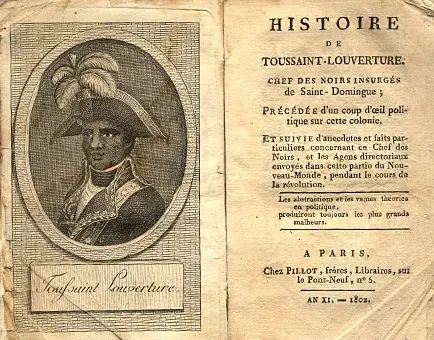
Title page and portrait from Histoire de Toussaint-Louverture
- CREATOR
- Cousin d’Avallon (author); engraver unnamed
- DATE
- 1802 (Year XI)
- ORIGIN
- Book published in Paris by Pillot frères during Leclerc’s expedition
Context. French publishers produced books about Toussaint while the expedition against him was under way; the subtitle calls him “chief of the insurgent Blacks”.
Wikimedia Commons (Public Domain Mark) · original ↗
The questions
- QUESTION 1 · COMPREHENSION
According to the Camp Turel proclamation, what did Toussaint want for Saint-Domingue in August 1793, and in whose service did he claim to act?
What a strong answer does
A strong answer identifies two points: Toussaint wanted “liberty and equality to reign in Saint-Domingue” and called others to join the same cause, and he signed as a general “of the King’s Armies”, meaning the King of Spain. The best answers note the tension between republican language and royal service.
- Quotes or paraphrases the aim of liberty and equality
- Identifies the King of Spain as the power he served
- Notes the tension between the two
- QUESTION 2 · ANALYSIS
What does the title page and portrait of 1802 suggest about how Toussaint was presented to French readers during Leclerc’s expedition?
What a strong answer does
Answers should read the image and its words together: a Paris publication of Year XI presents Toussaint in uniform and plumed hat, a figure of military authority, while its subtitle calls him “chief of the insurgent Blacks”. Good answers link this double image, commander and rebel, to the moment of publication, when France was at war with him.
- Describes visual features (uniform, hat, oval portrait)
- Uses the printed subtitle as evidence
- Links the presentation to the date and purpose
- QUESTION 3 · EVALUATION
With reference to its origin, purpose and content, assess the value and limitations of Lacroix’s report of Toussaint’s words aboard Le Héros for a historian studying how Toussaint saw his own role.
What a strong answer does
Value: it records words spoken at a decisive moment and shows Toussaint presenting himself as the trunk of a tree whose roots, the formerly enslaved, would survive him. Limitations: the words were reported by a French general and published in 1819, seventeen years later, in a memoir written partly to explain French defeat; the quotation may be polished. A strong answer weighs the two.
- Identifies author, date and publication gap
- Considers Lacroix’s purpose
- Explains what the content reveals about Toussaint’s self-image
- Reaches a balanced judgement
- QUESTION 4 · SYNTHESIS
Using the sources and your own knowledge, to what extent did Toussaint Louverture’s leadership define what freedom meant in Saint-Domingue between 1793 and 1802?
What a strong answer does
Strong answers build an argument from the sources: the proclamation shows freedom as a cause, the constitution of 1801 writes it into law as French citizenship while Article 14 subordinates it to plantation labour, and Lacroix’s report shows Toussaint linking freedom to the people beyond himself. Own knowledge should add the labour code of 1800, the Moyse revolt and Sonthonax’s role in emancipation. The best answers conclude that Toussaint defined freedom as citizenship without land, a definition many cultivators resisted.
- Uses at least three sources
- Adds relevant own knowledge (labour code, Moyse, Sonthonax)
- Addresses “to what extent” with a judgement
- Considers the cultivators’ perspective
More source sets in the atlas
The atlas holds 4 more source sets for this Focused Study. Their sources sit in the IB notes of the chapters named below: open a chapter in the atlas and turn on the IB notes switch to read them.
- How did Haiti’s founders define the new nation and its citizens, 1804–1816? HAITI
Its sources are in the IB notes of chapter 5. - Why did Haiti accept the indemnity of 1825, and how should its cost be judged? HAITI
Its sources are in the IB notes of chapter 1, chapter 6. - How did colonial law make land and labour the central grievances of Kenya, 1915–1934? KENYA
Its sources are in the IB notes of chapter 7. - How have the violence of the Kenya Emergency and its victims been recorded and remembered? KENYA
Its sources are in the IB notes of chapter 9, chapter 12.
Practice questions and essay plans
Each question below comes with the outline of a model plan: a thesis that answers the question and the claim each paragraph makes. Try your own plan before you read ours. The first plan comes from chapter 2, a free chapter, and is shown in full. The full plans, with evidence, a counter-argument and a judgement, are in the chapters’ IB notes in the atlas, and the atlas’s own page lists every chapter’s notes: IB notes for Haiti and Kenya.
PAPER 2 · TWO ROADS TO INDEPENDENCE · CHAPTER 2
To what extent was the rising of August 1791 caused by the ideas of the French Revolution?
French revolutionary ideas created the opening for the rising by dividing the colony’s free population and weakening authority, yet the rising itself was planned by the enslaved through their own networks and shaped by their own aims. French ideas were a trigger and a resource, while the driving force was the agency of the enslaved.
The Revolution divided the colony’s masters.
EVIDENCEPlanters formed colonial assemblies, the boldest at Saint-Marc in 1790; free men of colour demanded rights, and Ogé took up arms in October 1790; Paris granted rights in May 1791 and withdrew them in September.
LINKWith the free fighting each other, the forces that kept the enslaved in check were weakened.
The rising was organised through the enslaved’s own networks.
EVIDENCEDrivers met on 14 August 1791 and, by tradition, a ceremony at Bois Caïman led by Boukman bound the leaders; the rising began on 22–23 August across many estates at once.
LINKSuch coordination depended on structures planters ignored, from estate drivers to religious gatherings.
The insurgents’ aims were not simply French.
EVIDENCELeaders flew royalist flags and claimed the king had granted free days; Thornton argues many Kongolese veterans thought in terms of just kingship; in December 1791 the leaders asked only for freedom for a few hundred officers.
LINKThe ideas behind the rising were plural, and universal emancipation emerged later, in the course of the war.
Historians in the tradition of C. L. R. James stress that the language of rights reached the enslaved through sailors, servants and news, and that the timing of the rising, two years after 1789, shows the Revolution’s direct influence. The insurgents’ own appeals to the rights of man in later negotiations support that reading.
The French Revolution was a necessary trigger because it split the free and supplied a language of rights, but it was not the main cause of the rising, which grew from the enslaved’s organisation, experience and aims. The rising used French ideas without being defined by them.
Read the chapter behind this plan: The Revolution Crosses the Atlantic.
PAPER 1 · TWO ROADS TO INDEPENDENCE · CHAPTER 5
Using the sources and your own knowledge, examine how Haiti’s founders defined who belonged to the new nation between 1804 and 1816.
Haiti’s founders defined belonging by the experience of slavery and the war against France. The declaration of 1804 defined the nation against France, the constitution of 1805 made Blackness the name of every citizen, and the constitution of 1816 opened citizenship to all Africans and Indigenous Americans, turning the nation into a refuge.
The declaration defined the nation against France.
The 1805 constitution made Blackness a civic status.
The 1816 constitution turned identity outward.
The evidence for each point, the counter-argument and the judgement are in the IB notes of chapter 5 in the atlas. Read the chapter first: Dessalines and the Making of Haiti.
PAPER 2 · TWO ROADS TO INDEPENDENCE · CHAPTER 9
Evaluate the effects of the Kenya Emergency (1952–1960) on the people of central Kenya.
The Emergency transformed the lives of central Kenya’s people through death, detention, forced villagisation and land consolidation, and it divided them along lines that outlasted the war. Its effects fell unevenly: suspected rebels and their families bore the heaviest losses, while loyalists gained land and office.
Violence and death on a scale still debated.
Detention and villagisation reorganised daily life.
Land and power shifted to loyalists.
The evidence for each point, the counter-argument and the judgement are in the IB notes of chapter 9 in the atlas. Read the chapter first: The Emergency.
PAPER 2 · TWO ROADS TO INDEPENDENCE · CHAPTER 11
To what extent did Jomo Kenyatta maintain power between 1963 and 1978 through methods inherited from colonial rule?
Kenyatta maintained power largely through institutions inherited from colonial rule, especially the provincial administration and detention laws, but he combined them with new methods: patronage through land and office, ethnic alliances and a carefully managed single party. Kenyatta also benefited from Cold War support for his pro-Western course.
The colonial state’s machinery was kept and used.
Patronage through land bound supporters to the regime.
Ethnic politics and the party narrowed opposition.
The evidence for each point, the counter-argument and the judgement are in the IB notes of chapter 11 in the atlas. Read the chapter first: Challenges after Independence.
Revision tools
The atlas ends with a map quiz that asks you to find places and moments on the map itself (part of membership and of the Exam Sprint). The quick quiz and the discussion questions with our answers are free pages on this site, and the printable study guide gathers every chapter’s notes into one document for revision.
The same atlas for other papers
Several chapters also carry IB notes for Papers 2 and 3, and for topics of the old course examined in 2027:
- Paper 2 · Conflict · 4 CHAPTERS
- Paper 2 · Authoritarian Rule · 2 CHAPTERS
- Paper 2 · Popular Movements · 4 CHAPTERS
- Old course · World history topic 8: Independence movements (1800–2000) · 5 CHAPTERS
Maps of History is independent and is not affiliated with or endorsed by the International Baccalaureate Organization. IB course names describe alignment only; paper, theme and section names follow the new course outline and may change when the final guide is published.
THE DISPATCH
A short welcome series, then a letter when a new atlas opens — and the printable study guide for Two Roads to Independence is yours now, free.
NO TRACKING · YOUR ADDRESS IS USED FOR THE DISPATCH AND NOTHING ELSE · UNSUBSCRIBE ANYTIME